
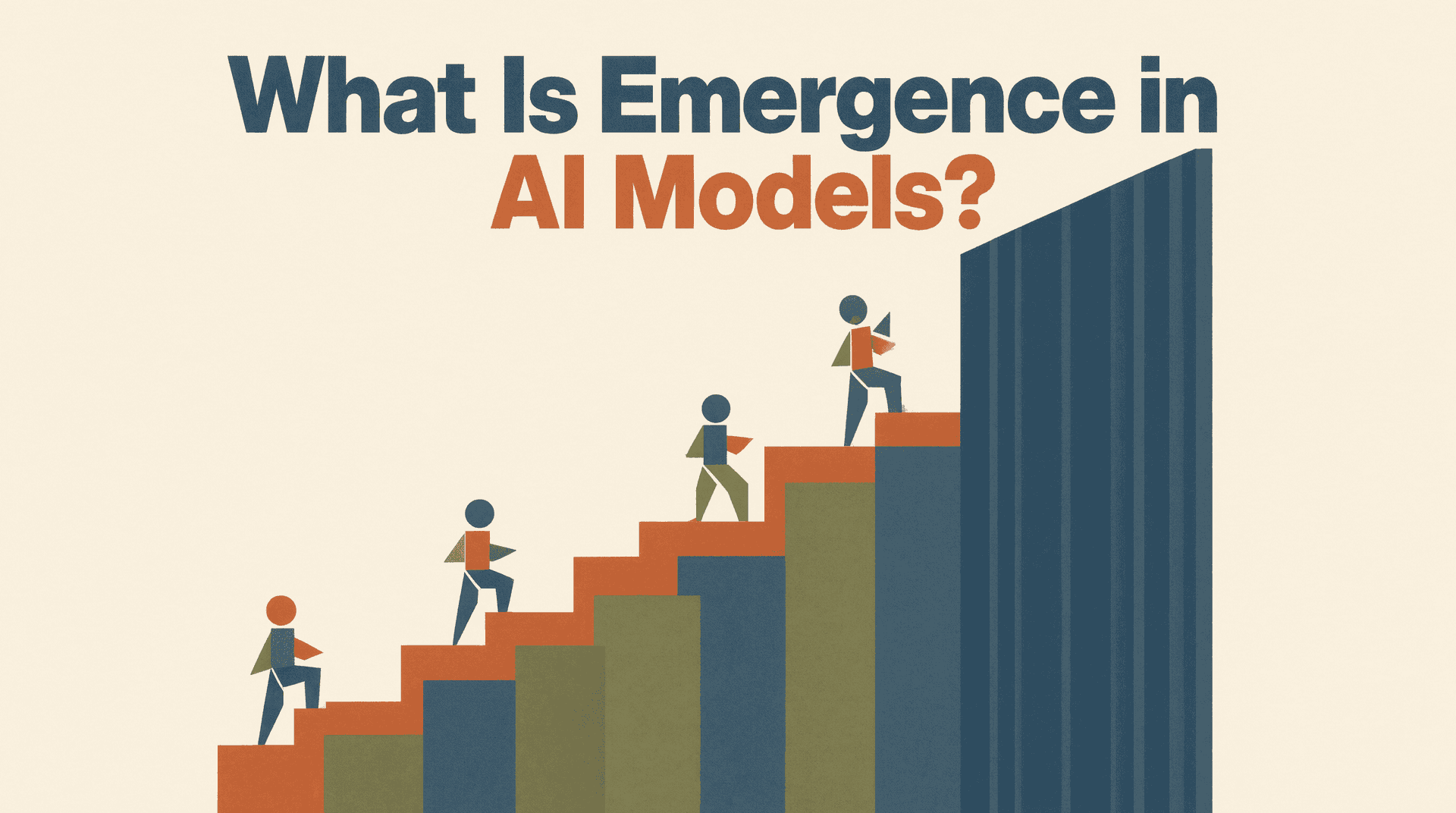
In June 2022, Jason Wei and colleagues at Google Research published a paper with an unusually confident title: Emergent Abilities of Large Language Models. The claim was simple. Some capabilities are "not present in small models but present in large models," and they "cannot be predicted simply by extrapolating the performance of smaller models." Below a certain size, a model scores at chance on a task. Above it, the same task type scores well. The jump happens fast, and nobody can say in advance where the threshold sits.
The authors borrowed the phrase "phase transition" from physics, as in the transition from liquid to gas, to describe what they saw. They cataloged 137 emergent abilities drawn from published scaling studies on GPT-3, Chinchilla, PaLM and other models: multi-digit arithmetic, word unscrambling, Persian question answering, college-exam problems. The pattern was consistent enough, and strange enough, that "emergence" became a standard word in AI discussion within months.
The flagship example
The clearest case was chain-of-thought prompting, the technique of making a model write out intermediate steps before answering. On grade-school math problems (the GSM8K benchmark), Wei et al. found that for models trained with less than roughly 10^22 floating-point operations of compute, giving the model reasoning examples did not help. It often made performance worse. Past that threshold, the same prompt produced a sudden jump to double-digit accuracy. The technique was useless one size down and powerful one size up, with no gradual ramp in between.
Why anyone cared: scaling laws can predict a model's loss fairly accurately before you train it, but loss is not capability. If capabilities genuinely appear overnight, then no one, not the labs themselves, knows what a next-generation model will be able to do until they test it. The Georgetown CSET explainer framed the stakes for regulators: if hazardous capabilities can emerge unpredictably, pre-deployment testing has to assume surprises.
The mirage
In 2023, Stanford researchers Rylan Schaeffer, Brando Miranda and Sanmi Koyejo published Are Emergent Abilities of Large Language Models a Mirage? (later a NeurIPS 2023 paper). Their argument: the cliff is in the scoreboard, not the model.
Most benchmark metrics are discontinuous. Exact string match awards zero unless the answer is letter-perfect; multiple-choice grade awards nothing unless the full sequence is right. A model whose underlying accuracy improves smoothly can therefore look like it scores at chance for ten model sizes and then passes, because the all-or-nothing metric converts a slow climb into a wall. Swap in a continuous metric that gives partial credit, such as token edit distance or the Brier score, and the same model family's curves turn smooth and predictable.

The paper's meta-analysis of BIG-Bench found that of the 39 preferred metrics in that suite, at most 5 displayed emergence at all, and most claimed emergent abilities concentrated in two of them: multiple-choice grade and exact string match. The authors also demonstrated the reverse trick, choosing a metric deliberately to manufacture a never-before-seen "emergent ability" in ordinary vision models. The critique landed hard enough that a US House Science Committee report cited emergence as "debunked by rigorous statistical analysis," per CSET's account.
Both sides, and what survived
Neither paper knocked out the other. Wei's response noted that many of the disputed tasks are themselves discrete. Long division either works or it does not, and a model that "almost" does multi-digit arithmetic is barely more useful than one that cannot. CSET made the same point: all-or-nothing performance is often the practically important measure, even if smooth metrics describe it differently. The 2022 original also acknowledged, in passing, that discontinuous metrics "may disguise compounding incremental improvements as emergence," so the disagreement is partly about emphasis.
A 2025 survey of the debate catalogues where the field stands: sharp jumps that survive smoother metrics have been reported by Wei's camp and others, while Schaeffer's camp holds that they evaporate under careful measurement. A third position, proposed in 2026 work discussed in that survey, argues breakthroughs reflect a bimodal distribution of training outcomes across random seeds rather than a fixed scale threshold or a metric artifact. Separately, researchers at the Santa Fe Institute applied a stricter definition from complexity science: real emergence requires a qualitative change in the mechanism by which a task is solved, and they note that no claimed LLM emergent ability has been accompanied by an identified internal reorganization. By that standard, the phenomenon is at best unresolved.
What to take away
Three practical conclusions hold regardless of which side wins the argument.
First, scaling laws predict loss, not behavior. Labs, evaluators and buyers still cannot say with confidence which new task types a larger model will pass. Second, the shape of a capability curve depends on how you measure it, so any claim of a sudden jump should name its metric. Third, the debate itself produced the useful artifact: benchmarks in 2026 routinely report both discontinuous and partial-credit scores, because after the mirage controversy, presenting only one kind stopped being defensible.
Emergence may be a real property of scaled models, a measurement illusion, or both at once. The settled fact is only this: nobody knows yet, and the honest version of either position says so.
Sources
- Wei et al., Emergent Abilities of Large Language Models, Transactions on Machine Learning Research, 2022
- Jason Wei, 137 emergent abilities of large language models, blog, 2022
- Jason Wei, Common arguments regarding emergent abilities, blog
- Schaeffer, Miranda, Koyejo, Are Emergent Abilities of Large Language Models a Mirage?, NeurIPS 2023
- CSET Georgetown, Emergent Abilities in Large Language Models: An Explainer
- Emergent Abilities in Large Language Models: A Survey, arXiv 2503.05788
- Santa Fe Institute, Does intelligence 'emerge' in large language models?
- Stanford HAI, Examining Emergent Abilities in Large Language Models
