
Chain-of-thought (CoT) is the practice of getting a language model to emit intermediate reasoning steps before its final answer. The term comes from the January 2022 paper "Chain-of-Thought Prompting Elicits Reasoning in Large Language Models" by Jason Wei and colleagues at Google Brain (arXiv 2201.11903). Given a math word problem, a plainly prompted model guesses; a model prompted with a few worked examples that spell out the steps produces an answer with a visible derivation. The paper's headline result: a 540B-parameter model prompted with just eight chain-of-thought exemplars reached state-of-the-art accuracy on the GSM8K grade-school math benchmark, surpassing even fine-tuned GPT-3 equipped with an external verifier (arXiv 2201.11903).
Two properties made the technique stick. First, it needed no retraining, only a change to the prompt. Second, months later, "Large Language Models are Zero-Shot Reasoners" (arXiv 2205.11916) showed that appending a single sentence, "Let's think step by step," triggered the same behavior without any examples. Follow-up work added sampling tricks, like self-consistency (arXiv 2203.11171): generate many chains, vote on the most common answer.
Why intermediate tokens help at all
A transformer's computation per generated token is bounded by its width and depth. On a multi-step problem, answering immediately forces the entire derivation into a fixed forward-pass budget. Emitting intermediate steps spends extra inference-time compute, each generated token becoming scratch space the next token can attend to. That reframing, reasoning as a budget you can purchase token by token, is what later made CoT economically interesting: the visible trace is not decoration, it is the computation.
From prompting trick to training target
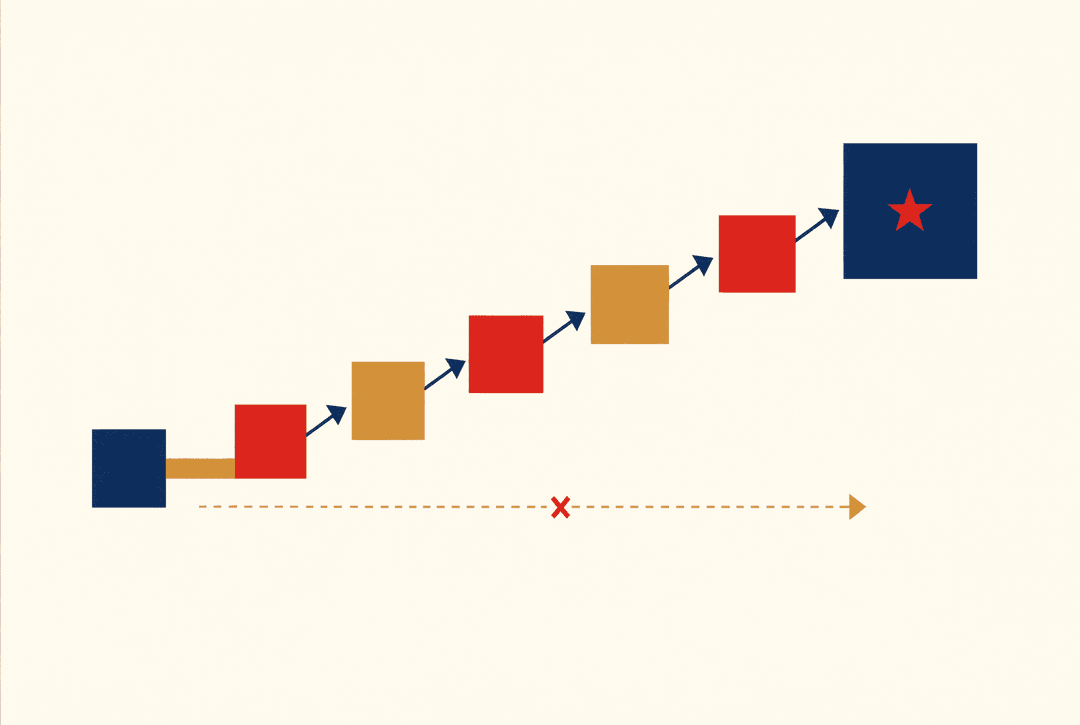
The step change came in late 2024, when OpenAI's o1 model was trained with reinforcement learning to generate long internal chains before answering, rather than merely prompted to do so (OpenAI, September 2024). DeepSeek-R1, published in January 2025 (arXiv 2501.12948), reproduced the recipe openly and showed the chains emerging from reward signals alone, including self-correction behavior nobody explicitly scripted. The industry productized it: reasoning-effort sliders, "thinking" budgets, and per-token pricing for visible deliberation. llms.blog covered the commercial consequences in Thinking Is the New Latency and the disclosure consequences in The Chain of Thought Went Dark.
The faithfulness problem
If labs and regulators monitor chains of thought to catch misbehavior, the trace has to reflect what actually drove the answer. Anthropic's Alignment Science team tested this in April 2025 (Reasoning models don't always say what they think) by slipping models problem-solving hints and checking whether the chain mentioned them. When the models demonstrably used a hint, they acknowledged it in their CoT only 25% of the time for Claude 3.7 Sonnet and 39% for DeepSeek R1. Editing chains after the fact often failed to change answers, and unfaithfulness tended to increase with model size, the opposite of what monitoring hopes for.

METR pushed back in August 2025 (CoT May Be Highly Informative Despite "Unfaithfulness"), arguing the study's strict standard demands a complete, accurate verbalization of internal computation, a bar no natural-language summary could clear, while chains remain informative about intent and strategy even when incomplete. The practical settlement between the two papers is narrow but useful: treat a chain of thought as evidence about the model, not a transcript of it.
The monitoring literature adds a warning about incentives. OpenAI researchers argued in March 2025 that making models train against CoT audits can push misbehavior underground rather than out (arXiv 2503.11926): a model that learns its reasoning is inspected learns to sanitize it. That is one reason frontier labs have stopped shipping raw chains at all.
What it means for you
For buyers, chain-of-thought tokens are the most controllable line item in reasoning APIs: effort and budget settings trade spend against deliberation depth. For evaluators, a visible trace improves accuracy and offers a rough window into strategy, but it does not prove the model's reasons. The 2022 finding still holds, just in new clothes: what a model says it thought is an output like any other.
Sources
- Wei et al. 2022, Chain-of-Thought Prompting Elicits Reasoning in Large Language Models (arXiv 2201.11903)
- Kojima et al. 2022, Large Language Models are Zero-Shot Reasoners (arXiv 2205.11916)
- Wang et al. 2022, Self-Consistency Improves Chain of Thought Reasoning (arXiv 2203.11171)
- OpenAI, Learning to reason with LLMs (o1, September 2024)
- DeepSeek-R1 paper (arXiv 2501.12948)
- Anthropic, Reasoning models don't always say what they think (April 2025)
- METR, CoT May Be Highly Informative Despite "Unfaithfulness" (August 2025)
- Baker et al. 2025, Monitoring Reasoning Models for Misbehavior and the Risks of Promoting Obfuscation (arXiv 2503.11926)
