
In late 2026, LLM latency is primarily determined by configurable reasoning budgets, host endpoint selection, and paid speed tiers rather than raw compute limits. High-effort reasoning significantly increases time-to-first-token and cost with diminishing quality returns, while production environments often face higher latency than published benchmarks suggest due to load and concurrency factors.
For most of the history of LLM APIs, a slow response meant one thing: the machine was busy. In late 2026, the wait your user stares at is mostly a decision someone made. How much the model is allowed to think. Whether you paid for the faster inference lane. Which of a dozen hosts is serving the model you called. The blank screen is no longer a compute limit. It is a configuration surface, and most teams configure it by accident.
Three numbers, and thinking breaks all of them
The measurement vocabulary has split to keep up. Artificial Analysis, the independent benchmarking service whose numbers the industry now cites the way it cites uptime tables, distinguishes time to first token (TTFT) from time to first answer token (TTFTAA). For reasoning models that stream internal thinking before the visible answer, the first token can arrive quickly while the user still waits through the entire thinking phase. Their methodology page is blunt about it: TTFT "will be the first reasoning token," and the answer-token metric is measured only after thinking time.
Their performance harness runs 1k, 10k and 100k input-token workloads, roughly eight times a day, from a single Google Cloud zone in us-central1, and reports the median of the past 72 hours. Longer prompts raise both TTFT and per-token time. Server location is a disclosed limitation, because TTFT includes the network path. None of this makes the numbers wrong. It makes them conditional, which is a different problem for anyone putting them in a slide.
The effort slider is the biggest latency knob in the API
All four major labs now expose some form of reasoning budget: Anthropic and OpenAI through an effort parameter, Google and Mistral through thinking budgets or separate reasoning models. AI Workshop's October 2026 read of Artificial Analysis data puts numbers on what that slider costs in seconds. Claude Opus 5.5 needs about 6 seconds to its first answer token at low effort, 16 at medium, 30 at high, 110 at extra-high and 653 at max. More than ten minutes of silence before the first word. GPT-6.1 Sol ranges from roughly 2 seconds to 236. Claude Sonnet 5.5 stays under 1.5 seconds at low and medium effort.
Two details in that data matter for architecture. Output speed barely moves with effort: Opus 5.5 writes at 80 to 96 tokens per second at every level. Effort changes how long the model thinks, not how fast it types. And the money and the wait rise together, because thinking tokens are billed as output. AI Workshop's per-task figures show Opus 5.5 at $0.55 at low effort versus $5.98 at max on Artificial Analysis' Intelligence Index, an elevenfold increase.
The quality curve does not follow. On the same index, Opus 5.5 gains about 9 points from low to medium effort for roughly 9 extra seconds of end-to-end time, and 4 more points from high to max for over ten additional minutes. The slider has sharply diminishing returns, and its useful range for anything a human waits on is low to high. Max effort is a batch tool for hard analysis that got attached to an interactive API.
Defaults vary by model, and they are not obvious
AIMultiple's November 2026 benchmark ran 33 models on two tasks, short-answer Q&A and code generation, and found three distinct default behaviors. Some models decide by task: most GPT-6 models, Claude Sonnet 5.5 and Claude Fable 5.1 answer questions directly but reason on coding prompts, which means they sit with the fast models on Q&A and fall back on coding. Some always reason, including Claude Opus 5.5, which did not reason at all in its predecessor's July results. Some never reason.
The practical effect: on Q&A, half the tested models start answering in under 2 seconds. On coding, models that switch to reasoning jump to 6 to 14 seconds, and the always-reasoning models like Opus 5.5 and Kimi K3.1 Pro average over 30 seconds to the first answer token, with p90 waits approaching a minute. A coding agent that chains dozens of model calls inherits that tail on every step.
The same model on the same day can be twice as fast somewhere else
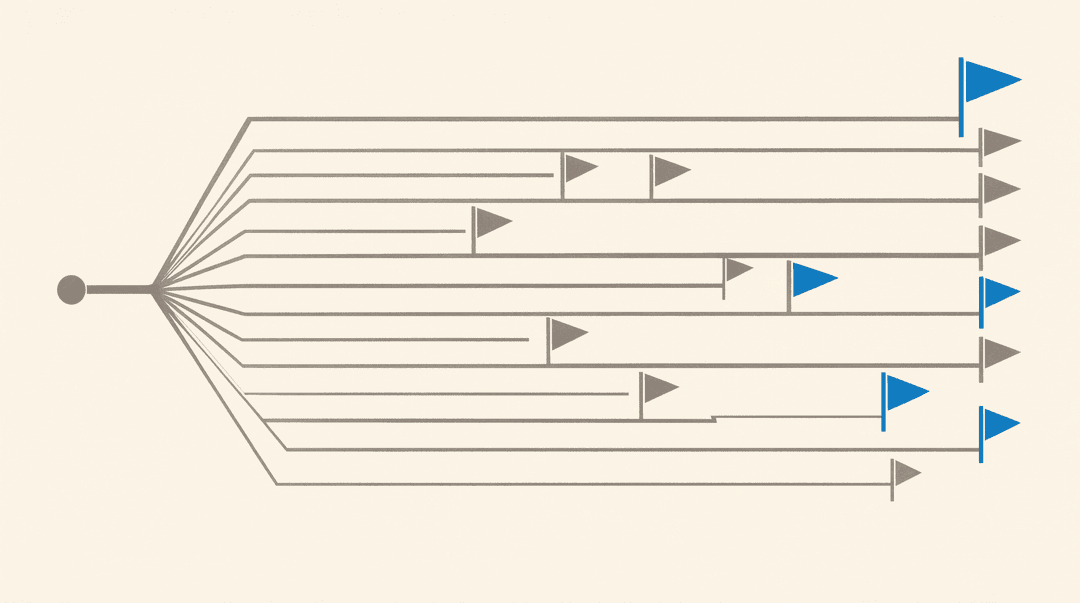
Latency is also an endpoint lottery. AIMultiple test-called every available host of each model before its main run and found that of 26 models, 23 were multi-hosted, and for 17 of those the slowest endpoint took at least twice as long as the fastest. Open-weight models vary the most: glm-5.3-flash ranged from under 1 second to over 8 seconds across 32 endpoints. And the maker's own API is rarely the fastest path. Twelve of 13 first-party models returned the first token sooner through somebody else's endpoint; gpt-6-luna answered in under a second on Amazon Bedrock and about 2.5 seconds on OpenAI's own API.
Speed is for sale as a product line
Because waiting is now optional, the labs sell its removal. Anthropic's fast mode sets a speed: "fast" flag on the request and delivers up to 2.5x higher output tokens per second on Claude Opus 5.5, at $8 per million input and $40 per million output tokens, exactly double the standard $4 and $20. The documentation is specific about what it buys: it speeds up output, not time to first token, it carries its own rate limit, and it does not combine with the Batch API. OpenAI renamed its priority processing to Fast mode in July 2026, with a similar up-to-2.5x claim on frontier output speed. On the hardware side, providers like Groq and Cerebras have built their pitch on silicon-level speed: Cerebras claims more than 1,100 tokens per second on Mistral Large 2, which powers Le Chat's Flash Answers, and latency rankings for voice agents routinely put these specialized providers ahead of general-purpose GPU clouds.
The pattern is consistent: premium pricing buys streaming speed and tail control, not intelligence. A $40-per-million-token output lane still waits 30 seconds if the model is thinking at high effort.
Production will be slower than every table you read
One more layer. GMI Cloud's May 2026 survey of the benchmark-to-production gap argues that published numbers are upper bounds: marketing tests use a warm instance, one concurrent user and a short prompt, while real traffic has Zipfian prompt lengths, bursts and cross-region clients. Their stated rules of thumb are uncomfortable but concrete: throughput drops 30 to 60 percent under realistic load mixes, cold-pod first tokens can run 5 to 10x a warm one, and off-peak benchmarks beat peak by 20 to 40 percent on the same endpoint. Most providers publish p50. Your support queue lives at p95.
What to actually do about it
Set reasoning effort per task, not per application. Stream everything. Cache long prompts, which cuts time to first token on repeat contexts at every major provider now. Benchmark the specific endpoint you will deploy, not the model name, because the maker's API is often not the fastest host of its own model. Price the effort ladder before defaulting to it: a max-effort assistant is an eleven-times-cost, ten-minute assistant. And treat any latency number without a disclosed region, concurrency and percentile as marketing, which is to say as a ceiling, not an expectation.
The labs spent 2024-2025 making models smarter and 2026 making the wait configurable. Almost nobody has decided what it should be.
Sources
- Artificial Analysis, "Language Model API Performance Benchmarking" methodology page: https://artificialanalysis.ai/methodology/performance-benchmarking
- Artificial Analysis model comparison: https://artificialanalysis.ai/models
- AIMultiple, "LLM Latency Benchmark by Use Cases" (Nov 12, 2026): https://aimultiple.com/llm-latency-benchmark
- AI Workshop, "LLM Speed and Latency 2026" (Oct 2026, reading Artificial Analysis data): https://ai.blocksize.hr/blog/en/llm-speed-latency-tokens-per-second-2026.html
- Anthropic, "Fast mode" documentation: https://platform.claude.com/docs/en/build-with-claude/fast-mode
- Anthropic, "Introducing Claude Opus 5.5": https://www.anthropic.com/claude-opus-5-5
- GMI Cloud, "Independent Speed Data for 2026" (May 28, 2026): https://www.gmicloud.ai/en/blog/llm-inference-speed-benchmark-2026
- RTC League, "Best Low Latency AI Inference APIs of 2026": https://rtcleague.com/blogs/best-low-latency-ai-inference-apis-2026
- Fireworks, "Best LLM API Providers in 2026": https://fireworks.ai/blog/best-llm-api-providers
Frequently asked questions
How does reasoning effort affect Claude Opus 5.5 latency?
Increasing effort on Claude Opus 5.5 drastically raises the time to the first answer token, ranging from approximately 6 seconds at low effort to over 10 minutes (653 seconds) at max effort.
Does paying for faster inference improve time to first token?
No. Paid options like Anthropic's Fast mode or OpenAI's priority processing increase output tokens per second but do not reduce the wait caused by internal model reasoning before the first token appears.
Are maker APIs always the fastest way to access a model?
No. For many models, third-party endpoints are faster; for example, gpt-6-luna responded in under a second on Amazon Bedrock compared to about 2.5 seconds on OpenAI's own API.
How much does max effort cost compared to low effort for Opus 5.5?
According to Artificial Analysis data cited by AI Workshop, Opus 5.5 costs $5.98 per task at max effort versus $0.55 at low effort, representing an elevenfold price increase.
How do real-world production metrics compare to benchmark tables?
Production latency is typically slower than benchmarks; throughput can drop 30-60% under realistic load, cold-pod first tokens can be 5-10x slower than warm ones, and peak traffic increases latency by 20-40%.
