
The oldest clerical job in business now ships as a subscription. Somewhere in your building, or your accountant's, a person used to spend ten hours a month matching bank lines to invoices. In late 2026 you can replace that hour with a flat monthly meter, and the meters start low enough to look like a rounding error: $0, $65, $99, $549. What they do not include is the thing that has always been the actual product: a human who signs the close.
Start with the baseline, because every vendor number in this lane is priced against it. The Bureau of Labor Statistics puts median pay for bookkeeping, accounting and auditing clerks at $50,670 a year, or $24.36 an hour, as of May 2025. Intuit's own pricing guide estimates a full-time in-house bookkeeper at roughly $3,516 a month before software, and says outsourced, staffed bookkeeping typically runs $300 to $1,500 a month on a flat-fee model. NerdWallet's 2026 guidance lands near $300 a month for basic service. That is the number AI bookkeeping is undercutting, and it undercuts it in four distinct billing lanes.
Lane one: the bundle, already inside your plan
QuickBooks and Xero now sell agents as a feature ladder rather than a product. Intuit announced a "virtual team" of AI agents (Accounting, Payments, Finance, Customer) on July 1, 2025, with Payroll and Sales Tax agents following on October 28, 2025. The pitch is quantified by Intuit itself: agents save businesses "up to 12 hours a month," a claim footnoted to internal data, and Intuit separately claims AI-assisted reconciliation closes books "nearly three times faster," again internal data, as of November 2025.
The catch is gating. Per an analysis of Intuit's own help documentation, the $38 Simple Start plan gets suggestions and chat only; the $85 Essentials plan unlocks batch AI posting; reconciliation AI, sales tax and customer agents start at $140 Plus; and a "Books Upkeep" service that posts high-confidence transactions under rules you set was announced in August 2026 for Advanced. At Intuit Connect in November 2026 the company put an "Agentic Books Close" pilot for accounting firms up for sign-up: free during the pilot, a paid add-on afterward.
Xero took the opposite tack, at least for now. Its JAX assistant is available to all subscribers with, in Xero's current phrasing, "no additional charge," while the same FAQ reserves the right to change that pricing at any time. Xero's stated goal is for JAX to auto-reconcile more than 80% of bank statement lines; there is no measured public accuracy number. At Xerocon US on August 19, 2026 Xero extended JAX integrations to Claude, ChatGPT and Microsoft 365, so live books can be queried from wherever the owner already is.
What you are buying here is continuity: your ledger stays where it is, and the AI is a surcharge that is free today and will be priced tomorrow.
Lane two: the AI-native ledger
The second lane asks you to move the books wholesale onto software built for machine categorization. Digits, which calls itself the first AI-native general ledger, charges $65 a month (Essentials), $100 (Core) and $250 (Pro) at published list prices, with its flagship "Agentic Close" month-end automation on the Pro tier. Every tier includes a free API and MCP server, which is how these vendors now meet you: your ChatGPT or Claude can query your financials directly. Digits claims 95% or more of transactions post without a person touching them.
Kick runs the same pitch one rung down: free for up to 250 transactions a year, $40 a month unlimited, $100 for accrual and multi-entity, $300 for consolidation, with a claimed 97% auto-categorization rate. Both claims are vendor-published, unaudited, and both companies sell against the same weakness: when you migrate, you also migrate your history, your chart of accounts and your accountant's muscle memory. Digits' own FAQ concedes it does not file your taxes.
Lane three: the parasite layer
If moving ledgers sounds insane, a third lane keeps QuickBooks or Xero and bolts an AI bookkeeper on top. Booke's AI Bookkeeper costs $129 a month per business and works inside QuickBooks Online, Xero and Zoho Books. Smaller plays sit below it: Switchbooks publishes $25 a month per company, Finlens $30 per client, both positioned as automation layers over existing QuickBooks files. This lane is the cheapest way to give a firm's existing workflow an AI first pass without touching the system of record, and the pricing reflects the modest ask.
Lane four: AI first pass, human signature
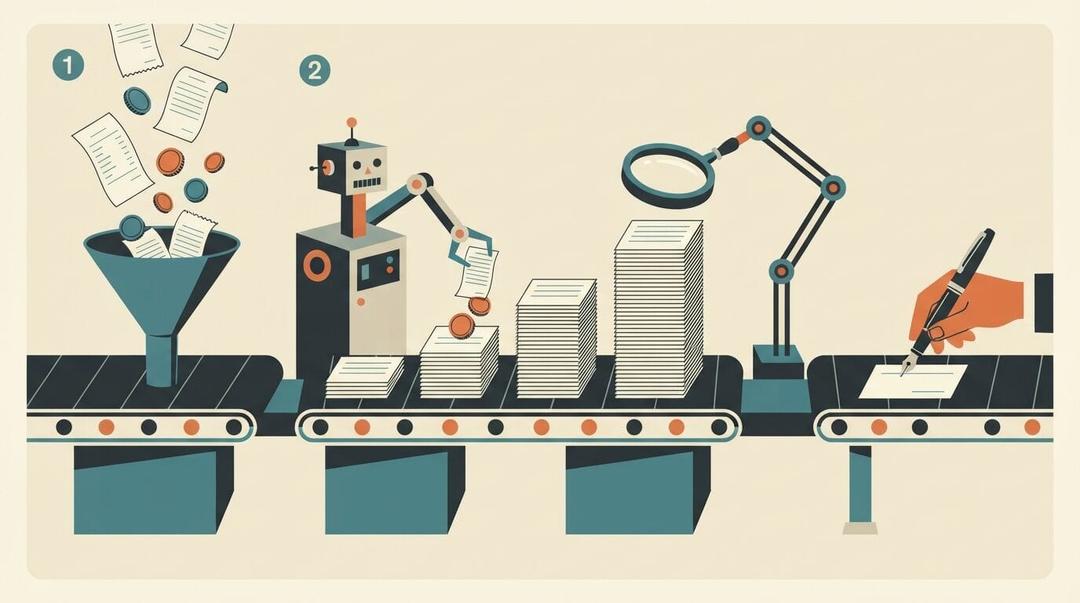
The fourth lane is what people mean when they say "AI bookkeeping service": software plus staff. Pilot sells two products that are easy to confuse. Essentials is $99 a month for businesses up to $100,000 in monthly expenses, and Pilot's own pricing page describes it as AI categorizing, reconciling and closing the books with no bookkeeper attached. Core, where a US-based bookkeeper handles and reviews the work, carries no published price; third-party comparisons put it at roughly $599 a month, $499 billed annually. Zeni starts at $549 a month ($494 billed annually) with a dedicated finance team, and sells fractional CFO work from $1,599 a month. Fondo starts around $399 a month for managed startup bookkeeping. QuickBooks Live, Intuit's own staffed option, bands near $300 and up by monthly expenses.
So the full ladder, software-only to fully managed: $0, $25, $40, $65, $99, $129, $300, $399, $549, $799, $1,599. A solo consultant with 120 transactions a month can plausibly pay nothing (Kick's free tier) or $65 (Digits). A venture-backed startup that wants monthly closes its investors will trust pays $399 to $800. The price is not set by how much work the AI does. It is set by whether a named human stands behind the books.
The Bench lesson: own your general ledger
This lane has a graveyard centerpiece. On December 27, 2024, Bench Accounting, one of the largest online bookkeeping services in North America, shut down without warning, locking roughly 35,000 customers out of their books and tax documents days before year end. Three days later Employer.com announced an acquisition and restored access; Bench's exit statement pointed customers toward a competitor, Kick, and its staff said they had been laid off with minimal notice. Proprietary ledgers turned out to be hard to export in a usable format.

The permanent rule this wrote into the category: whatever keeps your books, export your general ledger and year-end statements every year. The newer AI-native vendors noticed. Digits and Kick advertise open APIs and MCP access on every tier, and Zeni's pitch is that it runs on top of a QuickBooks or NetSuite account you own. Still, "you can export" and "your successor firm can read your export" are different claims, and nobody audits the second one.
Why the profession is buying: a pipeline that is not there
Demand for these meters is not primarily cost. It is scarcity. The AICPA/NASBA 2025 Trends Report found accounting degree completions fell to 55,152 in the 2023-24 academic year, a 6.6% decline and a 20-year low, roughly 17% below the peak a decade ago. New candidates entering the CPA exam pipeline dropped from 42,626 in 2023 to 28,082 in 2024. Meanwhile BLS projects more than 115,000 accounting and auditing openings a year through 2035. Firms are not choosing agents over staff; increasingly they cannot hire staff.
Adoption data says the buying is real but shallow. Thomson Reuters Institute found enterprise generative AI use among tax and accounting firms roughly tripled from 8% in 2024 to 21% in 2025, yet only 13% of professionals say AI is central to their workflow, 70% of firms have no AI usage policy and 72% offer no training. A Chartered Accountants Worldwide survey published through ICAEW in November 2026 found 83% of chartered accountants using AI weekly, while fewer than half (43%) had received any training on it. A June 2026 survey of 1,000-plus US tax professionals by CPA.com and Blue J (a tax AI vendor with an interest in the answer) found 60% using AI for tax research at least weekly, up from 33% a year earlier.
And the failure mode is documented. In January 2025 a taxpayer discovered that a Deloitte Australia assurance report for a federal department, worth about $439,000, contained fabricated academic citations and a misattributed Federal Court quote, reportedly drafted with GPT-4o via Azure OpenAI; Deloitte corrected the document and refunded A$290,000. The AI did not compute the wrong number. It confidently invented the evidence. That is the exact risk profile of letting a model own a close: the books can look internally consistent and still rest on a category decision that exists nowhere in the tax code.
What to actually do with the meters
Three rules fall out of the price list.
First, match the lane to the signature, not the software. If no human reviews the close, $65 automation is your liability, not your bookkeeper. If a chartered accountant signs the statements, the lane you pay is theirs to pick.
Second, treat every accuracy claim as a marketing number. Digits' 95%, Kick's 97%, Xero's 80% target and Intuit's "12 hours a month" are all vendor-published and none has a public, independent measurement. The honest state of the art is that AI does the daily data entry reliably and still does not own the month-end: accruals, revenue recognition and classification judgments are exactly where models are weakest and errors are most expensive.
Third, keep a copy. Bench's 35,000 customers learned ledger portability the hard way in December 2024, and the pricing pages of every AI-native vendor in 2026 are the scar tissue.
The bookkeeper was always the cheapest reliable employee in the building. The AI version is cheaper still, down to zero for small ledgers. What the market has not priced yet is the signature, and that is the line item to ask about before you ask about the meter.
Sources
- Bureau of Labor Statistics: Bookkeeping, Accounting, and Auditing Clerks
- Intuit QuickBooks: How much does a bookkeeper cost in 2026
- NerdWallet: Bookkeeping Prices for Small Business
- Intuit press release: virtual team of AI agents, July 1, 2025
- Switchbooks: QuickBooks AI agents, which plan unlocks what
- Intuit: Intuit Intelligence and agentic AI in QuickBooks (books-closed claim)
- CPA Practice Advisor: Intuit Connect 2026, Agentic Books Close pilot and Agent Studio
- Xero: Just Ask Xero (JAX) pricing and availability FAQ
- Xero media release: Xerocon US AI innovations, August 19, 2026
- Fast Company: Intuit lays off about 3,000 (17%) citing AI restructuring
- Digits pricing page (Essentials $65, Core $100, Pro $250)
- Kick pricing page (free to 250 transactions/year, $40, $100, $300)
- Finlens: Digits vs Kick comparison (97% auto-categorization claim)
- Pilot pricing page (Essentials $99, AI-only; Core with US-based bookkeeper)
- Zeni vs Pilot comparison (Starter $549/$494, Growth $799/$719)
- Pelcro: Best online bookkeeping services 2026 (QuickBooks Live, Zeni CFO from $1,599, Pilot Core)
- Median: AI bookkeeping tools compared, first-party pricing checked October 31, 2026 (Fondo, Digits)
- Booke AI: Zeni alternatives (AI Bookkeeper $129 per business)
- Switchbooks: best AI bookkeeping software compared (Switchbooks $25, Booke $129, Digits 95% claim)
- SiliconANGLE: Employer.com acquires Bench after abrupt shutdown
- Woodard Report: Employer.com acquires Bench after abrupt shutdown (customer chaos, data access)
- AICPA & CIMA: accounting firms report strong hiring outlook, 2025 Trends Report data (55,152 degrees, 20-year low)
- Journal of Accountancy: The accounting graduate pipeline
- LucaLedger: How AI Is Changing Accounting Firms in 2026 (Thomson Reuters Institute 2025 data: 8% to 21%, 13% central, 70% no policy, 72% no training)
- ICAEW: AI training lags for accountants, five takeaways from the CAW global survey (83% weekly, 43% trained)
- MIT AI Risk Repository: Deloitte Australia report with fabricated citations, partial refund
- Vectara: lessons from the Deloitte hallucination incident (A$290,000 refund, GPT-4o via Azure OpenAI)
