
Neural networks are trained to be good at a task. Meta-learning trains them to be good at learning tasks. The difference sounds philosophical and is mostly mechanical: instead of one optimization loop, you get two, one nested inside the other, and the outer one treats the inner one as its object.
That idea has been around since 1987, it produced a brief research craze between 2015 and 2019, and it never became standard production practice, even though parts of the argument it started now sit under every large language model. This post is about what meta-learning actually is, what the two-loop setup buys you, and why the question it raised never went away.
Two loops, one task distribution
Ordinary training asks: given data from one task, find parameters that perform well on it. Meta-training asks: given a distribution of tasks, find something (usually an initialization, sometimes an architecture or an update rule) such that a small amount of ordinary training on a fresh task from that distribution performs well fast.
The formal setup appears in the Reptile paper from Nichol, Achiam and Schulman at OpenAI: a distribution of tasks, and the goal of an agent that "performs well (i.e., learns quickly) when presented with a previously unseen task sampled from this distribution." Everything else is machinery around that sentence.
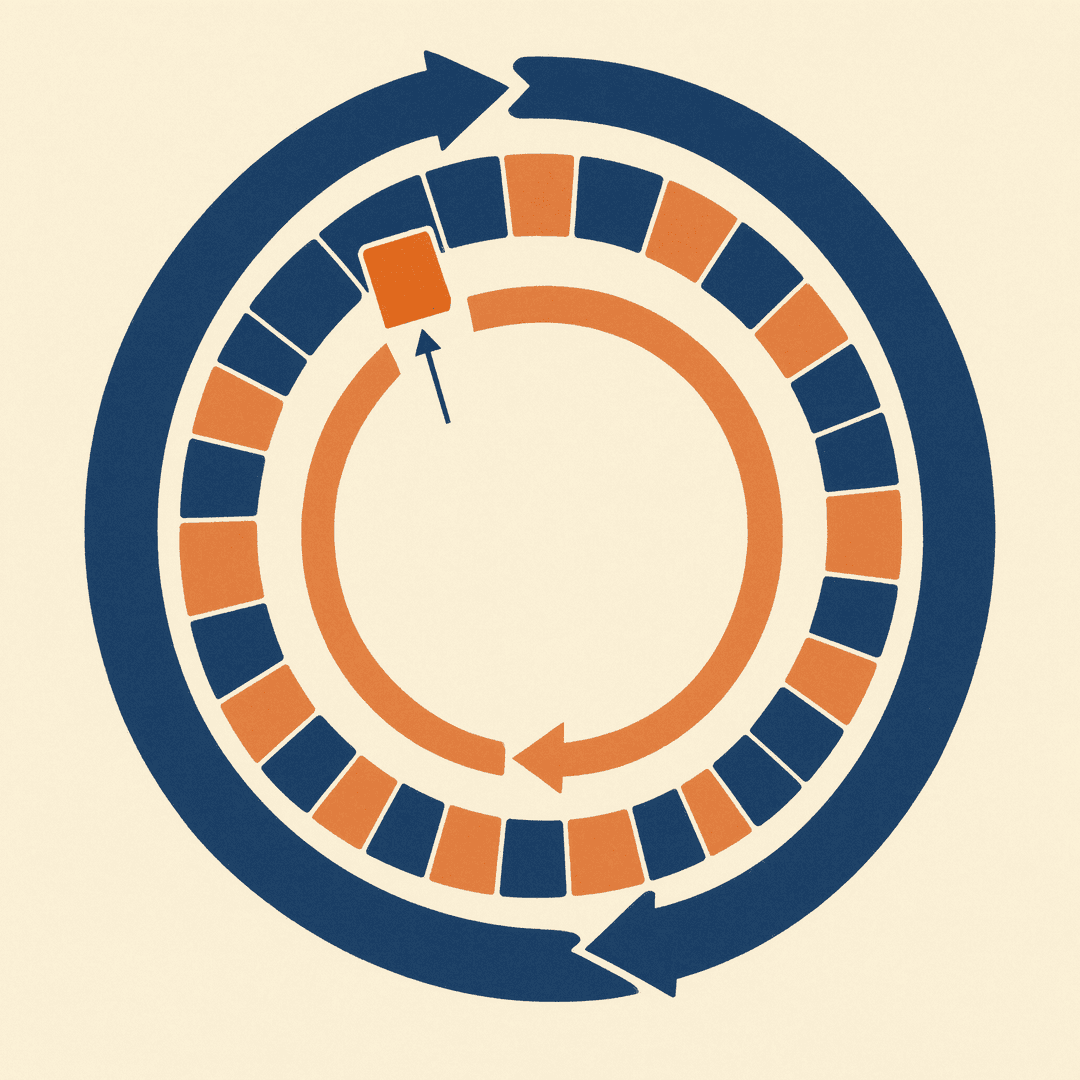
The machinery splits into two loops. The inner loop is normal gradient descent on one sampled task, a handful of steps, a handful of examples. The outer loop samples many such tasks, runs the inner loop on each, and updates the shared starting point to make all those inner loops end up in better places. The outer loop optimizes the learner; the inner loop is the learning being optimized.
The old part: learning to learn, 1987-1998
The term itself is older than the deep-learning wave. Juergen Schmidhuber's 1987 diploma thesis at the Technical University of Munich was literally titled Evolutionary principles in self-referential learning, or on learning how to learn, and it proposed applying genetic programming to genetic programming, recursively, so the system would evolve better learning methods instead of better answers. In the early 1990s the same line of work moved inside neural networks, using slow weights to control fast weights so a network could learn its own weight-change rule.
The subfield got its canonical name from a 1998 edited volume, Learning to Learn by Sebastian Thrun and Lorien Pratt (Springer), which collected the transfer-learning, lifelong-learning and meta-level-optimization work of that decade. Then the field went quiet for a while. Deep learning's answer to almost everything in this period was: more data, more compute, one big model.
The provocation: Omniglot, 2015
What restarted the story was a human benchmark, not a machine one. In Science in December 2015, Brenden Lake, Ruslan Salakhutdinov and Joshua Tenenbaum opened with a blunt comparison: "People learning new concepts can often generalize successfully from just a single example, yet machine learning algorithms typically require tens or hundreds of examples to perform with similar accuracy."
Their test case was Omniglot, a handwriting dataset of characters from dozens of the world's writing systems, assembled with stroke-order data so a learner sees how each character was drawn, not just the final glyph. Their model, built as a probabilistic program that composes motor primitives, could learn a new character concept from a handful of examples and match human one-shot generalization. It was not gradient-based, and that was partly the point: the gap it exposed was about sample efficiency, and the deep-learning stack of the day had no answer to it.
MAML: training a model to be easy to fine-tune
The gradient-based answer came twelve months later. Model-Agnostic Meta-Learning, by Chelsea Finn, Pieter Abbeel and Sergey Levine (ICML 2017), proposed the two-loop scheme described above and applied it to any differentiable model. The key sentence in the abstract is the design goal: "the parameters of the model are explicitly trained such that a small number of gradient steps with a small amount of training data from a new task will produce good generalization performance on that task. In effect, our method trains the model to be easy to fine-tune."
MAML reported state-of-the-art results on two established few-shot image classification benchmarks, and because the same recipe covered classification, regression and reinforcement learning, it set off a genuine wave. A 2021 survey by Hospedales and colleagues in IEEE TPAMI documents the scale of the literature the period produced.
The follow-up that mattered for practice was Reptile in 2018. Full MAML differentiates through the inner loop, which means second-order derivatives through every fast adaptation step: expensive and awkward at scale. Reptile dropped that requirement. It samples a task, takes a few ordinary gradient steps, and simply moves the shared initialization toward the adapted weights, exactly as its abstract describes ("repeatedly sampling a task, training on it, and moving the initialization towards the trained weights on that task"). Same goal, first-order math, and the authors showed it performed well on the same standard few-shot classification benchmarks.
Why it never ran the world
Three reasons, all visible from the papers themselves.
First, the assumption is strong. Meta-learning needs a task distribution that actually matches what the model will meet later. The Reptile framing is explicit that the payoff applies to "a previously unseen task sampled from this distribution." Miss the distribution and the tuned initialization buys you nothing.
Second, the outer loop is expensive. Even the first-order simplifications require training across a large sampled family of tasks, and gradient-based methods still needed to run inner updates for every task in every meta-batch.
Third, and this is the part that matters for how LLM news is usually framed, the industry solved the symptom differently. Fine-tuning services, adapters like LoRA, and retrieval took the "few examples, new behavior" problem and handled it with a pretrained backbone that already covers the task distribution implicitly, because it was trained on the internet. The Bitter Lesson framing from Richard Sutton, written in 2019 at the peak of the meta-learning wave, argues that the durable methods in AI are the ones that scale with computation, and names them: "The two methods that seem to scale arbitrarily in this way are search and learning."
The argument did not end, it moved into the context window
Here is the part every reader has experienced without the vocabulary. You paste eight examples of a new task into a ChatGPT prompt and the model does the ninth. In-context learning looks exactly like the thing meta-learning was built to produce, and researchers split over whether it is, mechanically, the same thing.
One camp connects the two formally. In Transformers learn in-context by gradient descent (ICML 2023), von Oswald and colleagues prove a weight-construction equivalence between a linear self-attention layer and gradient descent on a regression loss, then show experimentally that trained attention layers implement gradient-descent-like updates inside the forward pass, effectively becoming what they call mesa-optimizers, models that learn other models during inference. Under this reading, pretraining is the outer loop, and your prompt examples are the inner loop.
The other camp questions what in-context examples teach at all. Min et al. (EMNLP 2022) found that randomly replacing the labels in a demonstration "barely hurts performance" across 12 models including GPT-3. What demonstrations really supply, they argue, is the label space, the input distribution and the format, not the input-label mapping a meta-learner is supposed to extract.
Both results are real and the tension between them is not settled. The honest summary is narrower than either camp's marketing: meta-learning as a named training technique faded from production practice around 2019, but its central question, can a model get better at getting better, reappeared as an open question about what happens inside a transformer's context window when you show it a few examples.
Where the term still applies correctly
If you are reading ML papers in late 2026, four labels still mean what the 2017 literature defined. Meta-learning is the outer-loop family in general. Few-shot learning is the capability being evaluated, the ability to adapt from a handful of labeled examples. An initialization trained so that a few gradient steps suffice is a meta-learned initialization, in the MAML sense. And learned optimizers, update rules obtained by meta-training instead of hand-design, remain a niche but active line, a direct descendant of the 1987 idea of a system evolving its own learning method.
Fine-tuning itself is not meta-learning; it is the inner loop. LoRA is not meta-learning either; it is a parameterization of the inner loop. The distinction is worth keeping because the marketing language around "models that learn from your data instantly" blurs exactly the line the 2015-2018 literature spent three years drawing.
Sources
- Finn, Abbeel, Levine, Model-Agnostic Meta-Learning for Fast Adaptation of Deep Networks, ICML 2017
- Nichol, Achiam, Schulman, On First-Order Meta-Learning Algorithms (Reptile), 2018
- Lake, Salakhutdinov, Tenenbaum, Human-level concept learning through probabilistic program induction, Science 350, 2015
- Schmidhuber, Metalearning or Learning to Learn Since 1987 (history page; the 1987 diploma thesis and 1990s fast-weight work)
- Thrun and Pratt (eds.), Learning to Learn: Introduction and Overview, Springer 1998
- Hospedales, Antoniou, Micaelli, Storkey, Meta-Learning in Neural Networks: A Survey, IEEE TPAMI 2021
- von Oswald et al., Transformers Learn In-Context by Gradient Descent, ICML 2023
- Min et al., Rethinking the Role of Demonstrations: What Makes In-Context Learning Work?, EMNLP 2022
- Sutton, The Bitter Lesson, 2019
