
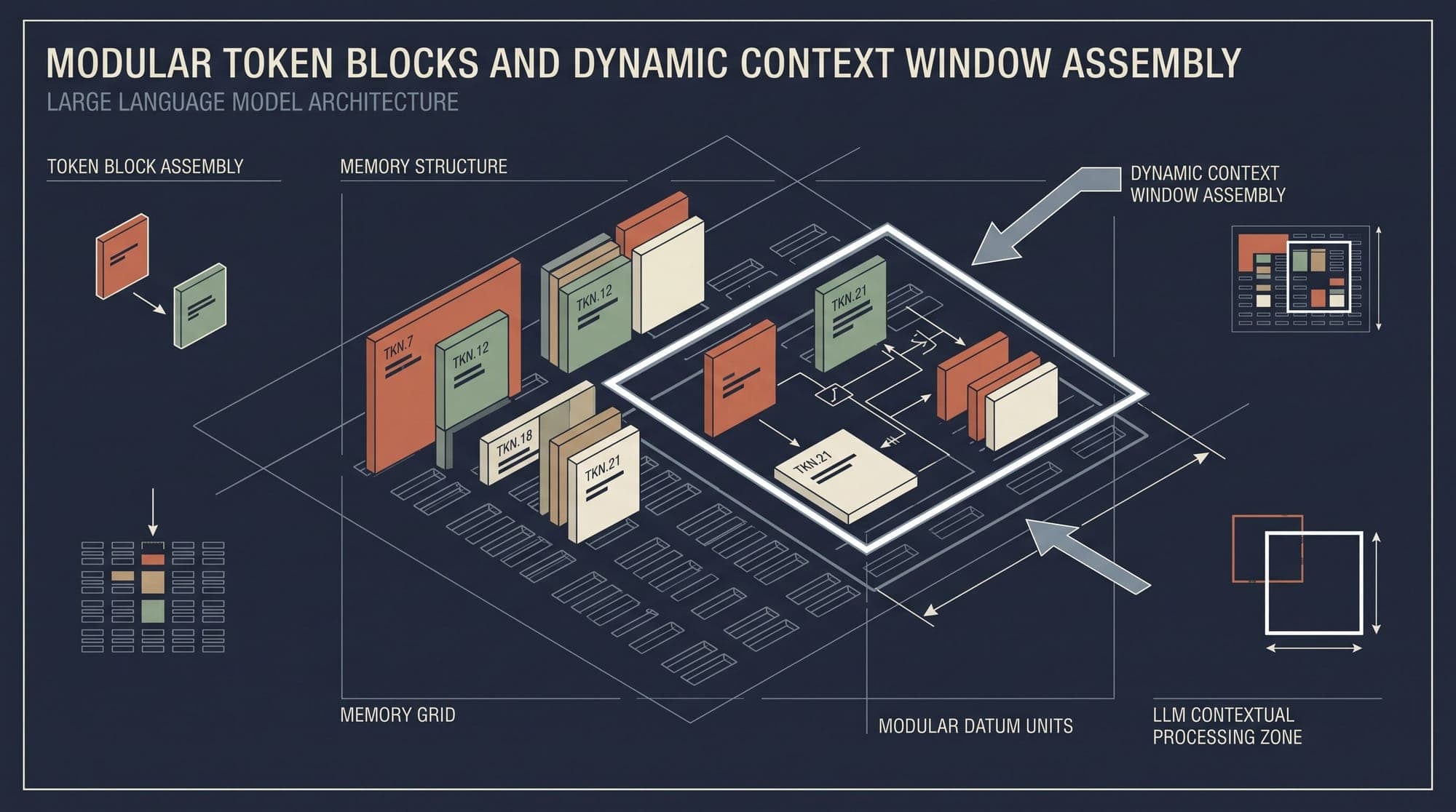
In production large language model systems, prompt construction is frequently treated as simple string concatenation. Engineers assemble system instructions, tool schemas, retrieved document snippets, memory state, and multi-turn conversational history using template strings. In low-throughput prototypes, this approach functions adequately. In high-throughput production systems and multi-agent workflows, naive assembly introduces critical failure modes: abrupt context window overflows triggering HTTP 400 errors, non-deterministic token spikes, degraded attention over long contexts, and complete invalidation of upstream prefix caches.
Treating the prompt as a managed memory layout with explicit token budgeting is necessary to maintain system reliability and cost efficiency. Building a production context assembly engine requires structured token allocation across functional tiers, priority-based packing algorithms, strict prefix cache alignment, and automated degradation fallbacks.
The Layered Anatomy of a Context Budget
A production context window is a constrained resource shared among distinct functional components. Rather than allowing unbounded expansion from any single data source, context assembly engines partition available capacity into structured tiers.
- Tier 0: System Directives and Invariant Instructions. Baseline persona instructions, safety boundaries, and strict output schema constraints. This tier is immutable across user requests within a given application deployment.
- Tier 1: Tool and Function Declarations. JSON Schema declarations defining available external actions, parameter types, and docstrings. This payload remains static unless dynamic tool filtering is applied.
- Tier 2: Persistent User Profile and State. Long-term preferences, user profile attributes, and workspace definitions loaded from persistent storage.
- Tier 3: Dynamic Knowledge Retrieval (RAG). Document chunks, semantic search results, and knowledge graph entities injected to ground model responses in domain facts.
- Tier 4: Interaction History and Execution Traces. Prior conversational turns, past tool call invocations, and raw tool execution observations.
- Tier 5: Current User Input and Turn Metadata. The active prompt submitted in the current request cycle.
- Tier 6: Reserved Output and Generation Margin. The allocation reserved for model output generation, chain-of-thought scratchpads, and token safety buffers.
According to engineering analysis by Maxim AI, production systems must reserve a safety margin of 10 to 15 percent of total context capacity to prevent sudden context boundary violations during intermediate reasoning steps and unexpected schema expansions.

Priority Packing vs. Naive FIFO Trimming
When total payload size exceeds the available input budget, simple first-in, first-out (FIFO) truncation creates severe operational issues. Truncating purely by chronological age can evict critical task setup directives or leave partial tool responses that produce syntax errors in downstream model passes.
Production context engines resolve this with priority knapsack packing and fractional degradation schedules. As detailed in architectural research on token budgeting, allocating budget by functional priority rather than arrival time prevents silent context corruption.
A standard degradation cascade follows a strict eviction hierarchy:
- Stage 1: Lowest-Ranked RAG Eviction. Retrieved knowledge chunks are dropped in reverse order of vector similarity or cross-encoder reranking score. High-scoring chunks are preserved at full length while marginal passages are eliminated entirely.
- Stage 2: Tool Observation Compaction. Detailed tool output payloads (such as raw database records or large JSON responses from intermediate tool turns) are replaced with compact structured summaries, preserving status codes and key identifiers while removing redundant fields.
- Stage 3: Conversational History Pruning. Dialogue history is compressed using rolling summarization or sliding window eviction, maintaining recent turns while collapsing older turns into a single background context string.
- Stage 4: Dynamic Tool Pruning. Functions irrelevant to the immediate intent are excluded from the tool registry payload, reclaiming token capacity consumed by unused schema definitions.
- Inviolable Core. Tier 0 (system rules) and Tier 5 (current user prompt) maintain strict 100 percent allocation priority and are never truncated.
# Conceptual priority packing pipeline for context assembly

def assemble_context(
    system_prompt: str,
    tool_schemas: list[dict],
    user_state: dict,
    retrieved_chunks: list[dict],
    history: list[dict],
    current_query: str,
    max_context_limit: int,
    output_reserve: int = 2048,
    safety_buffer_ratio: float = 0.10
) -> list[dict]:
    # Calculate available budget for input assembly
    usable_input_budget = int(max_context_limit * (1.0 - safety_buffer_ratio)) - output_reserve

    # 1. Allocate inviolable tokens
    static_prefix = build_static_prefix(system_prompt, tool_schemas)
    current_turn = {"role": "user", "content": current_query}

    fixed_cost = count_tokens(static_prefix) + count_tokens(current_turn)
    remaining_budget = usable_input_budget - fixed_cost
    if remaining_budget <= 0:
        raise ValueError("Static directives and user query exceed total input budget")

    # 2. Pack user state
    state_payload = format_state(user_state)
    state_tokens = count_tokens(state_payload)
    if state_tokens <= remaining_budget:
        remaining_budget -= state_tokens
        included_state = state_payload
    else:
        included_state = compact_state(user_state, max_tokens=remaining_budget)
        remaining_budget -= count_tokens(included_state)

    # 3. Pack knowledge retrieval (sorted by reranking score)
    included_chunks = []
    for chunk in sorted(retrieved_chunks, key=lambda c: c["score"], reverse=True):
        chunk_cost = count_tokens(chunk["text"])
        if chunk_cost <= remaining_budget * 0.60: # Cap RAG at 60% of dynamic budget
            included_chunks.append(chunk)
            remaining_budget -= chunk_cost
        else:
            break

    # 4. Pack recent dialogue turns with remaining capacity
    included_history = []
    for turn in reversed(history):
        turn_cost = count_tokens(turn)
        if turn_cost <= remaining_budget:
            included_history.insert(0, turn)
            remaining_budget -= turn_cost
        else:
            break

    return compile_messages(static_prefix, included_state, included_chunks, included_history, current_turn)
Prefix Cache Alignment and the Dynamic Poisoning Pitfall
Prompt caching mechanisms in modern inference engines (such as vLLM Automatic Prefix Caching, Anthropic Prompt Caching, and OpenAI Automatic Prompt Caching) reuse precomputed Key-Value (KV) cache tensors for identical prompt prefixes.
Prefix caching operates on exact sequential token matching. When a request matches a cached prefix:
- Cache reads on providers like Anthropic offer up to 90 percent discounts on input token pricing, as noted in caching economics studies by Timeless.
- Time-to-first-token (TTFT) latency drops by 70 to 85 percent because the inference engine skips redundant transformer prefill operations.
- Providers like Anthropic require a 1,024-token minimum prefix to trigger caching breakpoints, while OpenAI enforces automatic 1,024-token prefix matching in 128-token increments.
The central architectural vulnerability in prompt assembly is dynamic cache poisoning. If volatile data (such as current timestamps, fluctuating session IDs, randomized nonces, or updated balance values) is placed near the beginning of the system prompt, the token sequence changes on every call. This invalidates the entire downstream KV cache block sequence, converting what should be a 90 percent cache hit into a full-price prefill recomputation.
To maximize cache hits, context engines enforce a strict entropy ordering:
- Top of Prompt: Lowest Entropy (Static Invariants). System instructions, persistent behavioral policies, and static tool definitions. This block must remain byte-identical across all requests and sessions.
- Middle of Prompt: Medium Entropy (Session & Knowledge State). Long-term user profile definitions and document passages that remain stable across multiple dialogue turns.
- Bottom of Prompt: Highest Entropy (Volatile Dynamics). Timestamps, recent user messages, short-lived ephemeral flags, and active execution observations.
High-Throughput Token Accounting
Accurate context budgeting requires rapid token calculation. Running exact BPE tokenizers (such as tiktoken for OpenAI architectures, SentencePiece for Llama/Gemini variants, or Hugging Face tokenizers) inside the critical request path can introduce unexpected CPU bottlenecks under high concurrency.
Production systems adopt hybrid accounting models:
- Pre-computed Chunk Metadata. Vector databases and document repositories store exact pre-calculated token lengths alongside text content during ingestion, eliminating runtime tokenization overhead for retrieved RAG chunks.
- Fast Heuristic Estimators for Fast-Path Triage. High-speed gateways use character-ratio heuristics (typically 3.8 to 4.2 characters per token for standard English text) for initial coarse-grained boundary checks, invoking exact tokenizers only when estimated utilization crosses 80 percent of capacity.
- Explicit Output Token Budgeting. Research on token-budget-aware reasoning emphasizes configuring explicit output budgets (
max_tokensor thinking token limits) to prevent reasoning models from consuming generation limits before emitting concrete answers.
Context Observability and Circuit Breakers
Context assembly engines operate as defensive infrastructure. Production deployments track four key telemetry dimensions:
- Context Utilization Ratio. The percentage of available context consumed per request. Sustained rates above 85 percent indicate imminent overflow risks, while rates below 40 percent suggest over-provisioned context windows.
- Tier Consumption Breakdown. Tracking token consumption distributions across system prompts, tool schemas, RAG passages, and conversational history to pinpoint bloat.
- Prefix Cache Hit Rate. Monitoring cache read token percentages across provider responses to identify accidental prefix invalidation regressions.
- Overflow Circuit Breakers. Pre-flight validation middleware that intercepts requests before API submission, executing programmatic summarization passes or selective truncation to avoid provider HTTP 400 rejections.
By replacing unconstrained template strings with structured, priority-packed, and cache-aligned context engines, engineering teams eliminate a major class of runtime failures while slashing input token costs and prefill latencies across production LLM applications.
Sources
- Automatic Prefix Caching - vLLM Documentation
- Prompt Caching Guide - Anthropic Documentation
- Prompt Caching in API Endpoints - OpenAI Documentation
- Context Engineering for AI Agents: Production Optimization Strategies - Maxim AI
- Token Budget Strategies for Production LLM Applications - Tianpan Engineering
- Caching for AI Systems: Prompt, Semantic, KV Reuse - Timeless Research
- Token-Budget-Aware LLM Reasoning - arXiv



