
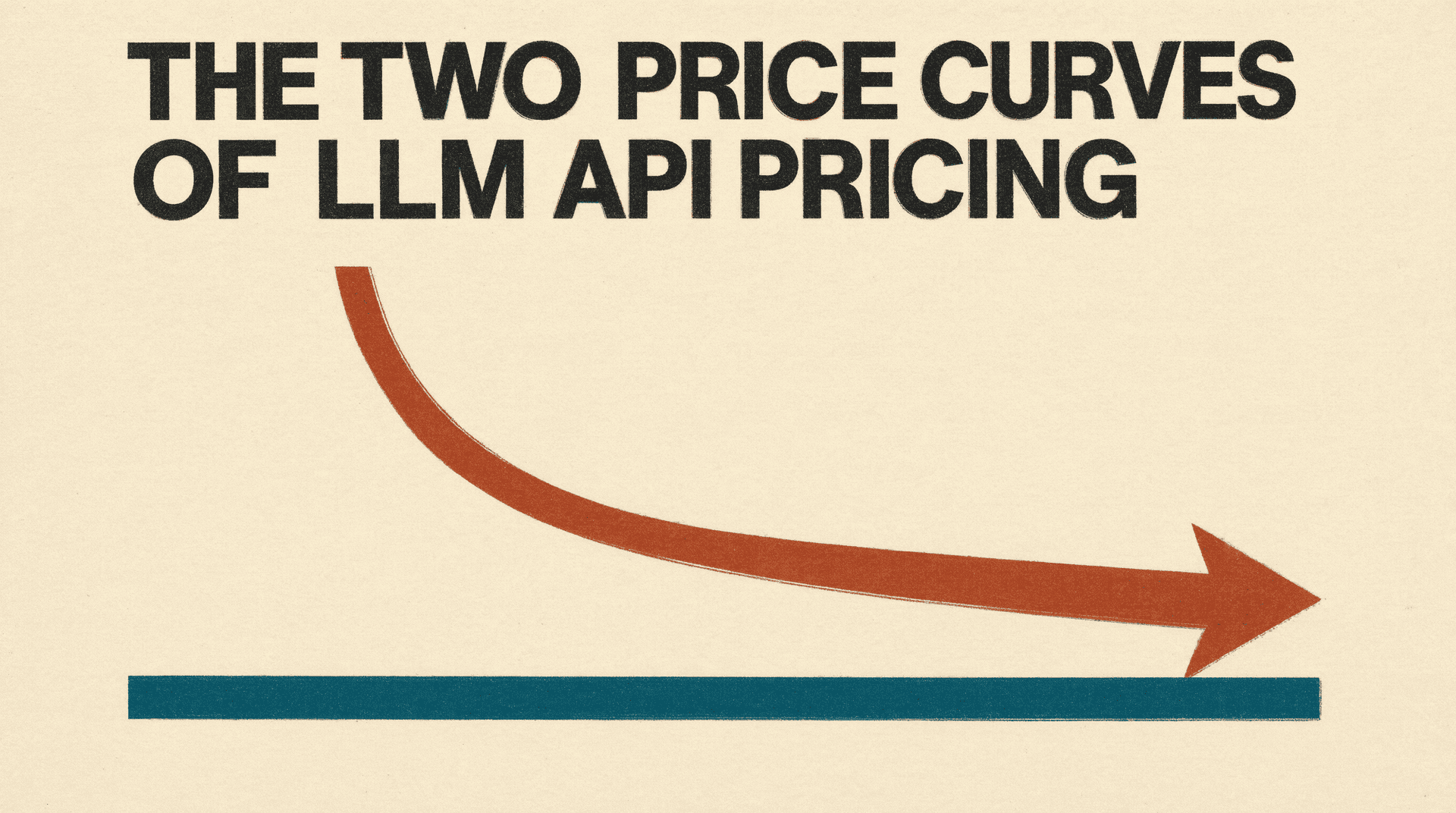
Ask an AI buyer whether LLM prices are falling and the honest answer is yes and no. Unit prices for old capability have collapsed at a speed that has no precedent in computing history. Unit prices at the frontier have gone sideways, and in a few cases up. Both statements are true at the same time, and the gap between them is where most budgets are either saved or wasted in late 2026.
Curve one: fixed capability is in free fall
The cleanest way to measure price deflation is to hold capability fixed and ask what the cheapest way to buy it costs. Epoch AI did this across five benchmarks in a September 2026 report by Luke Emberson and David Roodman. Their finding: the cost of achieving a given level of AI performance has fallen about 47% per quarter, or roughly 13x per year, since 2023. For context, they put that at four times faster than the decline in DNA sequencing costs, six times faster than historical compute prices, 18 times faster than lithium battery cells, and 54 times faster than electricity in the century up to 1973.
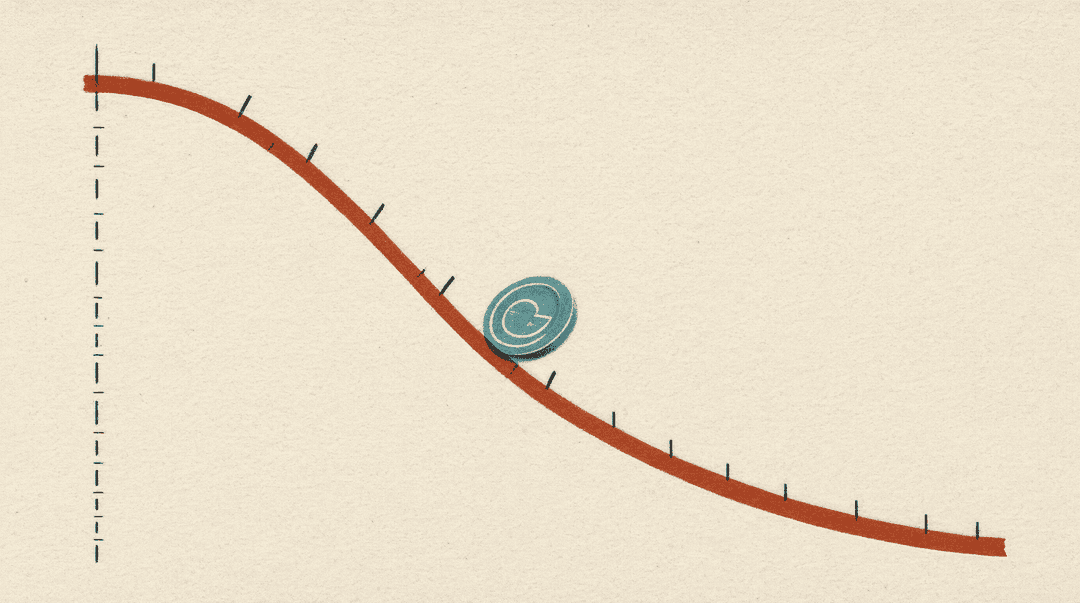
The older and wider-cited version of this number comes from Andreessen Horowitz. In November 2024, Guido Appenzeller showed that GPT-3, which cost $60 per million tokens at its November 2021 launch, had been matched on MMLU by Llama 3.2 3B at $0.06 per million, a 1,000x drop in three years, or about 10x per year. Stanford's 2025 AI Index, as summarized by Monte Carlo, tracked the cost of GPT-3.5-level performance falling from $20 to $0.07 per million tokens between late 2022 and late 2024, a 280x reduction.
A third dataset, Gravity's daily price tracker, rebuilt month by month from the LiteLLM price file's git history, puts hard dates on the collapses. The blended rate for the cheapest model rated at or above the original GPT-4 fell from $37.50 per million tokens in October 2023 to $0.0575 on 16 November 2026, about 652x cheaper. The single largest step came in August 2024, when gpt-4o-mini cleared the old GPT-4 capability bar at $0.15 input and $0.60 output and dropped the floor by more than 95% in one month. Since late 2025 the floor has been set not by labs but by open-weight models such as gpt-oss and Gemma served by price-competitive hosts.
Epoch adds two nuances that matter for forecasting. First, decline is fastest right after a capability level is new: averaging across its benchmarks, the cost of a just-debuted state-of-the-art level falls about 66% per quarter (75x per year), halving to 32% per quarter (4.7x per year) two years later. Second, the rate varies by domain, at 50 to 52% per quarter on math problems and a slower 39 to 43% on game-based puzzles.
Curve two: the frontier holds its line
Now look at what labs charge for the current state of the art, and the picture inverts. Whizi's October 2026 survey of OpenRouter's paid model list notes that while Anthropic cut Claude Opus's output price from $75 to $20 per million tokens across two releases, it simply opened a new, pricier tier above it: Claude Fable 5 launched in June 2026 at $50 output and Fable 5.1 kept that price. OpenAI's most expensive standard GPT went the other way, from $10 output with GPT-5 in August 2025 to $50 with GPT-6 Astra in September 2026. At the very top, OpenAI's o1-pro still lists at $150 input and $600 output per million tokens.
This is not a new pattern. Appenzeller's 2024 a16z post observed that OpenAI's then-leading model o1 cost the same per output token as GPT-3 did at launch in 2021: $60 per million. Labs concede the low end and re-monetize at the top.
There is one recent crack in the frontier line, and timing looks like the cause. Anthropic priced Claude Fable 5.2 at $8 input and $40 output, down from $10 and $50 for Fable 5.1, a cut Yardeni Research attributes to price competition as the usage-weighted Silicon Data LLM Token Expenditure Index fell more than 40% between June 30 and early October. Google, for its part, has attached a calendar to its prices: per its own pricing page as read in October, Gemini Flash models list at promotional rates through December 31, 2026 and roughly double from January 1, 2027.
Why your bill goes up while the unit price goes down
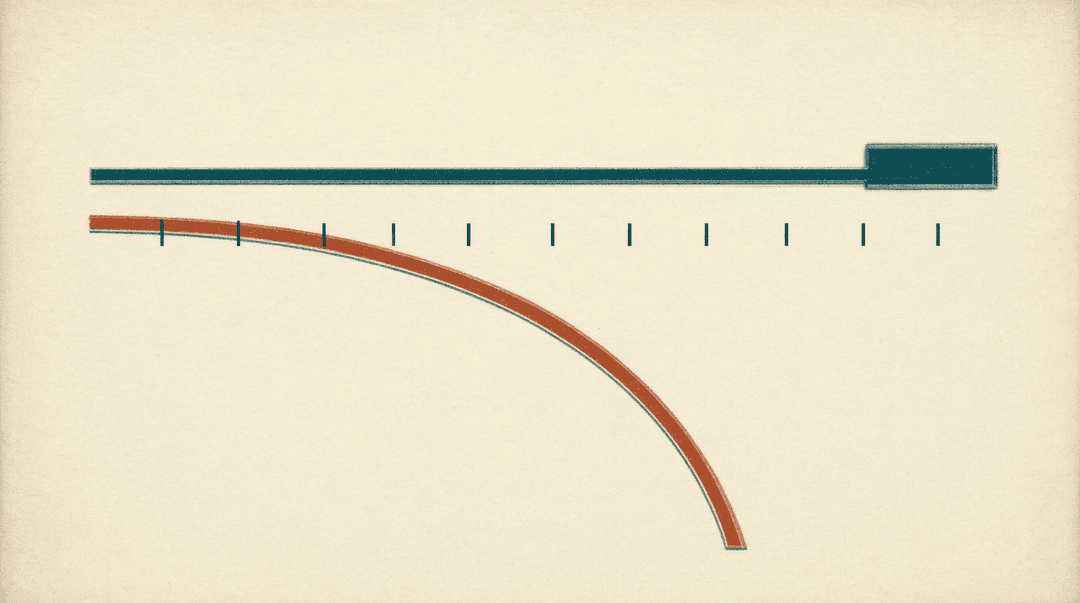
The reconciliation is Jevons paradox plus a hidden multiplier. Cheaper tokens make more workloads worth running, and agentic products consume tokens in ways that never appear on a price page. Monte Carlo points out that a single user-facing query in a mature enterprise deployment routinely triggers several underlying model calls, plus retrieval, planning and verification passes. The revenue data suggests the volume effect is overwhelming the price effect: Google reported processing nearly 32 billion tokens per minute on its October earnings call, more than four times the year-earlier level, and Anthropic's third-quarter revenue reached $16.96 billion, up 47% quarter over quarter, while its compute and infrastructure expenses rose 382% year over year, per Yardeni's read of the numbers. Falling unit prices and rising bills are the same event.
What this means for buyers
Three practical implications follow from the two curves.
- Buy capability, not model names. The median newly listed model from 11 major labs goes for $0.95 input and $3.88 output per million tokens, while Gravity shows GPT-4-class output available for well under $0.10 blended from open-weight hosts. For tasks where yesterday's frontier is overkill, the deflation curve is the discount.
- Discounts are structural, not negotiated. Batch endpoints run at exactly half the normal rate at 66 of the 73 batch listings Whizi checked, and cached input costs a median of 12% of the normal input price, with flagship models cutting 90 to 97.5% for cache hits. Most token spend in agent workloads is repeated context, so caching is the largest single lever.
- Price your roadmap on the decay curve. If Epoch's 47%-per-quarter holds, the capability you pay $10 per million output tokens for today will have a sub-$1 open-weight substitute within roughly a year, and a cents-level one within two. Contracts and architectures that lock in today's frontier tier depreciate faster than any other line item in the stack.
The market is not overpriced or underpriced; it is two markets. One sells the old frontier, and its price is collapsing on a schedule. The other sells the new frontier, and its price is a negotiating position that labs reset with each launch. Most AI finance confusion comes from quoting the wrong curve to the wrong audience.
Sources
- Epoch AI, "The plunging price of thought," Emberson and Roodman, September 22, 2026. https://epoch.ai/publications/the-plunging-price-of-thought
- Andreessen Horowitz, "Welcome to LLMflation: LLM inference cost is going down fast," Guido Appenzeller, November 12, 2024. https://a16z.com/llmflation-llm-inference-cost/
- Gravity, "LLM API Pricing History: Every Price Drop Since 2023," updated November 16, 2026. https://gravity.fast/data/llm-api-price-history
- Whizi Research, "LLM API Pricing Statistics: 335 Models, Output 4x Input," October 2026. https://whizi.io/resources/llm-api-pricing-statistics
- Monte Carlo, "Token Prices Are Falling, So Why Is Your AI Bill Going Up?" https://montecarlo.ai/blog-token-prices-are-falling-so-why-is-your-ai-bill-going-up
- Investing.com, "Why falling AI token prices aren't the negative for AI providers one might assume," Yardeni Research note, October 2026. https://uk.investing.com/news/stock-market-news/why-falling-ai-token-prices-arent-the-negative-for-ai-providers-one-might-assume-4983204
