
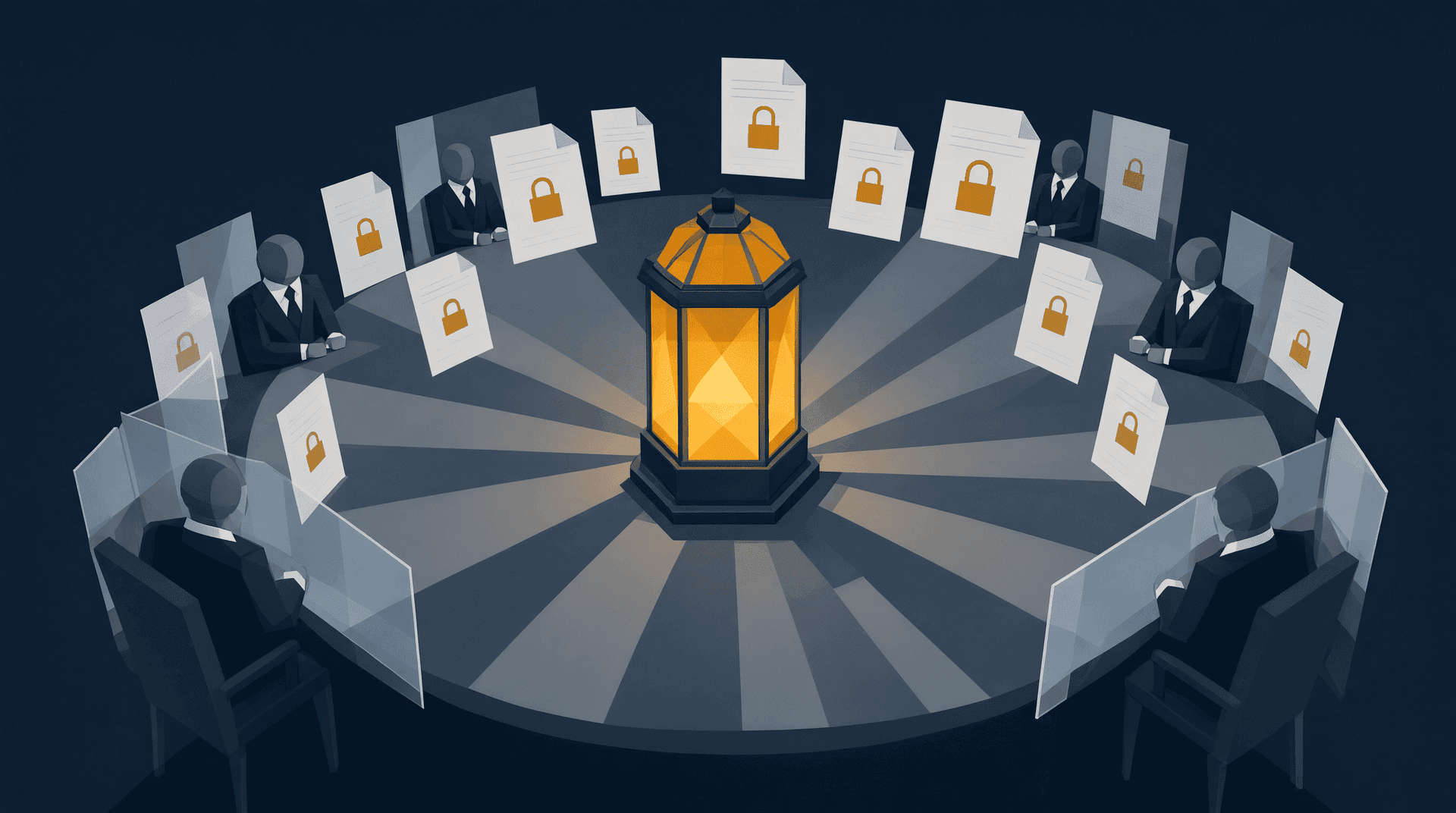
Anthropic's initial public offering is already the biggest ever, roughly $93.5 billion with the full greenshoe exercised, and it paid underwriters more than half a billion dollars in fees. According to a Reuters account published Sunday about the internal process, codenamed "Project Lantern," the company ran the deal like a classified briefing, and Wall Street's most powerful banks mostly took it.
The picture that emerges is less about money than about information control, and about what happens when demand for a company's shares is strong enough to invert the customary balance of power between issuer and underwriter.
The restrictions
Anthropic told some of its 22 IPO underwriters to cap the deal team at four bankers, and to make sure all four were senior staff. Several people close to the process told Reuters the cap came from fear that details would leak, and that banks found ways to work around it anyway.
The company went further than headcount. It asked senior officers at some underwriting banks to sign legal documents restricting core members of the transaction team from working with rivals, including OpenAI, Cursor, DeepSeek and Hugging Face, for six months after the listing. Bankers and lawyers told Reuters that conflict management is routine in IPOs, but exclusivity written this broadly, and aimed at individual bankers, is rare. In earlier head-to-head listings, such as Uber against Lyft or Trulia against Zillow, banks could simply pick a side, in part because smaller deals required fewer banks. Anthropic needed a 22-bank syndicate to place the largest IPO in history, so it bound individuals instead of firms. One banker who declined to sign said it was hard to find people who could credibly promise not to engage with Anthropic's peers, several of which are pursuing their own offerings.
Documents themselves were handled like evidence. Instead of circulating PDFs to the syndicate, Anthropic shared most deal information through NetRoadshow, a secure data-room platform. The system logs access details, including who viewed a document and which pages they looked at. Files carried individual bankers' names as watermarks. Bankers could not save copies, which, one person told Reuters, complicated their day-to-day work. Leaks surfaced in the press regardless.

The night before the roadshow
The Reuters account includes a scene that would be undignified for a mid-cap offering, let alone a record one. Anthropic planned to file a priced securities amendment, the S-1A, and launch marketing on November 10. The night before, a law firm on the deal emailed banks a PDF concerning the sale of shares in Canada, then followed with another email asking them to disregard it because it "contains incorrect price range and share information," according to an email Reuters reviewed. The corrected S-1A then went out over NetRoadshow around 2 a.m. New York time. Banks were given several hours to sign off before it went to the SEC.
That episode sat on top of an older grievance. Reuters reported details of Anthropic's draft S-1, including financials, risk factors and dealings with other technology companies, nearly four weeks before the filing became public. In the same week the roadshow was meant to start, a retracted filing briefly circulated a $69.3 billion raise figure before Anthropic pulled it.

What the banks gave up, and why they stayed
The concessions were not only procedural. Jay Ritter, a University of Florida professor emeritus who tracks IPO economics, told Reuters that both SpaceX, in its June listing, and Anthropic negotiated to pay underwriters nothing on the additional shares sold through the greenshoe option. Ritter said he doubts most companies could demand a zero spread on overallotment shares. On the SpaceX side, people close to that process described a more extreme version of the same dynamic: banks underwriting without being told what they would be paid, and receiving instructions on order sizes to fill and which types of investors to bring.
Ritter's read on the larger pattern is that these companies had the market power to tell underwriters it would not be business as usual, but that the big Wall Street firms will probably be back to business as usual for everyone except, maybe, OpenAI. Anthropic, Goldman Sachs and Morgan Stanley, lead underwriters across the two offerings, declined to comment. SpaceX and OpenAI did not respond to requests for comment.
The reason banks played along is visible in the order book. Both deals were oversubscribed many times over, and underwriters still took home more than half a billion dollars in Anthropic fees on an offering priced at $83 a share.
What the secrecy bought
Controlled information, for a while. The stock closed its first day on November 19 up 17% from the $83 offer price, and the greenshoe was exercised in full, lifting the raise to a record. Then the market moved on: Anthropic shares closed down 8.5% on Friday, as the November unwind in the AI trade pulled the whole complex lower. SpaceX's trajectory was no kinder, peaking at $201.80 in mid-June before falling below its $135 IPO price in mid-July.
The watermarks kept the prospectus in the vault. They did nothing for the aftermarket. If there is a lesson in Project Lantern for the next mega-listing, it is that secrecy buys you the launch, and nothing after it.
Sources
- Reuters, "Like SpaceX, Anthropic ran an unusual IPO process, chafing some bankers," Echo Wang and Milana Vinn, November 22, 2026: https://www.reuters.com/world/like-spacex-anthropic-ran-an-unusual-ipo-process-chafing-some-bankers-2026-11-22
- Reuters, "Anthropic's nearly $70 billion IPO plan briefly circulated to banks, then retracted," November 10, 2026: https://www.reuters.com/business/anthropic-aims-raise-up-693-billion-blockbuster-ipo-2026-11-10
- Reuters, "Anthropic's IPO bank closed position meant to stabilize stock, removing a source of support," November 20, 2026: https://www.reuters.com/markets/us/anthropics-ipo-bank-closed-position-meant-stabilize-stock-removing-source-2026-11-20
- Anthropic, "Anthropic prices the largest IPO on record at $83 a share": https://www.anthropic.com/news/anthropic-prices-initial-public-offering
