
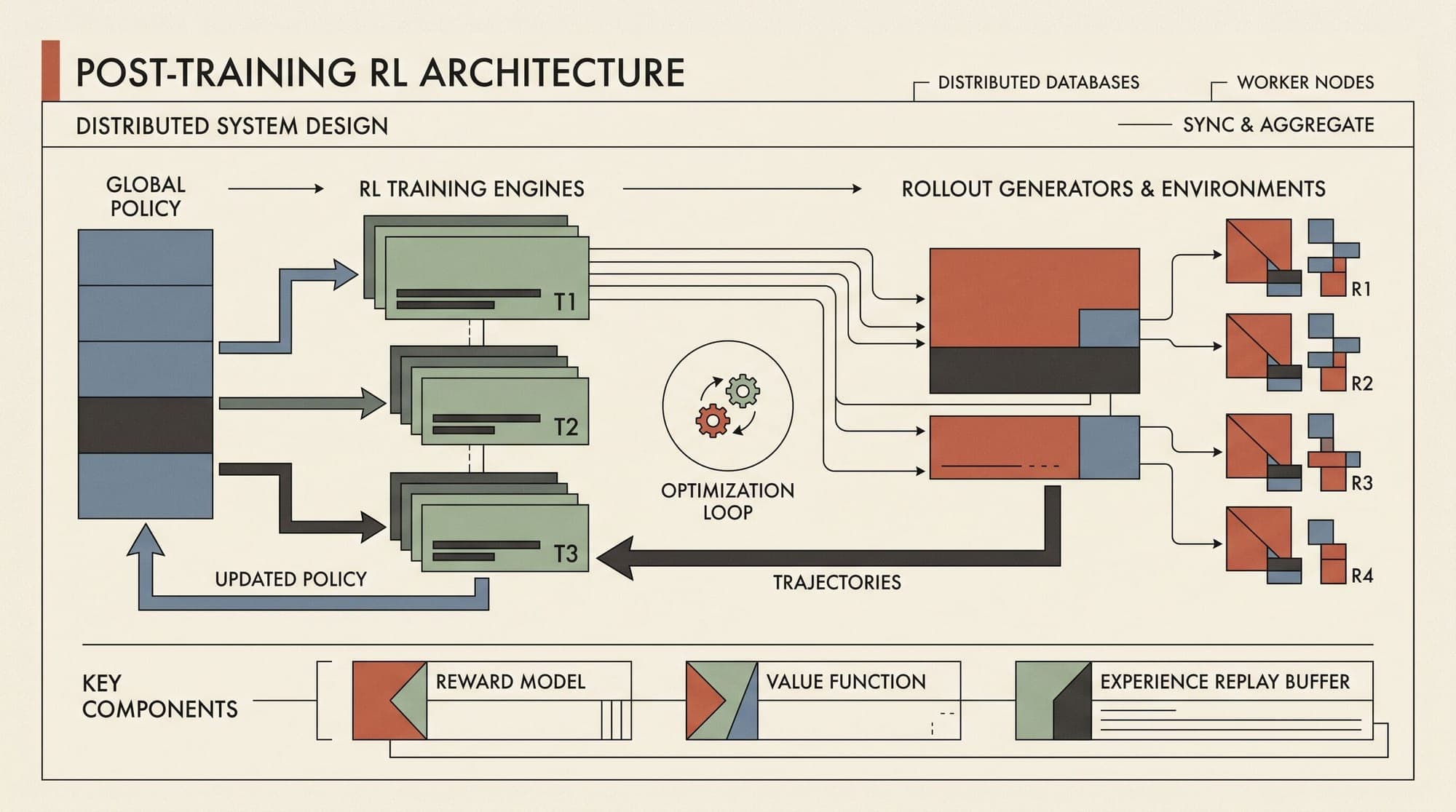
Post-Training RL Frameworks in Production: Comparing verl, OpenRLHF, TRL, and DeepSpeed-Chat Architecture, Distributed Scheduling, and Serving Trade-Offs
Post-training reinforcement learning (RL) has replaced standard supervised fine-tuning (SFT) as the primary mechanism for frontier model alignment and reasoning expansion. Whether running classic Proximal Policy Optimization (PPO), Direct Preference Optimization (DPO), Group Relative Policy Optimization (GRPO), or Reinforcement Learning with Verifiable Rewards (RLVR), modern post-training pipelines introduce an execution pattern distinct from standard pre-training: they alternate between high-throughput autoregressive generation (rollouts) and memory-intensive distributed backward passes (training).
In standard pre-training or SFT, workloads are compute-bound and maintain static parallel state throughout execution. In contrast, RL post-training is dominated by the generation phase, which frequently consumes 75% to 90% of total end-to-end iteration time. Serving long reasoning traces (16k to 64k tokens) requires high-throughput inference optimizations like PagedAttention, continuous batching, and tensor parallelism. Conversely, updating the actor and critic networks requires distributed training techniques like Fully Sharded Data Parallel (FSDP), DeepSpeed ZeRO-3, or Megatron-LM 3D parallelism.
Bridging the divide between high-throughput inference engines (vLLM, SGLang) and distributed training runtimes (PyTorch FSDP, DeepSpeed, Megatron-LM) has led to four primary architectural frameworks: verl (HybridFlow), OpenRLHF, Hugging Face TRL, and DeepSpeed-Chat.

The Core Bottlenecks in Post-Training Reinforcement Learning
A production RL post-training pipeline coordinates up to four distinct model roles:
- Actor (Policy Model): Generates rollout completions given prompt batches and receives gradient updates via policy gradient loss.
- Critic (Value Model): Estimates expected returns for state-action pairs in actor-critic setups (e.g., PPO); requires separate optimizer states and parameter sharding.
- Reference Model: A frozen checkpoint of the initial policy used to compute per-token Kullback-Leibler (KL) divergence penalties to prevent policy drift.
- Reward Model / Verifier Oracle: Scores completions using a learned classifier or an automated programmatic sandbox (unit tests, math checkers, compiler execution).
In modern reasoning models using critic-free algorithms such as GRPO or RLVR, the Critic network is eliminated entirely, replacing value estimation with group-relative baseline normalization. However, the system must still solve three fundamental hardware constraints:
1. Memory Layout and Resharding Overhead
During rollout generation, inference engines achieve optimal throughput using Tensor Parallelism (TP) across intra-node NVLink domains, caching Key-Value (KV) tensors in contiguous GPU blocks. During policy training, memory overhead shifts to optimizer states (which consume 12 to 16 bytes per parameter under AdamW), requiring Data Parallelism combined with ZeRO-3 or FSDP sharding across nodes. Transferring or resharding weights between these disparate memory layouts every training iteration introduces substantial communication latency if not managed in place.
2. Heterogeneous Resource Utilization
Generation and training exhibit opposite hardware demands. Rollouts are memory-bandwidth-bound during token decoding and latency-sensitive. Gradient updates are compute-bound across matrix-multiplication tensor cores and network-bound across inter-node interconnects. Locking GPUs into a static training configuration during rollout execution wastes compute capacity.
3. Long-Horizon Rollout Memory Inflation
Reasoning-focused RL tasks require generating thousands of speculative tokens per prompt. In an 8-GPU node running 32k-context rollouts across 64 concurrent sequences, the uncompressed KV cache alone can exceed 100 GB of VRAM, competing directly with model weights and optimizer states.
Architectural Comparison of Production Frameworks
1. verl (Volcano Engine Reinforcement Learning / HybridFlow)
Developed by ByteDance and open-sourced under the verl project, this framework implements the architecture formalized in the HybridFlow research paper.
┌────────────────────────────────────────────────────────────────────────┐
│                              verl Architecture                         │
├────────────────────────────────────────────────────────────────────────┤
│  Single-Controller Python Interface (Ray Driver)                       │
│  └─► Hierarchical API: Actor / Critic / Ref / Reward Workers           │
├────────────────────────────────────────────────────────────────────────┤
│  3D-HybridEngine (Colocated Weights on Identical GPU Allocation)        │
│  ┌──────────────────────────────┐    ┌──────────────────────────────┐  │
│  │   Training Mode (FSDP/Meg)   │◄──►│  Inference Mode (vLLM/SGLang)│  │
│  │   • ZeRO / FSDP Sharding     │    │  • Tensor Parallelism (TP)   │  │
│  │   • Backward + Optimizer Step│    │  • PagedAttention Rollout    │  │
│  └──────────────────────────────┘    └──────────────────────────────┘  │
│             ▲ In-Place Layout Transformation (Zero VRAM Duplication)   │
└────────────────────────────────────────────────────────────────────────┘
Core Mechanisms
- 3D-HybridEngine: Rather than running separate GPU clusters for training and inference, verl co-locates training and rollout engines on the same physical GPUs. When switching between rollout generation and policy training, verl executes an in-place tensor permutation between FSDP/Megatron parameter shards and vLLM/SGLang tensor parallel weights. This avoids duplicating model weights in VRAM.
- Hierarchical Programming Model: Combines the usability of a single-controller Python script with the execution scalability of multi-controller Ray actors. Data transfers between model roles are managed through abstract tensor containers that handle inter-node resharding automatically.
- Native 3D Parallelism Support: Integrates directly with Megatron-LM for Tensor Parallelism (TP), Pipeline Parallelism (PP), Sequence Parallelism (SP), and Context Parallelism (CP), enabling scaling beyond 70B and 400B parameter frontiers.
2. OpenRLHF
OpenRLHF is a distributed framework built on top of Ray, vLLM, and DeepSpeed ZeRO-3.
┌────────────────────────────────────────────────────────────────────────┐
│                           OpenRLHF Architecture                        │
├────────────────────────────────────────────────────────────────────────┤
│  Ray Placement Groups & Orchestration                                  │
│  ┌──────────────────────────────────┐  ┌────────────────────────────┐  │
│  │ Rollout Pool (vLLM / SGLang)     │  │ Training Pool (DeepSpeed)  │  │
│  │ • TP-optimized inference workers │  │ • ZeRO-3 Actor / Critic    │  │
│  │ • High-throughput batch decode   │  │ • Gradient update workers  │  │
│  └──────────────────────────────────┘  └────────────────────────────┘  │
│                    │                                 ▲                 │
│                    └─► Ray Remote Plasma Store ──────┘                 │
│                        (Prompt & Completion Tensors)                   │
├────────────────────────────────────────────────────────────────────────┤
│  Optional Topology: Colocated or Disaggregated Heterogeneous Nodes     │
└────────────────────────────────────────────────────────────────────────┘
Core Mechanisms
- Decoupled Ray Placement Groups: OpenRLHF abstracts each model role into dedicated Ray actor pools. This architecture allows two distinct deployment topologies:
- Colocated Mode: Actor training and vLLM rollout alternate on the same GPUs using weight synchronization over host memory or NCCL.
- Disaggregated Heterogeneous Mode: Rollouts run on inference-optimized instances (e.g., L40S or H100 PCIe), while policy updates run on NVLink-connected H100 SXM clusters. Lightweight reward verifiers and rule-based code sandboxes run asynchronously on CPU/GPU worker pools.
- Unified Agent Execution Paradigm: Decouples prompt formatting and tool-calling execution from the RL loss calculation. Multi-turn reasoning traces, tool interactions, and compiler execution return token trajectories that pipe directly into a standardized loss layer.
- Ring Attention Sequence Parallelism: Integrates Ring Attention sequence parallelism during the training forward/backward pass, supporting long contexts without running out of GPU memory during log-probability evaluation.
3. Hugging Face TRL (Transformer Reinforcement Learning)
TRL is Hugging Face's native post-training library, built directly on top of transformers, accelerate, and the PyTorch ecosystem.
Core Mechanisms
- Hugging Face Hub and Trainer Native: Designed around the familiar
TrainerAPI pattern (PPOTrainer,GRPOTrainer,DPOTrainer,ORPOTrainer). Models, datasets, and configurations integrate directly with the Hugging Face Hub without custom data serialization formats. - Accelerate & FSDP Backend: Distributed training is managed via Hugging Face Accelerate, supporting standard PyTorch FSDP and DeepSpeed ZeRO configurations out of the box.
- Inference Integration: TRL v1.0 integrates vLLM for rollout generation, enabling high-throughput generation during online RL runs.
- Target Workloads: TRL offers the lowest setup friction and easiest code modification for research prototyping, single-node runs, and models up to 32B parameters. However, for multi-node clusters requiring complex 3D parallelism (TP + PP + DP) or heterogeneous actor-critic scheduling, TRL requires more manual scaffolding than verl or OpenRLHF.
4. DeepSpeed-Chat
Introduced by Microsoft in 2023, DeepSpeed-Chat pioneered the initial end-to-end RLHF pipeline architecture.
Core Mechanisms
- DeepSpeed Hybrid Engine: Introduced the concept of toggling an identical model between ZeRO-3 training mode and an optimized DeepSpeed inference kernel.
- Unified ZeRO Pipeline: Leveraged ZeRO-Stage 1, 2, and 3 along with ZeRO-Offload to enable running multi-model RLHF pipelines on memory-constrained hardware.
- Production Limitations: DeepSpeed-Chat relies on static inference execution without modern continuous batching, chunked prefills, or PagedAttention. As a result, its rollout generation phase is significantly slower than vLLM- or SGLang-backed engines, making it largely superseded in modern large-scale production environments.
Technical Comparison Matrix
| Feature / Metric | verl (HybridFlow) | OpenRLHF | Hugging Face TRL | DeepSpeed-Chat | | :--- | :--- | :--- | :--- | :--- | | Primary Maintainer | ByteDance / Community | OpenRLHF Team | Hugging Face | Microsoft | | Training Engine | PyTorch FSDP / Megatron-LM | DeepSpeed ZeRO-3 / Megatron | PyTorch FSDP / DeepSpeed | DeepSpeed ZeRO-3 | | Rollout Engine | vLLM / SGLang (In-Place) | vLLM / SGLang (Ray Pool) | vLLM / Hugging Face Native | DeepSpeed Inference | | Weight Synchronization | 3D-HybridEngine (In-Place) | Ray Shared Memory / NCCL | Accelerate / vLLM Sync | DeepSpeed Hybrid Engine | | 3D Parallelism Support | Full (TP, PP, DP, SP, CP) | High (TP, PP, ZeRO-3, Ring SP) | Standard (DP, FSDP, ZeRO) | Moderate (ZeRO-3, TP, PP) | | Heterogeneous Clusters | Supported via Ray pools | Native first-class topology | Manual configuration | Not supported | | Long-Context Rollouts | Native (vLLM/SGLang + SP) | Native (Ring Attention + vLLM) | Standard vLLM support | Limited | | Supported Algorithms | PPO, GRPO, Reinforce++, DPO | PPO, GRPO, DAPO, DPO, KTO | PPO, GRPO, DPO, ORPO, KTO | PPO, DPO | | Setup Complexity | Moderate | Moderate | Low | Moderate | | Ideal Production Scale | 7B to 400B+ on large clusters | 7B to 70B+ (Heterogeneous setups) | 1B to 32B (Prototyping/Production) | Legacy / Educational |
Architectural Trade-Offs in Production
1. In-Place Resharding vs. Disaggregated Ray Pools
The primary architectural choice between verl and OpenRLHF centers on hardware topology:
- verl's In-Place Approach: Excels in homogeneous GPU clusters where all nodes possess identical compute and memory capacity (e.g., all H100 SXM8 nodes). By swapping memory layout in place on the same physical GPUs, verl eliminates inter-node network transmission of weights between the rollout engine and training engine.
- OpenRLHF's Disaggregated Approach: Excels when compute resources are heterogeneous or when rollout verification is compute-heavy. If reward scoring requires executing code in thousands of isolated sandbox containers, OpenRLHF can stream generated trajectories across Ray to dedicated CPU/GPU evaluation pools, freeing primary training GPUs for backward passes.
2. Critic-Free Post-Training (GRPO and RLVR)
With the rise of reasoning models, pipelines increasingly discard the Critic network in favor of GRPO or rule-based verification. In a standard PPO run, four models (Actor, Critic, Reference, Reward) must be represented in memory. Under GRPO:
Eliminating the Critic reduces training VRAM requirements by over 40%, allowing teams to allocate larger batches and longer KV cache budgets for rollouts. Both verl and OpenRLHF provide native, highly optimized implementations of GRPO and rule-based reward functions.
Selection Guide for Production Engineering
- Choose verl if:
- You operate homogeneous multi-node clusters (e.g., clusters of 8xH100 or 8xH200 nodes).
- You are training large foundation models (32B to 400B+) requiring Megatron-LM 3D parallelism and Sequence Parallelism.
- You need maximum throughput with zero VRAM weight duplication during rollout-to-training transitions.
- Choose OpenRLHF if:
- You need flexible, heterogeneous cluster orchestration (e.g., running rollouts and rule verification on distinct worker pools).
- You are training agentic workflows with multi-turn tool calling and code execution sandboxes.
- You want a turn-key Ray-native architecture backed by DeepSpeed ZeRO-3 and vLLM.
- Choose Hugging Face TRL if:
- You are fine-tuning models up to 32B parameters on single-node or smaller multi-node setups.
- You require tight integration with Hugging Face datasets, tokenizers, and the Hub.
- You want minimal infrastructure overhead and rapid iteration on preference optimization algorithms.
Sources
- HybridFlow: A Flexible and Efficient RLHF Framework (verl Research Paper)
- verl Project Repository and Documentation
- OpenRLHF: An Easy-to-use, Scalable and High-performance RLHF Framework
- Accelerating RLHF with vLLM: Best Practice from OpenRLHF
- OpenRLHF Repository and Architecture Guide
- TRL v1.0: Post-Training Library Built to Move with the Field
- DeepSpeed-Chat: Easy, Fast and Affordable RLHF at Scale
- vLLM RLHF Integration Documentation



