

Ask an AI company what a unit of value costs and you get a token, a resolution, an outcome. Ask a row-crop farmer and the answer is older and stranger: the acre. Weed control is probably the largest deployed base of production computer vision anywhere, and unlike the chat and coding markets, it grew up billing per physical outcome. In late 2026 the category runs on four different meters at once: a per-acre license that only bills the acres you did not spray, a $1.4 million machine plus a software fee, a per-acre service pass, and, newest of all, a flat annual unlimited license. The graveyard of companies that picked the wrong meter explains most of the rest.
The bill AI is cutting into
The baseline makes the pitch easy. Uncontrolled weeds cost US crop production roughly $33 billion a year in lost yield, with weed control activities costing up to $6 billion more, per USDA Agricultural Research Service estimates. A frequently cited industry study by Soltani and colleagues puts potential losses in corn and soybeans alone at $43 billion a year across the US and Canada if nothing were sprayed. USDA NASS data compiled in Weed Technology peg US soybean herbicide spending at about $4.1 billion in 2023, roughly $125 per hectare. Typical in-crop broadcast herbicide programs run $25 to $35 per acre, and University of Nebraska trials benchmarked a full broadcast post-emergence program at $105.80 per acre.
The labor side is worse and getting worse. The H-2A seasonal visa program certified 398,258 positions in fiscal 2025, up 185 percent in a decade, with a federal wage floor for field workers starting at $14.83 an hour in 2025. Hand weeding organic leafy greens runs about $449 per acre before machinery, according to a Western Growers case study. Against those numbers, a camera that lets a sprayer skip half the field is not a feature. It is a line item in the operating budget.
Meter one: the per-acre license that bills the acres you skipped
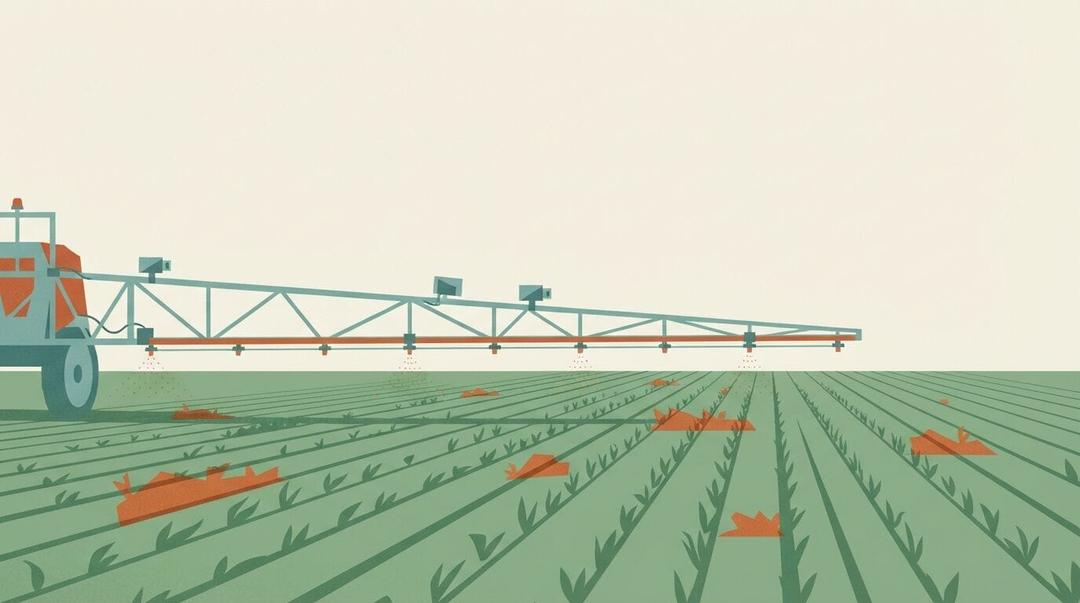
John Deere bought Blue River Technology for $305 million in 2017. Blue River had by then built the core of what See & Spray became, and its original LettuceBot product was itself a pay-per-acre weeding service covering more than 10 percent of US lettuce. Deere relaunched the technology on boom sprayers in 2021 and settled on a strikingly literal performance meter. The license fee is $5 per in-crop acre and $1 per fallow acre, and it applies only to acres the machine chose not to spray. Where the system applies chemistry, there is no fee. Deere calls the guarantee the Application Savings Guarantee, and its field manager for the product states the logic plainly: if See & Spray does not save you money, you do not pay.
Deere's own 2025 season numbers: See & Spray was used across 5 million acres, and the company claims average savings of $12.63 per acre after license fees, with cotton trials showing lint gains worth up to $61 per acre.
Here is the part the fee hides.
Arkansas Cooperative Extension published a full economics comparison of the option tiers, valuing a base new Deere self-propelled sprayer at $650,000, a See & Spray Premium build at $750,000, and an Ultimate build at $900,000. At a $20 per acre herbicide program, their return-on-investment math says Premium needs roughly 13,400 to 20,400 treated acres to pay back the steel premium over a plain sprayer, and Ultimate needs 53,300 to 117,000 acres. The per-acre license is the visible price. The $100,000 to $250,000 hardware surcharge is the real one, and it only amortizes at custom-applicator scale.
New for the 2026 season, Deere added an Unlimited Annual License for high-use operations. The per-acre meter is now optional.
Meter two: the machine plus the software fee
Carbon Robotics sells the most commercially serious weeding robot in North America. The LaserWeeder G2 is a tractor-pulled implement with a bank of CO2 lasers that thermal-kills individual weeds, reported at roughly $1.4 million for the G2 600 up to $1.7 million or more for the G2 1800, plus an annual software and support fee reported in the tens of thousands of dollars. The company's claimed statistics read like a model card: 4.7 million images processed per hour, 5,000 weeds killed per minute, a labeled dataset of 25 million plants, and more than 10 billion weeds eliminated across 14 countries since 2022.
The financials describe the market's tolerance for that price. Carbon raised a $70 million Series D in October 2024 at a reported valuation near $370 million, told GeekWire in 2025 it had raised $177 million lifetime with about 260 employees and more than $100 million in annual revenue, and said it was not yet profitable. Third-party case studies are strong where the fit is right: brassica growers reported an average $454 per acre reduction in the weeding bill, and organic leafy growers cut combined hand-labor and laser weeding costs by roughly 40 percent. Speed is the constraint: the machine works at about 0.9 acres per hour, so it is a substitute for hand crews in high-value specialty rows, not for a 3,000-acre corn farm.
Meter three: the per-acre service pass
Two companies sell the judgment rather than the machine. FarmWise built the Titan and then the Vulcan intra-row weeder and sold weeding by the acre in California and Arizona, raising a $45 million Series B in 2022. Grower numbers were good: a 38 percent cut in romaine weeding costs, and one 10,000-acre operation reported saving $550,000 in a season. FarmWise nonetheless wound down operations in April 2025, and Taylor Farms, an investor from the Series B, bought the technology and runs it as a service today.
Greeneye Technology takes the service economics to the retrofit lane. Instead of a new machine, it bolts camera-and-nozzle precision spraying onto any brand of existing sprayer and bills on the spray plan. Its 2024 US season data shows an average 87 percent reduction in non-residual herbicide, translating to typical savings of $25 to $35 per acre; University of Nebraska-Lincoln trials measured $40.50 per acre saved on post-emergence passes and $24.70 on pre-emergence burndown. The Greeneye pitch is the cheapest per-acre AI meter in the category because it asks for no new steel.
The graveyard explains the meters

The failures are as instructive as the price list. Monarch Tractor raised roughly $240 million, including a $133 million Series C in July 2024 that was pitched as the largest raise in agricultural robotics history, valued at over half a billion dollars, and sold an electric autonomous tractor priced up to $100,000. It sold its manufacturing plant to SoftBank in August 2025, emptied its headquarters and auctioned equipment by early 2026, and saw its technology and patents acquired by Caterpillar in April 2026. CNH Industrial, an investor, took a $62 million write-down. The UK's Small Robot Company was liquidated in 2024, and France's Naio Technologies went into receivership in 2025.
The pattern is not that the robots did not work. It is that farm machinery is a capital-and-service business with one cash flow per year, a ten-day weather window per operation, and a support obligation in counties where the dealer network is the only network. Startups that took on manufacturing died of it; the buyers were always incumbents or growers. Caterpillar bought Monarch's autonomy stack. Taylor Farms kept FarmWise's fleet as a service. Deere's lesson from 2017 is being repeated by everyone else: sell the meter, own the machine.
What the price list means
Three conclusions travel well outside agriculture.
First, outcome-linked billing is not a 2026 software invention. Deere's fee fires on the acre that was not sprayed. The vendor and the buyer count the same physical event, and the guarantee is enforced by the meter itself, not by a sales call. It is the cleanest per-outcome pricing in production AI, and it exists because herbicide, not tokens, is the marginal cost being avoided.
Second, under most farm economics the intelligence is the discount, not the price. Arkansas Extension's payback numbers say the camera license is trivial next to the $100,000-plus hardware premium and the operating-speed trade-offs. A buyer comparing See & Spray Premium against Ultimate is choosing a utilization rate, not choosing AI. Where utilization is low, the retrofit lane (Greeneye) and the service lane (FarmWise, now Taylor Farms) are the actual on-ramps.
Third, the Deere unlimited license for 2026 is meter fatigue, exactly the migration every AI vendor eventually makes. Start with a per-acre performance guarantee to earn adoption, watch the guarantee's accounting cost collapse the sales cycle, then offer the flat annual pass to high-use customers who no longer want to audit skipped acres.
The company that runs the most AI acres in North America bills $5 for the ones it does not touch, sells $750,000 of steel to deliver it, and has just quietly offered to take a flat fee instead. The graveyard next door is full of firms that priced the intelligence and forgot the machine.
Sources
- USDA Agricultural Research Service, pepper/weed economics summary ($33B losses, $6B control costs): https://www.ars.usda.gov/research/publications/publication?seqNo115=269001
- Weed Science Society of America on Soltani et al. potential corn-soy losses ($43B): https://wssa.net/2016/05/wssa-calculates-billions-in-potential-economic-losses-from-uncontrolled-weeds
- Weed Technology, perspectives on US herbicide economics (soybean $4.1B, ~$125/ha): https://www.cambridge.org/core/journals/weed-technology/article/perspectives-on-the-economics-of-herbicide-usage-in-corn-and-soybean-production-in-the-united-states/84C81E804E9D0B4C7070DF1E38389D41
- American Farm Bureau Federation, H-2A positions FY2025 (398,258, +185% in 10 years): https://www.fb.org/intel/markets/h-2a-program-use-continues-to-soar
- USDA ERS, Farm Labor topic page (AEWR range, FY2024 certifications): http://www.ers.usda.gov/topics/farm-economy/farm-labor
- Western Growers / Carbon Robotics case study (hand-weeding $/acre, ~40% cost cuts): https://wga.s3.us-west-1.amazonaws.com/cit/2024/cit_case-study_carbon-robotics.pdf
- Deere press via Precision Farming Dealer (5M acres 2025, $1/$5 fees, Application Savings Guarantee, 2026 Unlimited Annual License): https://www.precisionfarmingdealer.com/articles/6834-farmers-use-john-deere-see-and-spray-across-5-million-acres-in-2025
- Michigan Farm News (See & Spray fee mechanics, $12.63/acre after fees, $25-30 chemistry): https://www.michiganfarmnews.com/john-deere-see-spray-technology-that-pays-for-itself-in-the-field
- RDO Equipment podcast (Select/Premium/Ultimate license tiers, fee only when spray is avoided): https://www.rdoequipment.com/resources/podcasts/john-deere-see-and-spray-explained
- University of Arkansas Cooperative Extension, FSA2225 (sprayer values $650K/$750K/$900K, payback acreages): https://www.uaex.uada.edu/publications/pdf/FSA2225.pdf
- John Deere See & Spray product page (cotton lint and revenue claims): https://www.deere.com/en-us/products-solutions/sprayers-and-applicators/see-spray
- Deere/Blue River acquisition, PR Newswire ($305M, 2017): https://www.prnewswire.com/news-releases/deere-to-advance-machine-learning-capabilities-in-acquisition-of-blue-river-technology-300514879.html
- The Robot Report, Blue River sale (LettuceBot pay-per-acre service, 10% of US lettuce): https://www.therobotreport.com/startup-blue-river-technology-sells-deere-305-million
- The Bot Scout, LaserWeeder G2 review (prices $1.4M-$1.7M+, software fee, $100M revenue, 10B weeds): https://www.thebotscout.com/reviews/carbon-robotics-laserweeder
- GeekWire, Carbon Robotics $20M raise (total $177M, 260 staff, not profitable, 14 countries): https://www.geekwire.com/2025/carbon-robotics-raises-20m-as-laserweeder-maker-plans-secretive-new-ai-robot-for-farms
- The Robot Report, Carbon funding (4.7M images/hr, 5,000 weeds/min, 25M labeled plants): https://www.therobotreport.com/carbon-robotics-raises-funding-to-destroy-weeds-on-farms
- Anton Robots review, LaserWeeder G2 ($454.26/acre brassica case study, 0.89 acres/hr): https://antonrobots.com/carbon-robotics-laserweeder-g2-review
- The Robot Report, FarmWise Series B ($45M, pay-per-acre model): https://www.therobotreport.com/farmwise-labs-brings-in-45m-for-robotic-weeding
- The Packer, FarmWise after wound-down (38% romaine, $550K savings, Taylor Farms): https://www.thepacker.com/news/packer-tech/ai-powered-farmwise-prepares-next-chapter-ag-robotics
- Soil Practice, electric tractor shakeout (Monarch shutdown, Caterpillar April 2026, Small Robot Company, Naio): https://soilpractice.com/guides/electric-tractor-shakeout-monarch-solectrac
- TechCrunch, Caterpillar acquires Monarch assets (SoftBank plant sale, $133M Series C): https://techcrunch.com/2026-04-15/monarch-tractors-collapse-ends-in-with-an-acquisition-by-caterpillar
- Upstream.ag, Monarch post-mortem (~$250M raised, CNH $62M write-down): https://upstream.ag/p/the-cost-of-straddling-what-monarch-s-pivot-tells-us-and-what-caterpillar-bought
- Greeneye Technology 2024 season press release (87% reduction, $25-35/acre savings): https://www.greeneye.ag/press-releases/greeneye-technology-customers-achieve-87-average-reduction-in-non-residual-herbicide-use-in-2024
- PR Newswire, UNL Greeneye trial ($105.80 broadcast program, $40.50/acre saving): https://www.prnewswire.com/news-releases/greeneye-precision-spraying-system-reduces-non-residual-herbicide-use-by-87-while-delivering-same-efficacy-as-broadcast-spraying-unl-trial-finds-301607676.html
