
What Is a Recommender System? The 1992 Math That Picks What You Watch
The most-used machine-learning system in your life is not a chatbot. It is whatever decides your queue: the titles on a streaming homepage, the videos on a side rail, the products under "customers also bought." Netflix says its recommender influences about 80% of the hours its members stream, and that personalization and recommendations together save the company more than $1 billion a year. The field that produces those numbers is three decades old, was named twice before it settled, and runs on an idea you can state in one sentence: people who agreed in the past will probably agree again.
From Tapestry to GroupLens
The term "collaborative filtering" was coined in 1992 by David Goldberg and colleagues at Xerox PARC, in a paper about Tapestry, an experimental mail-filtering system. The premise, as they put it, was that filtering works better when humans are in the loop: people annotate the documents they read, and the system uses those reactions to route mail to like-minded colleagues. You collaborated with your coworkers whether they volunteered or not.
GroupLens, presented at CSCW in 1994 by Paul Resnick and colleagues at the University of Minnesota, made the same idea work between strangers. It scored Usenet news for readers who never met, using nothing but past ratings, and it did so over an open, distributed architecture with pseudonymous ratings. The prediction engine was the heuristic quoted above. In 1997, Resnick and Hal Varian wrote a Communications of the ACM editorial that gave the whole family of systems the name still in use, "recommender systems," and laid out the standing problems, including what the field still calls the cold-start problem: a system cannot recommend for a user, or a title, that it has no data on.
Two ingredients, two families
Every recommender is a match between a preference signal and a pool of items. The engineering split is about where the signal comes from.
Collaborative systems ignore what an item is and care only about who liked it. Content-based systems read item attributes, genre, director, keywords, and match them against a user profile. Real platforms mix both, and the mix is a business decision: content features are also the standard answer to cold start, because a new title has attributes before it has ratings.
Amazon made the most consequential architectural choice in the collaborative family. User-to-user matching, which finds your lookalikes and copies their taste, works on a lab dataset and collapses under a catalog of millions. Amazon's production answer, in use since 1998 and published in 2003, was item-to-item filtering: precompute a similar-items table (what people who bought this also bought), then a recommendation for any customer is a fast lookup and blend over the few items that customer actually touched. The expensive work happens offline, once per item, not once per request per user.
The matrix, and the million dollars spent on it
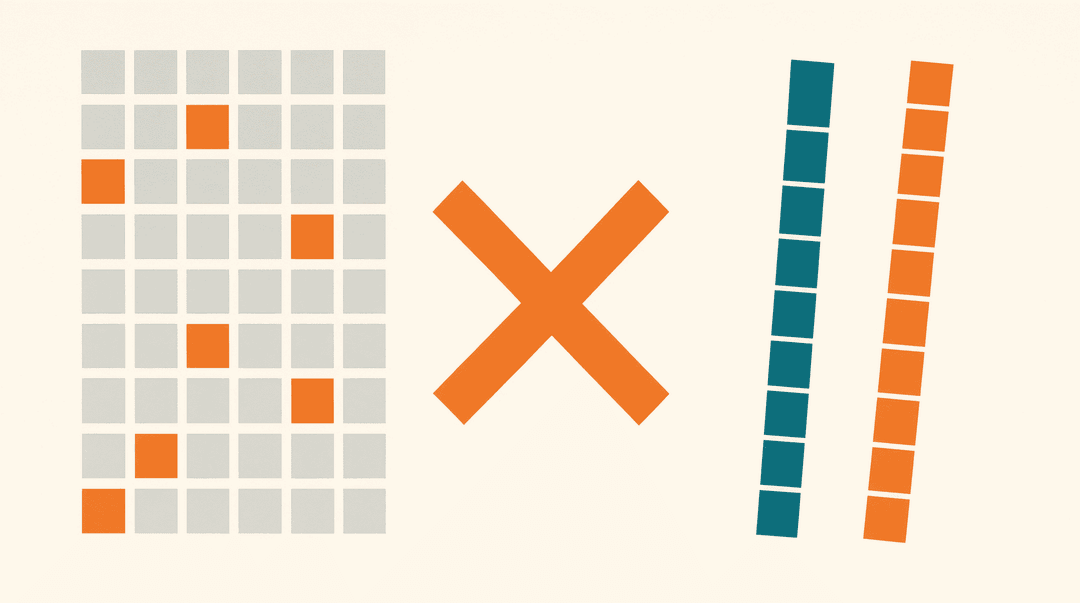
Formally, recommenders stare at a giant grid: rows are users, columns are items, and the cells that exist, ratings or purchases, are a sliver of the total. Fill in the blanks, and you can rank anything for anyone.
The blank-filling method that defined the modern era is matrix factorization: approximate the grid as the product of two much smaller grids, one row-vector per user, one per item, so a predicted rating is the dot product of two short lists of numbers. Yehuda Koren, Robert Bell and Chris Volinsky described the techniques, including SVD++, in a 2009 IEEE Computer article that remains the field's most cited practical reference. The user vector and the item vector are, in other words, embeddings, and the recommender problem is nearest-neighbor search: the items for you are those whose vectors point the way yours does.
The contest that made all this famous was the Netflix Prize. Launched in October 2006 with a $1 million grand prize for a 10% improvement over Netflix's in-house Cinematch predictor, it ran three years. On September 21, 2009, the prize went to BellKor's Pragmatic Chaos for a 10.06% improvement. The margin story is the one to remember: the rival team The Ensemble scored slightly better, 10.09%, and lost because it submitted twenty minutes late. The winning solution was a blend of matrix-factorization and other predictors, exactly the family Koren had championed.
The funnel era
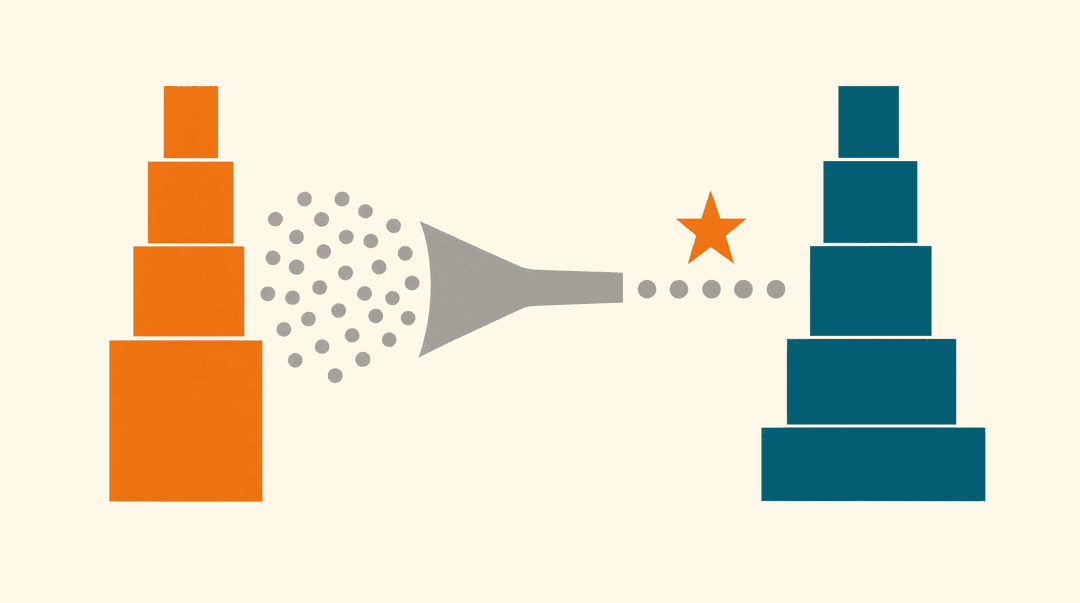
By 2016 the deep-learning version of the same idea was standard. Google's RecSys paper that year described YouTube's system as a two-stage funnel: a candidate-generation network narrows a corpus of millions of videos to a few hundred, and a separate ranking network scores those candidates with far richer features. Both stages are trained on user history; the corpus itself lives as learned embeddings.
The retrieval half of that design got its canonical industrial form in 2019, when Google researchers described a two-tower model for YouTube: one neural network turns the user context into a vector, a second turns each video into a vector, and retrieval is an approximate nearest-neighbor search inside the shared space. This is the same vector lookup that RAG pipelines use to fetch documents, applied to products, videos and posts instead of text chunks. Content features in the item tower are also the cold-start patch: a brand-new video gets an embedding from its metadata before anyone watches it.
Failure modes worth knowing
Cold start is the first: no history, no collaborative signal, worse recommendations, for the platform's newest users and creators at once.
The filter bubble is the famous one, and the evidence is thinner than the phrase. Eli Pariser coined it in a 2011 book to describe personalization isolating people from diverse content. The first individual-level longitudinal measurement most often cited is Nguyen and colleagues' WWW 2014 study of a collaborative filtering recommender: it found that users are indeed exposed to a slightly narrowing set of items over time, but that the users who actually consumed the recommendations experienced lessened narrowing and rated what they saw more positively. Narrowing is real and small in that data, not the dramatic isolation the metaphor implies.
Feedback loops are the third mode, and the least studied in the open literature: recommendations shape behavior, behavior becomes training data, and the model learns to show you what it already showed you.
What LLMs change, and do not
A 2023 survey by Likang Wu and colleagues catalogues the current wave: large language models enter recommendation in two paradigms, discriminative (LLM as a feature encoder, retrained or fine-tuned) and generative (the LLM directly produces or reranks recommendations, zero-shot or prompted). The survey's own conclusion is a caution: gains are dataset-dependent and latency and cost remain open problems. Meanwhile no major feed has announced replacing the embedding-plus-funnel stack that Netflix and YouTube built. For now, LLMs in recommenders are mostly useful for the part the old models were worst at, reading items: titles, descriptions, reviews, the text side of content-based filtering with a very large reader attached.
The 1992 premise survives intact. Systems got faster, learned their own item representations instead of hand-built similar-item tables, and scaled to billions of interactions. But your queue is still, at bottom, a prediction made by strangers who agreed with you once before.
Sources
- Goldberg, Nichols, Oki & Terry, "Using Collaborative Filtering to Weave an Information Tapestry," Communications of the ACM, 1992 - https://dl.acm.org/doi/10.1145/138859.138867
- Resnick, Iacovou, Suchak, Bergstrom & Riedl, "GroupLens: An Open Architecture for Collaborative Filtering of Netnews," CSCW, 1994 - http://presnick.people.si.umich.edu/papers/cscw94
- Resnick & Varian, "Recommender Systems," Communications of the ACM, 1997 - https://cacm.acm.org/research/recommender-systems
- Linden, Smith & York, "Amazon.com Recommendations: Item-to-Item Collaborative Filtering," IEEE Internet Computing, 2003 - https://doi.org/10.1109/MIC.2003.1167344
- Koren, Bell & Volinsky, "Matrix Factorization Techniques for Recommender Systems," IEEE Computer, 2009 - https://doi.org/10.1109/MC.2009.263
- Netflix Prize (rules, results, BellKor vs The Ensemble) - https://en.wikipedia.org/wiki/Netflix_Prize
- Gomez-Uriarte & Schwandrowski, "The Netflix Recommender System: Algorithms, Business Value, and Innovation," ACM TIST, 2015 - https://dl.acm.org/doi/10.1145/2843942
- Covington, Adams & Sargin, "Deep Neural Networks for YouTube Recommendations," RecSys, 2016 - https://research.google.com/pubs/archive/45530.pdf
- Yi et al., "Sampling-Bias-Corrected Neural Modeling for Large Corpus Item Recommendations," RecSys, 2019 - https://doi.org/10.1145/3298689.3346996
- Nguyen, Hui, Harper, Terveen & Konstan, "Exploring the Filter Bubble: The Effect of Using Recommender Systems on Content Diversity," WWW, 2014 - https://doi.org/10.1145/2566486.2568012
- Wu et al., "A Survey on Large Language Models for Recommendation," arXiv:2305.19860 - https://arxiv.org/abs/2305.19860
