
The problem debate was designed for
Every mainstream alignment technique rests on one assumption: a human can tell when the model is right. RLHF works because ratectors can read two answers and pick the better one. Evaluation pipelines work because graders can check a solution. But the premise starts to crack the moment a model reasons about things the grader cannot follow: a 400-step proof, a novel exploit, a research program that pays off in two years. The supervisor would need to be at the level of the supervised, which defeats the purpose of building the model in the first place.
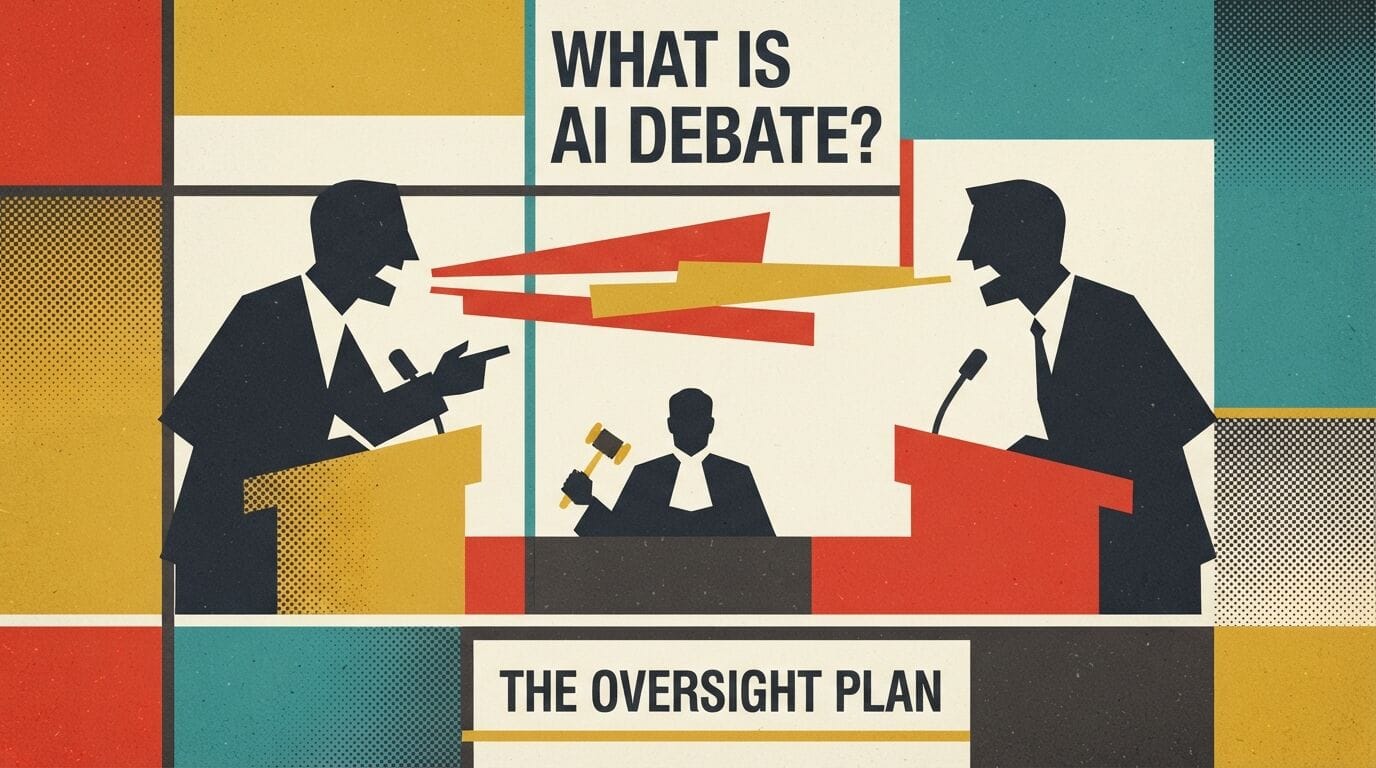
That gap has a name in the literature: scalable oversight, the family of methods that try to keep weak humans (or weak AIs) in control of strong systems. And the oldest concrete protocol for it, proposed in 2018, is one that looks less like machine learning and more like a courtroom: two AI systems argue opposing sides, and a judge picks the better argument.
The 2018 proposal
Geoffrey Irving, Paul Christiano and Dario Amodei laid out the scheme in the paper AI Safety via Debate and a companion OpenAI post. Given a question, two agents take turns making short statements, up to a move limit, and then a human judge decides which agent gave the most true and useful information. The agents are trained by self-play on this zero-sum debate game, the same training logic that powered AlphaGo.
The design rests on an adversarial bet: it is easier to refute a bad argument than to construct a good one. If lying requires defending the lie against an opponent whose only job is to attack it, then honest claims should survive scrutiny more cheaply than false ones. The truthful debater can point at the flaw; the lying debater has to patch it, and the judge watches who is left standing.
What the theory promised, and what it did not
The 2018 paper attached a complexity-theoretic result to the idea: with optimal play, debate can answer any question in PSPACE even when the judge is limited to polynomial time, where direct judging only reaches NP. In plain terms, two adversarial witnesses with structured back-and-forth can convince a bounded verifier about a much wider class of claims than a single witness ever could.
The caveats were stated in the paper itself. The result assumes ideal players, and the authors wrote plainly that whether debate works in practice depends on empirical questions about humans and tasks. The theoretical guarantee also does not address adversarial examples or distribution shift; it is a training-signal proposal, not a robustness proof. Later theory work kept chipping at the gap. The "obfuscated arguments problem" showed that a debater can win by decomposing a claim into sub-arguments that are individually too complex for the judge to check, and newer protocols, such as the instance-optimal debate scheme in an October 2026 paper, continue trying to close it.
The empirical wave of 2024
The first serious test came from Anthropic's Measuring Progress on Scalable Oversight (Saunders et al., 2022/2023): humans with access to a deliberately unreliable LLM assistant beat their own unaided performance on MMLU and reading-comprehension questions. That was consultancy (one model, asked questions), not debate, but it established that the weaker judge plus stronger advisor framing was experimentally tractable.
Then the field ran the actual protocol. In Debating with More Persuasive LLMs Leads to More Truthful Answers, Khan et al. (FutureHouse and UCL, 2024) had expert GPT-4-class models argue opposite answers to reading-comprehension questions from QuALITY, while non-expert judges picked winners. Non-expert model judges reached 76% accuracy and non-expert humans reached 88%, against 48% and 60% for naive baselines. Optimizing the debaters for persuasiveness without ground-truth labels made judges more accurate, not less, which was the paper's most hopeful finding: the adversarial structure transferred.
Google DeepMind's On scalable oversight with weak LLMs judging strong LLMs (Kenton et al., 2024) compared debate, consultancy and direct answering across mathematics, coding, logic and multimodal tasks with weak judges and strong agents. Debate outperformed consultancy across all tasks when the consultant was randomly assigned to argue for the correct or incorrect answer, and stronger debater models increased judge accuracy. Notably, when debaters were allowed to choose their own side instead of having one assigned, judges were less often convinced by wrong answers in debate than in consultancy.
Persuasiveness is still the failure mode
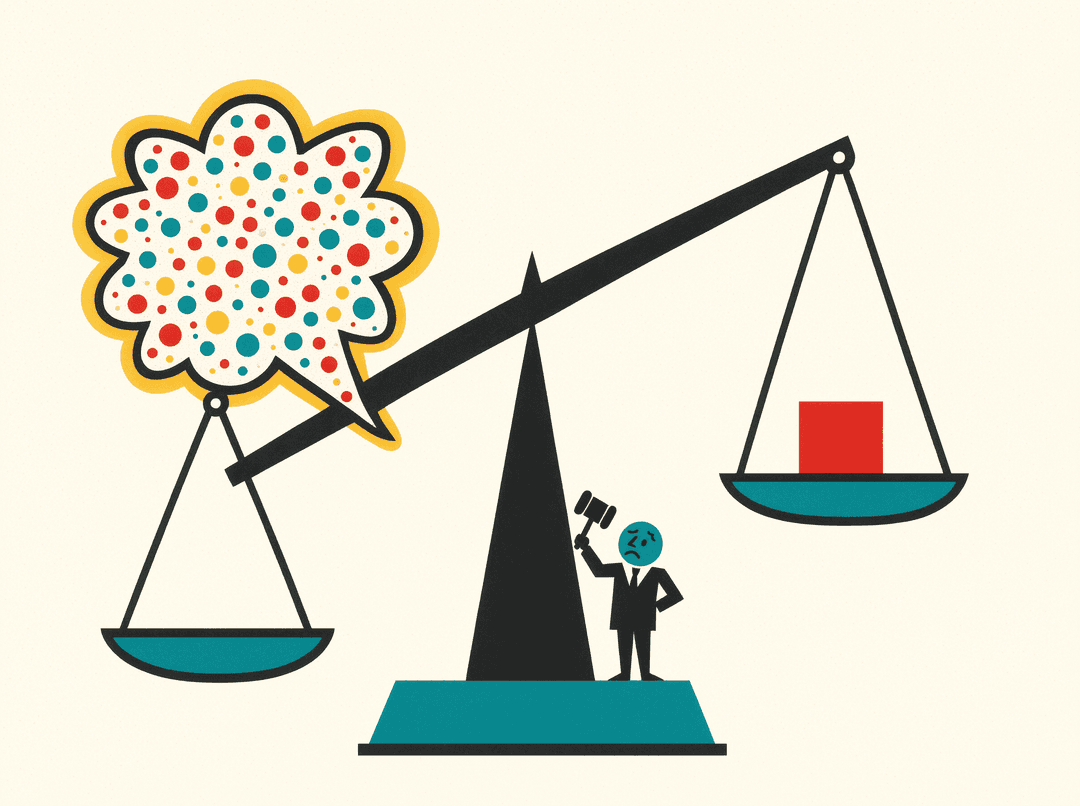
The skeptic literature grew alongside the positive results. The Khan et al. setup already logged the known judge biases: verbosity (longer arguments win), position (order effects), and overconfidence (judges miscalibrate how sure they should be).
More pointedly, when two LLMs debate, both of them think they will win, a 2025 study finding systematic overconfidence in models' predictions of debate outcomes, which is uncomfortable for any protocol that assumes the loser of an argument is evidence against its claim.
And a 2026 study, AI Safety via Debate is Compromised by Cognitive Biases (Liu et al.), put 369 human participants through 68 LLM-generated detective-mystery debates where one side used rhetorical interventions borrowed from competitive debate: anchoring, letting fallacies slide, jargon density, verbosity. Pooled across bias types, the interventions significantly shifted judgments toward the side using them, a design the authors built specifically to separate rhetorical influence from correctness. Adversarial scrutiny, it turns out, can be dodged by whoever is better at theater.
The contested-facts results cut both ways. A 2025 study on AI debate for controversial claims (Rahman et al.) had two models debate COVID-19 and climate claims in front of human judges with mainstream or skeptical priors. Debate beat consultancy by 4 to 10 percentage points on accuracy and improved calibration, with gains up to 15.2% for mainstream-belief judges. The AI judges with human-like personas hit 78.5% accuracy versus 70.1% for the human judges, a data point the authors read as evidence for AI-overseeing-AI pipelines. The uncomfortable asterisk: the benefit was uneven across belief groups, which is exactly what a protocol meant to neutralize bias should not be.
The adjacent bet: weak supervisors
Debate shares its intellectual parentage with Weak-to-Strong Generalization (Burns et al., OpenAI, 2023), the experiment of training GPT-4 on labels from a GPT-2-level supervisor. Fine-tuning on weak labels consistently beat the weak supervisor itself, but fell short of the strong model's full capability. Adding an auxiliary confidence loss recovered performance close to GPT-3.5 level on NLP tasks, which the authors took as evidence that supervising stronger systems with weaker ones is empirically tractable, not hopeless. Debate feeds directly into that lane: a 2025 paper, Debate Helps Weak-to-Strong Generalization, found that letting two strong models debate to pre-select better labels improved what the weak supervisor could teach.
Where it stands in late 2026
AI debate never shipped as an alignment product. The post-training stack that dominates frontier labs runs on RLHF, preference optimization and verifiable rewards, and scalable-oversight research was, by the mid-2020s, described by its own practitioners as out of fashion. What survived is the research program: protocol design in the complexity-theory lane, cognitive-bias audits in the human-factors lane, and applied pilots like an Arcadia Impact study that ran debate over verifiable tasks such as competitive programming (LiveCodeBench) and ARC-AGI puzzles while asking whether oversight generalizes to automated alignment research itself.
The honest scorecard is mixed. Debate reliably helps a weak judge outperform its own unaided accuracy on questions where strong models disagree: that is reproduced across at least three lab-affiliated studies. It has not been shown to keep a sufficiently persuasive liar from winning, and 2026's bias-exploitation results say the gap is real. If oversight protocols matter for systems smarter than their judges, the weak link in every published experiment is still the judge.
Sources
- Irving, Christiano, Amodei, AI Safety via Debate, arXiv:1805.00899 (2018)
- OpenAI, AI safety via debate (2018)
- Saunders et al., Measuring Progress on Scalable Oversight for Large Language Models, arXiv:2211.03540 (2022)
- Khan et al., Debating with More Persuasive LLMs Leads to More Truthful Answers, arXiv:2402.06782 (2024)
- Kenton et al., On scalable oversight with weak LLMs judging strong LLMs, arXiv:2407.04622 (2024)
- Burns et al., Weak-to-Strong Generalization, arXiv:2312.09390 (2023)
- Debate Helps Weak-to-Strong Generalization, arXiv:2501.13124 (2025)
- Rahman et al., AI Debate Aids Assessment of Controversial Claims, arXiv:2506.02175 (2025)
- When Two LLMs Debate, Both Think They'll Win, arXiv:2505.19184 (2025)
- Liu et al., AI Safety via Debate is Compromised by Cognitive Biases, arXiv:2610.05461 (2026)
- How to Have a Sensitive Debate: An Instance-Optimal Protocol for AI Debate, arXiv:2610.02557 (2026)
- Zachary Kenton, A Vision for Scalable Oversight, Alignment Workshop
- Arcadia Impact, Obstacles to the scalable oversight of auto-alignment research
