
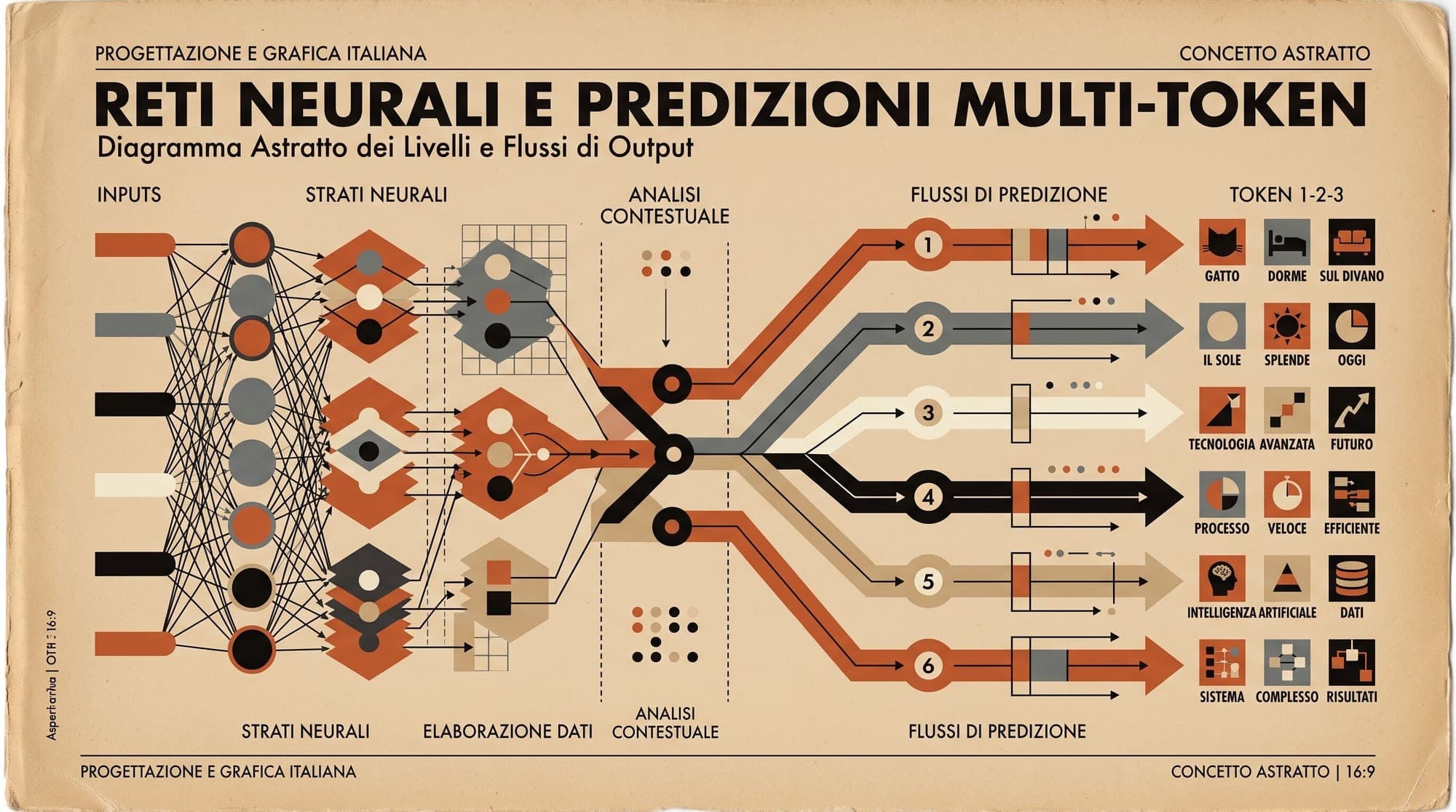
Standard autoregressive language models are trained under a strict next-token prediction objective. At every sequence position, the model consumes a prefix of tokens and predicts the single immediate successor token using a cross-entropy loss. While this paradigm has scaled language modeling across orders of magnitude, it suffers from an architectural limitation: myopic optimization. By evaluating loss exclusively on the immediate next step, standard training fails to reward representations that anticipate long-range dependencies, multi-step syntactic structures, or broader algorithmic trajectories.
Multi-Token Prediction (MTP) modifies this foundational pretraining objective. Instead of predicting a single next token at position i, an MTP model is trained to predict n future tokens (t_{i+1}, t_{i+2}, ..., t_{i+n}) simultaneously. This architectural shift provides two distinct advantages: it enriches the gradient signal during pretraining to improve downstream reasoning and coding benchmarks, and it equips the resulting model with a native drafting mechanism for speculative decoding at inference time without requiring an external draft model.
The Myopia of Next-Token Prediction
Autoregressive transformer pretraining relies on teacher forcing, where ground-truth tokens are fed into the context window and the network minimizes cross-entropy against the single immediate next token. This formulation introduces specific systemic drawbacks:
- Greedy local optima: In natural language and source code, multiple valid paths often diverge at a single token before converging later. Next-token loss heavily penalizes rare intermediary tokens even if they lead to an optimal complete sequence, encouraging models to favor high-frequency local n-grams over globally coherent structures.
- Weak supervision density: In a standard forward pass over a sequence of length L, the model receives exactly L token-level cross-entropy loss values. The gradient updates propagate back solely from the immediate next-step error.
- Planning deficits in algorithmic generation: In code generation, choosing a variable name, loop construct, or function signature directly dictates the structure of the next dozen tokens. Optimizing purely for t_{i+1} provides no direct gradient pressure to build representations that anticipate the dependencies required at t_{i+4} or t_{i+8}.
Multi-token prediction addresses these limitations by forcing the hidden representations of the base transformer to contain sufficient information to reconstruct multiple future steps at once.
Core Architectures: Parallel vs. Sequential Prediction
There are two primary paradigms for implementing multi-token prediction in transformer architectures: parallel output heads and sequential causal modules.
1. Parallel Multi-Token Prediction (Meta AI / Gloeckle et al.)
In the foundational formulation introduced by Gloeckle et al. (2024) at Meta AI Research, a single shared transformer trunk processes the input sequence and produces hidden states h_i at the final layer. On top of this shared backbone, n independent output heads (either linear projections or single-layer transformer blocks) project h_i into vocabulary logits to predict t_{i+1}, t_{i+2}, ..., t_{i+n}.
The total training loss is computed as the arithmetic mean of the cross-entropy losses across all n prediction heads:
L_MTP = (1 / n) * SUM_{k=1}^n L_k(y_{i+k}, y_hat_{i+k})A major engineering challenge with parallel heads is memory consumption. Materializing logits for n heads across a large vocabulary (for example, 128,000 tokens) simultaneously would require n times the GPU memory for the logit tensors. To overcome this, implementations compute logit projections and cross-entropy losses sequentially per head, accumulating gradients into the shared trunk hidden states without holding all output tensors in VRAM at once.
2. Sequential Causal MTP (DeepSeek-V3)
A limitation of independent parallel heads is that the prediction of t_{i+2} does not condition on the actual token selected at t_{i+1}. To preserve the causal generation chain across future tokens, the DeepSeek-V3 Technical Report introduced a sequential MTP architecture using cascaded modules.
In DeepSeek-V3's implementation, the model deploys D sequential MTP modules to predict D additional tokens:
- Shared embeddings and output projections: All MTP modules share the main model's token embedding layer and final unembedding projection head, minimizing parameter expansion.
- Representation fusion: At prediction depth k, the module takes the normalized hidden representation from depth k-1 and concatenates it with the embedding of the ground-truth token t_{i+k-1}.
- Linear projection and transformer block: The concatenated vector is projected back to the hidden dimension d via a projection matrix M_k and passed through a dedicated transformer block before computing the loss for token t_{i+k}.
h_i^k = TRM_k( M_k * [ Norm(h_i^{k-1}) ; Emb(t_{i+k-1}) ] )This sequential causal structure ensures that each prediction depth conditions on all previous ground-truth tokens during training, mirroring standard autoregressive generation while continuing to supervise the main trunk.

Representation Learning and Inductive Biases
Training with multi-token prediction alters the internal geometry of a language model's hidden states. By enforcing that h_i must predict several future tokens, the training dynamics shift in measurable ways:
Dense Gradient Signals
Rather than receiving a single supervisory signal per sequence position, an MTP model with depth n=4 receives four distinct gradient signals per position. This increased supervision density accelerates representation learning, allowing the model to extract more structural information from each training token.
Representation of Abstract Syntax and Schemas
On algorithmic benchmarks such as Python code synthesis and formal mathematics, MTP demonstrates its largest performance advantages. In the experiments published by Gloeckle et al. (2024), a 13-billion parameter model trained with a 4-token prediction objective solved 12% more problems on HumanEval and 17% more problems on MBPP than an equivalent model trained strictly on next-token prediction.
Because writing code requires planning nested syntax (such as matching indentation blocks, closing brackets, and variable scope bindings), the MTP objective forces the shared trunk to encode higher-level syntax trees rather than surface-level token transitions.
Parameter Scaling Dynamics
Empirical findings across both the Meta AI and DeepSeek research papers highlight that the benefits of multi-token prediction scale with model size:
- Small models (<3B parameters): Smaller models often show minimal gains or slight regression under MTP. With limited parameter capacity, dedicating representational bandwidth to predicting multiple uncertain future steps can interfere with mastering basic next-step distribution modeling.
- Mid-to-large models (7B, 13B, and MoE architectures): Larger models have sufficient capacity to capture joint distributions over multi-token spans. For models with 7B parameters and above, MTP consistently outperforms next-token prediction baselines across reasoning, summarization, and coding benchmarks.
Native Speculative Decoding at Inference
Beyond pretraining efficiency and benchmark gains, multi-token prediction fundamentally alters model serving economics through self-speculative decoding.
In standard speculative decoding, an auxiliary "draft model" generates candidate tokens that a larger "target model" verifies in a single parallel forward pass. However, maintaining a separate draft model introduces significant production complexity:
- Draft models consume additional GPU memory and memory bandwidth.
- Distribution mismatch between the draft model and target model leads to low token acceptance rates.
- Deploying and versioning two separate model checkpoints adds operational latency.
MTP provides two flexible serving paths that eliminate these bottlenecks:
1. Zero-Overhead Deployment
If serving in memory-constrained environments or standard legacy inference pipelines, the auxiliary MTP heads or modules can be completely discarded after pretraining. The base transformer trunk retains all the representation quality and benchmark improvements gained during training, with zero changes to standard autoregressive inference.
2. Native Self-Speculative Decoding
When the MTP modules are retained during serving, they function as an integrated draft generator. As detailed in implementation guides by Sebastian Raschka (2025) and AMD ROCm / SGLang, the serving engine uses the MTP heads to generate candidate tokens t_{i+1}, ..., t_{i+k} in parallel.
The main model then verifies the drafted candidate tree in a single forward pass using causal attention masking. Because the draft heads share the exact embedding space and backbone representations of the base model, acceptance rates are high. In production serving engines like SGLang and vLLM, this achieves real-world inference speedups between 1.8x and 3.0x on code and structured output workloads without requiring an external draft model.
Engineering Trade-offs and Best Practices
Deploying multi-token prediction involves several practical engineering trade-offs:
- Pretraining compute overhead: Adding n=4 parallel heads or lightweight transformer blocks adds roughly 5% to 15% additional compute (FLOPs) during pretraining. However, the resulting improvement in sample efficiency typically outweighs this cost by allowing the model to match next-token baseline performance on substantially fewer total pretraining tokens.
- Optimal horizon length: Empirical benchmarks establish that n=4 future tokens is the optimal configuration for models using standard subword tokenizers (vocabulary size 32k to 128k). For byte-level tokenizers where each individual token represents smaller semantic units, n=8 provides the best trade-off.
- Logit memory bandwidth: Computing cross-entropy across multiple heads can saturate memory bandwidth if not properly optimized. Implementations must use fused cross-entropy kernels and gradient accumulation across heads to prevent memory spikes.
- Post-training alignment: During supervised fine-tuning (SFT) and reinforcement learning (such as RLHF or GRPO), practitioners can either continue training the auxiliary MTP modules alongside the main model to maintain speculative drafting alignment, or freeze and discard them to streamline the post-training pipeline.
Sources
- Better & Faster Large Language Models via Multi-token Prediction (Meta AI Research / Gloeckle et al., 2024)
- DeepSeek-V3 Technical Report (DeepSeek-AI, 2024)
- Multi-Token Prediction (MTP) Architecture Guide (Sebastian Raschka, PhD, 2025)
- Accelerating DeepSeek-V3 Inference Using Multi-Token Prediction in SGLang (AMD ROCm / SGLang Tutorials)



