
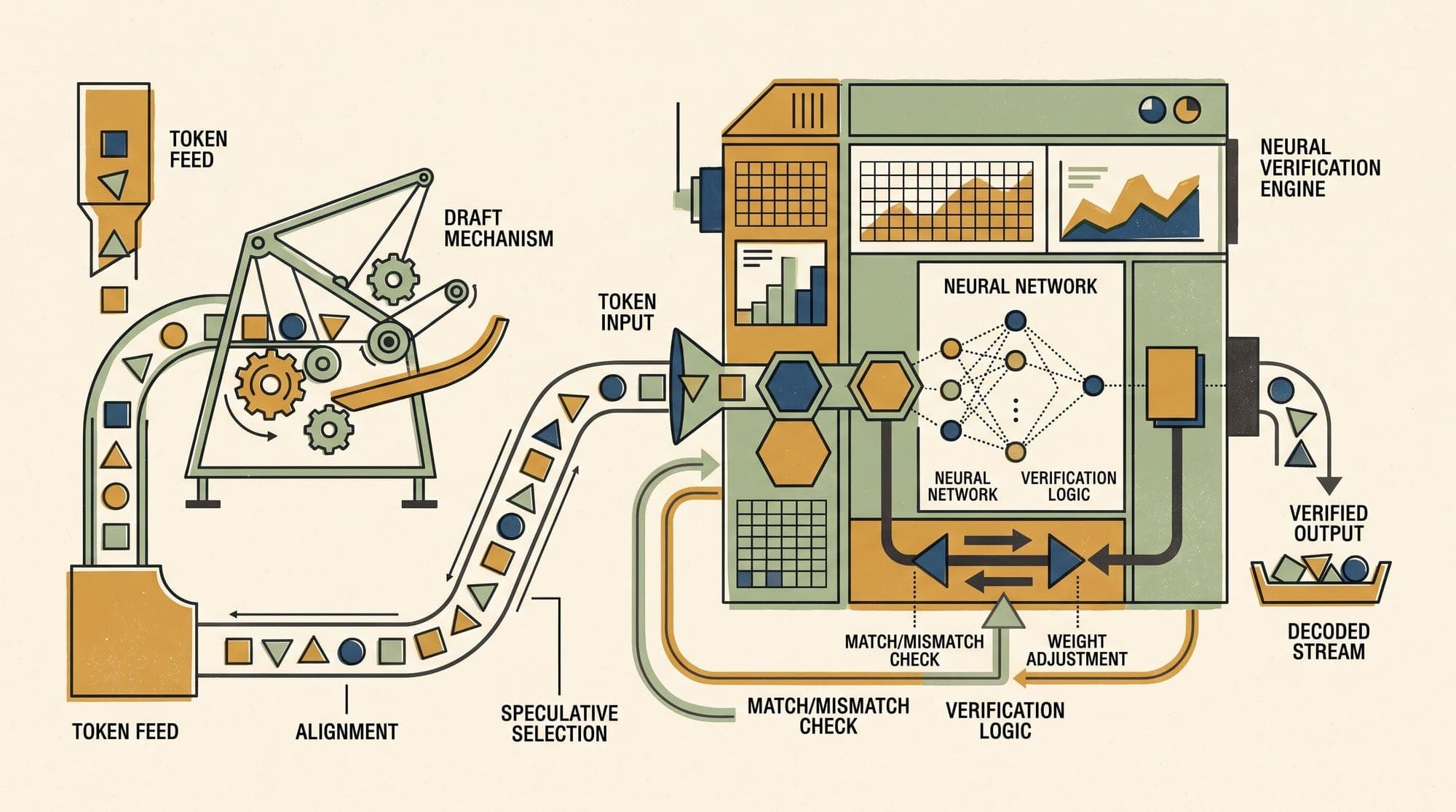
Liquid AI has released speculative decoding draft checkpoints for three models across its LFM2.5 series: LFM2.5-1.2B-Instruct, LFM2.5-2.6B, and the mixture-of-experts model LFM2.5-8B-A1B. The release introduces small companion models designed to accelerate auto-regressive generation without altering final token distributions.
The draft models are available in Safetensors and GGUF formats on Hugging Face, with immediate support implemented for SGLang and llama.cpp.

Architecture and Draft Design
Standard autoregressive decoding is bounded by GPU memory bandwidth rather than arithmetic throughput, as model weights must be loaded from memory for every generated token. Speculative decoding mitigates this bottleneck by using a compact draft model to propose blocks of candidate tokens, which the larger target model subsequently verifies in a single batched forward pass.
Liquid AI adopted the DSpark speculative decoding recipe, which utilizes:
- A five-layer attention-only decoder stack.
- A block size of nine draft tokens per generation step.
- A hidden-state projection layer and a Markov head operating across a 128,000-token vocabulary.
- A total draft model footprint of approximately 295.7 million parameters for the 1.2B variant and 327.7 million parameters for the 2.6B and 8B-A1B variants.
The checkpoints were trained for 15 epochs on a dataset containing supervised fine-tuning, conversational text, programming code, and tool-calling trajectories. Checkpoints were selected based on maximum empirical token acceptance rate rather than standard validation loss. Because greedy decoding strictly validates proposed tokens against the target model's output probabilities, generated sequences maintain mathematical equivalence to baseline runs.
Serving Benchmarks Across Hardware
Liquid AI evaluated the draft models across five standard evaluation datasets (MATH500, HumanEval, MBPP, GSM8K, and MT-Bench) on two hardware setups: an Nvidia H100 80GB running SGLang with BF16 precision, and an Apple M4 Max running llama.cpp with experimental Metal kernels in FP16 GGUF format.
For LFM2.5-2.6B:
- Nvidia H100: Mean generation speed increased by 2.67x, moving from 323 tokens per second to 864 tokens per second.
- Apple M4 Max: Mean generation speed increased by 2.27x, rising from 61 tokens per second to 139 tokens per second.
- Tool Calling: Latency across multi-tool evaluation suites decreased by 57%.
For LFM2.5-8B-A1B:
- Nvidia H100: Mean throughput rose 2.54x (from 418 to 1,074 tokens per second), reaching a peak speedup of 3.18x on MATH500 (1,362 tokens per second).
- Apple M4 Max: Mean throughput improved by 1.18x (from 90 to 106 tokens per second). Liquid AI attributed the lower edge gain to existing mixture-of-experts kernel limitations in Metal and the memory traffic required when activating multiple experts across draft token blocks.
For LFM2.5-1.2B-Instruct:
- Nvidia H100: Throughput averaged 1,384 tokens per second (2.10x speedup).
- Apple M4 Max: Throughput averaged 350 tokens per second (2.54x speedup).
The checkpoints and integration configurations are published directly under the Liquid AI organization on Hugging Face.



