
An Advocate General at the EU Court of Justice has advised that AI chatbots which retrieve and reuse online press articles to answer user queries may, "in certain circumstances", infringe the rights of press publishers. Advocate General Maciej Szpunar gave the opinion in Case C-250/25, Like Company v Google, on 3 November 2026 in Luxembourg, according to the Court's press release No 155/26.
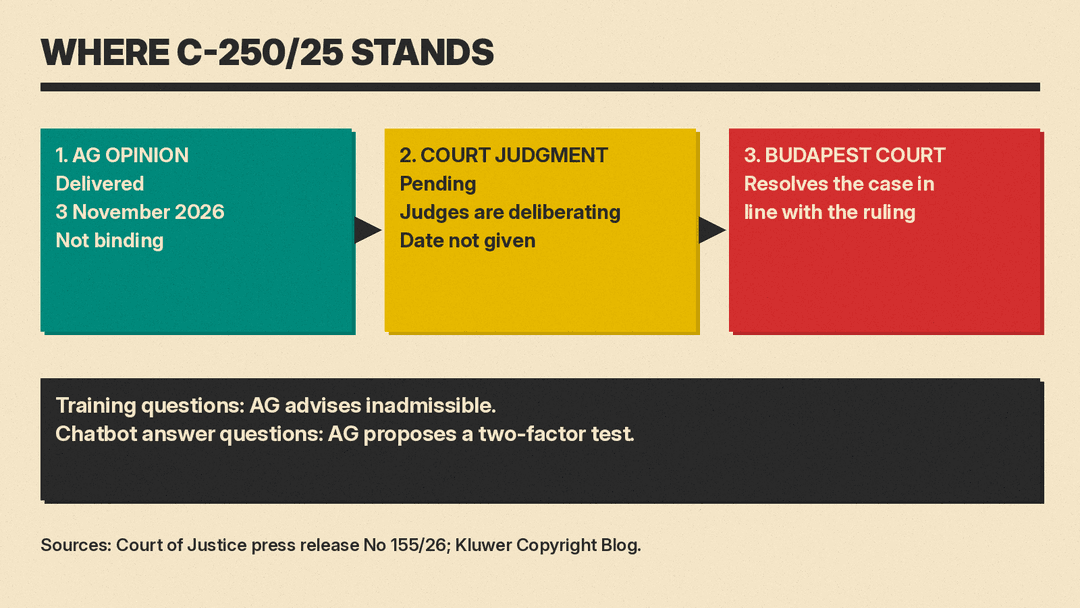
This is an opinion, not a ruling. The release says it "is not binding on the Court of Justice" and that the Judges of the Court "are now beginning their deliberations in this case." The Court has not yet decided. The release calls it "the first generative AI case to reach the Court of Justice."
The case
According to the release, the Alphabet Group, of which Google Ireland Ltd. is a member, provides Google Gemini, "a generative artificial intelligence chatbot". The release says its models use "Retrieval-Augmented Generation", which allows them to "collect information in real-time from the World Wide Web".
Like Company, a Hungarian operator of various web portals, brought proceedings against Google before the Budapest Regional Court. It claims protection for its articles under the press publishers' right over the "online use" of their "press publications". It argues that Google used the articles to train the Gemini LLMs and repeatedly reproduced them and made them available to the public through the chatbot between 13 June 2023 and 31 May 2024. These are Like Company's claims in the Hungarian proceedings. The opinion makes no finding that Google infringed anything.
The Hungarian court stayed the proceedings and sent four preliminary questions to the Court of Justice. Two concern LLM training. Two concern the chatbot's answers.
Training questions: inadmissible
The Advocate General advises the Court to declare the two training questions inadmissible. The release gives two reasons: there is no evidence that Like Company's articles were used to train the Gemini LLMs, and the training of an LLM is not a form of online use of press publications. It calls the questions "hypothetical".
The Kluwer Copyright Blog, in a post by João Pedro Quintais of the Institute for Information Law, quotes the opinion as saying "the case in the main proceedings has nothing to do with LLM training."
Still, "for the sake of completeness", the release says, he suggests that using protected works to train an LLM "is, as a rule, freely permitted under the text and data mining exception." According to Quintais's reading on the Kluwer blog, the opinion says this holds only where the exception's conditions are met, including lawful access and no applicable reservation of rights (the "opt-out"). That point is the Advocate General's suggestion, not a ruling. Kluwer notes that he urges the Court not to answer the training questions.
Chatbot answers: two factors
On the answers, the Advocate General stresses that the publisher's right "does not protect the mere facts reported in press publications, but only the specific form of expression of those publications." Its aim, the release says, is "not to give publishers a monopoly over the news itself."
According to the release, whether a chatbot's use falls under the reproduction right depends on two factors:
- Whether the chatbot accessed the publication unlawfully, in particular by circumventing effective technical measures, such as a paywall, designed to restrict access or web-scraping.
- Whether the answer merely reports facts from the original, or reuses its form of expression in a recognisable manner, so that the user is entirely dispensed from accessing the original publication.
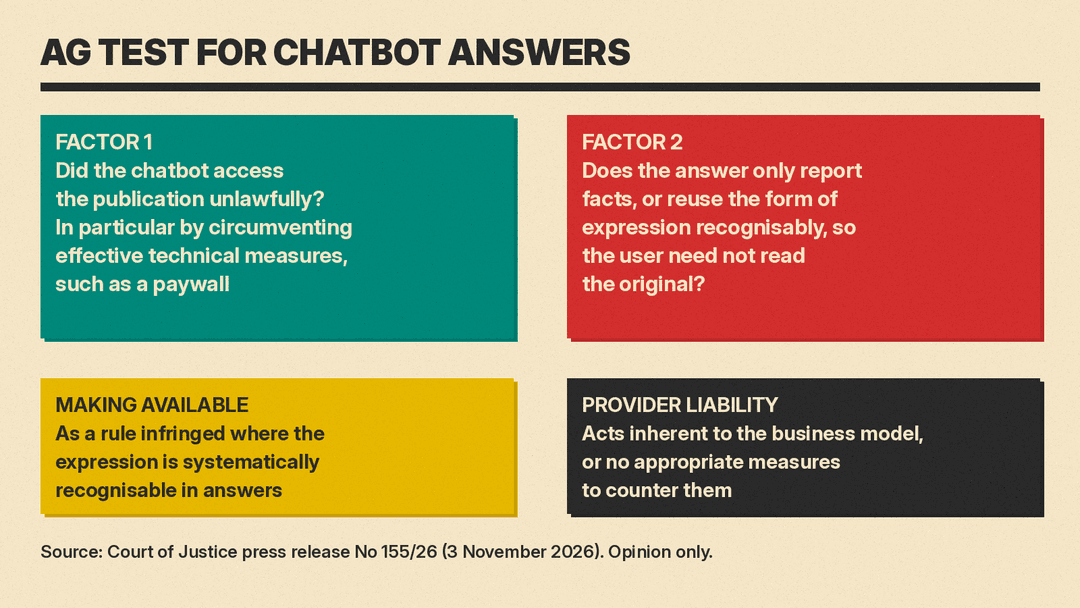
The right of making available to the public is, the release says, "as a rule, infringed" where the publication's form of expression is systematically recognisable in answers to related user queries.
In the Advocate General's view, the provider is liable for such potential acts of use where they are "inherent to the business model" of the provider or it "has failed to put in place appropriate measures in order to counter those acts credibly and effectively."
A provisional view on the Gemini example
The press release does not apply the test to the facts. Kluwer reports that, applying the framework provisionally to the example before the national court, the Advocate General suggests the conditions for liability do not appear to be met. Kluwer says the article's form of expression did not appear recognisable in the response, and Google appeared to have implemented measures to mitigate the risk. It adds that the final assessment remains for the referring court.
Quintais notes that he was on the drafting committee of the European Copyright Society's opinion on the reference.
What happens next
The release says judgment "will be given at a later date."
Kluwer says two more generative AI and copyright cases are pending before the Court after referrals by Hungarian courts: Manchester United Fanatics Klub (C-806/26) and Mobilguru (C-829/26). Quintais writes that the judgment will have significant implications for those referrals and for national cases such as those brought by GEMA against OpenAI and Suno in Germany.
CEA Digital Law published a note on 4 November 2026. It lists open questions: how recognisability will be measured, which measures will count as credible and effective, and how unlawful access will be proven.
Music publishers are also pressing copyright claims against AI companies in the United States: Round Hill Music has sued Suno and Anthropic, as covered in our post on the Round Hill copyright suits against Anthropic and Suno.
This case turns on EU copyright law, in particular the press publishers' right in the Copyright in the Digital Single Market Directive, not on the AI Act. For the AI Act, see our EU AI Act explainer.
Related: the NotebookLM voice suit against Google.
