
Mark Humphries, a historian who runs the Generative History newsletter, handed OpenAI's unreleased GPT-6.2 Astra a set of images from an anonymous sketchbook in Yale's Beinecke Library, gave it what he calls a throwaway prompt ("identify the artist who painted these images"), and left it running. Twenty-two minutes and one second later, the model returned a name: Louis-Guy-Charles-Guillaume de Rohan-Chabot, vicomte de Chabot (1780-1875), a minor French aristocrat serving as a British Army officer and Deputy Adjutant General in Canada in 1808.
It also told him how to falsify the claim. Chabot had kept a diary of the journey, the model said, microfilmed by the Library of Congress as part of the Lafayette papers and available from Cleveland State University. Order it.
Humphries, who says he had never heard of Chabot, ordered it. The handwriting matched the sketchbook's distinctive captions, with their long-tailed d's and capitals that dip below the line. The itinerary matched the three dated drawings place for place and day for day. Then he found the line historians rarely get: on June 18, 1808, after Chabot's canoe reached Fort St. Joseph, he wrote "I took a sketch," then described the exact view of the fort depicted in the matching drawing.
How the model got there
The sketchbook (Beinecke WA MSS S-4271) has resisted attribution for the decades it has been known to scholars. Yale bought it from an antiquarian bookseller in 2020. It holds 84 pages, 34 of them drawings of an 1808 journey from Montreal to Fort William and back, and hundreds of canoes made the same route every year. The artist could have been any of several thousand people.
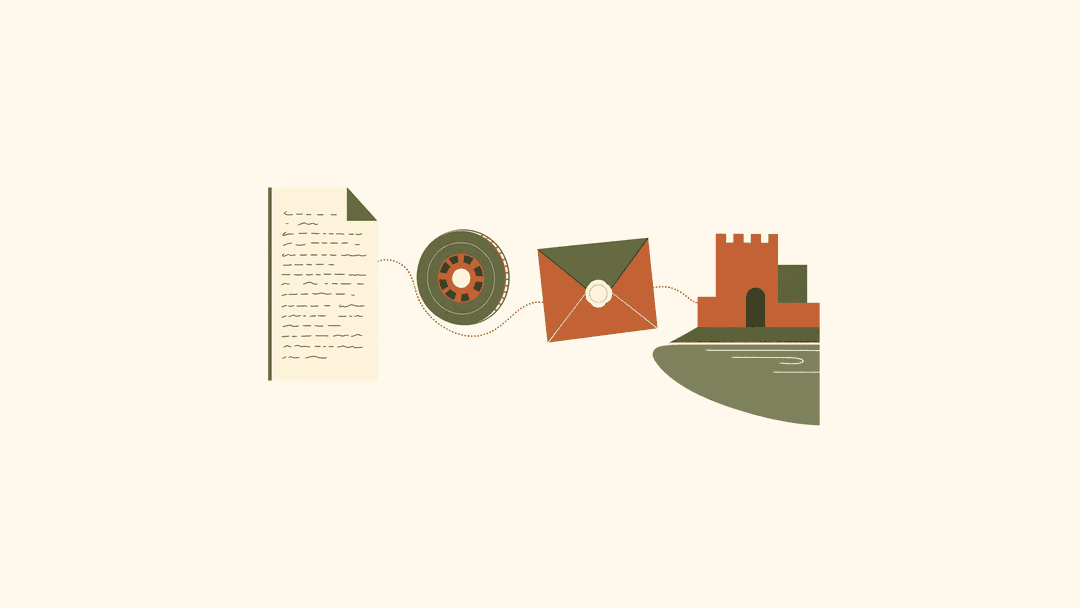
Humphries's review of the reasoning traces suggests Astra worked like a historian with impossible recall. It read his published article on an unrelated authorship question, eliminated the two candidates Humphries had floated by placing them elsewhere on the days certain drawings were made, then read primary documents from the archives a specialist would consult. The pivotal find was the diary of Joseph Frobisher, a retired fur trader who logged his Montreal dinner guests: on June 6, 1808, "the vicomte de Chabot left Lachine for Kaministiquia with William McGillivray and William McKay." A letter by John Askin Jr., published in a document collection nearly a century ago, placed Chabot at Fort St. Joseph later that month. The lead on the diary itself traces to a passing footnote in a 2014 PhD thesis by Juliette Reboul at the University of Leeds.
Humphries notes the hindsight trap: no fur-trade historian would have thought to check a Montreal social diary for an unknown artist, and even then Chabot's name sits among dozens of traders heading west that spring.

The comparison that makes it more interesting
Fable 5.2, given the same prompt, reached the same attribution in about 35 minutes along a nearly identical research path. It did not find Chabot's journal. That, Humphries writes, suggests this class of autonomous research capability is starting to exist across frontier models, with headroom between them.
The diary turned out to be a find in its own right: 162 notebook pages covering the journey, plus attached excerpts from long-destroyed North West Company papers that touch on fur trade business structure, Indigenous ethnography, and the origins of Canada's Masson Collection. The Lower Canada half of the journal sits in a private family archive in France.
Reasonable caveats
This is one researcher's self-reported case, run on a pre-release model he tested starting in late October, and the standard objections apply. Attribution is a narrow, verifiable task; it is not interpretation, as historian Timothy Burke argued in the comments. Provenance research is one precondition of history, not the discipline. The model itself hedged even after proof arrived, describing the diary as "an anonymous diary attributed to Chabot." Humphries blames the math-optimized post-training regime that makes Astra cautious about non-deterministic claims, and mentions a habit of riddle-like phrasing that turns out to be technically correct.
The moment is legible mainly as sequencing. Math has been the showcase for autonomous AI research since the Erdos problems started falling: the Navier-Stokes millennium prize problem in September, Anthropic's Riemann Hypothesis claim in November, a quiet VP versus VNP solution posted this month. The sketchbook result says the same agentic pattern (hypothesis, archival search, falsification plan) is now transferring to fields where the evidence is handwritten, unindexed, and scattered across a dozen archives. If the pattern holds, the first beneficiaries will be the humanities' census work: attribution, provenance, identification of anonymous manuscripts. That is a large, quiet library nobody has benchmarked.
Sources
- Mark Humphries, "GPT 6.2 Astra Solves a Historical Mystery," Generative History, Nov 24, 2026: https://generativehistory.substack.com/p/gpt-62-astra-solves-a-historical
- Mark Humphries on X, Nov 24, 2026: https://x.com/HistoryGPT/status/2125213218045858149
- Ethan Mollick on X, Nov 24, 2026: https://x.com/emollick/status/2125245031842042301
- Techmeme, Nov 24, 2026: https://www.techmeme.com/261124/p49
- Beinecke Library catalog, WA MSS S-4271: https://collections.library.yale.edu/catalog/32369099
- Juliette Reboul, "French Emigration in Great-Britain in Response to the French Revolution," PhD diss., University of Leeds, 2014: https://etheses.whiterose.ac.uk/id/eprint/8254/
