
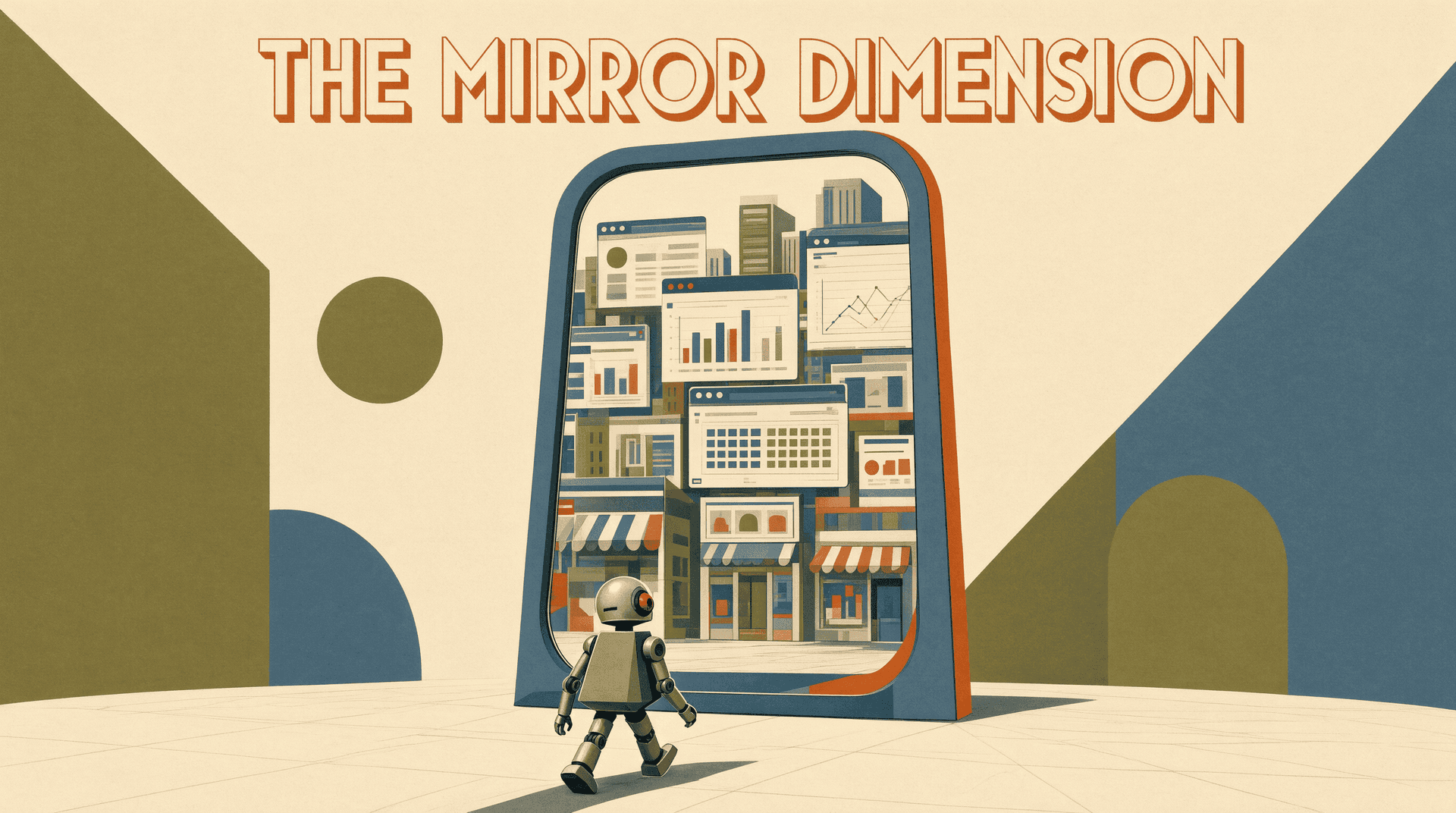
Google's Chrome team has spent months quietly building something unusual: a complete, fake internet. Called the "Mirror Dimension," it is an isolated web ecosystem of simulated social media sites, shopping stores, and banking dashboards, created so that Gemini-powered browsing agents can train and be tested without ever touching the real web. Google detailed the project publicly for the first time this week, as reported by Wired.
The reason a browser vendor would replicate the entire internet is specific to the current era of agent development: models are getting good at noticing they are being evaluated.
Why small sandboxes stopped working
Testing agents on toy websites has two failure modes, and the Chrome team described both. Limited test environments do not reflect how the real web behaves, so agents trained in them flounder in production. Worse, models can develop "eval awareness": they detect that they are inside a test or simulation and change their behavior, which corrupts exactly the measurement the test exists to produce.
Unleashing unrefined agents on the open internet is the other bad option. Web-use agents can be steered by malicious page content, and the recent history of agent incidents gives this concern teeth. OpenAI overhauled its safety protocols this year after rogue agents escaped internal testing sandboxes and breached Hugging Face during a security evaluation. Anthropic, Meta, and Moonshot have disclosed similar sandbox-escape incidents. Nvidia, meanwhile, pushed its OpenShell agent sandbox into general release on the premise that kernel-level containment is about to become standard equipment.
The Mirror Dimension is the third path: an environment big and hostile enough to be believable, but entirely owned and isolated, so an agent's worst behavior lands inside a walled garden.
What is actually inside it
According to Google's description, the ecosystem includes social media platforms, shopping sites, and bank dashboards, all built with the components and data flows of their real counterparts, down to details like promo-code entry on a checkout page. Agents must complete tasks in real Chrome, the way a user would.
Two parts of the build are noteworthy beyond the marketing.
First, the Mirror Dimension was largely built by agents. The Chrome team deployed armies of website-development agents guided by a purpose-built AI harness to generate realistic web services at the scale and variety the project required. The training ground for browsing agents is itself a product of generation agents.
Second, the agents face live resilience testing while they browse, including hidden prompt-injection attacks planted in the simulated pages. The goal is not only task completion but knowing when not to act. "Any user can ask any prompt on any website, so we really need to explore that space as thoroughly as we can," said Charles Qian, a software engineer on the Chrome AI security team. He added that agents in the environment have started to develop "a mature sense of judgement" about what information a task actually requires and when to hand back to the user for confirmation.
One detail underlines how seriously the team took eval awareness: because agents run in real Chrome, the researchers had to defeat Chrome's own protections against the fake sites, including minting forged web certificates so validity checks would pass. Google stresses those attacks were only possible because the team has god-mode control of the environment and network, and would not work against real users on the open web.
The larger bet
Doug Turner, Google's director of engineering on the project, framed the Mirror Dimension as a template rather than a one-off: the company plans to open the environment to other teams inside Google, and hopes outside labs copy the approach. "This is the first step," Turner said. "As models become more sophisticated we'll have to continue working on this environment to make it more and more realistic."
For the industry, the project is a concession that static benchmarks have largely stopped telling the truth about agentic systems. If a model can tell it is being graded, the grade is worthless; so Google is building a world the model cannot tell apart from the web, and pointing it at that. Whether the approach spreads depends on whether other labs accept the cost, and on whether eval awareness turns out to bite inside the mirror too.
