

The automation platforms that spent the 2010s selling "zap this to that" spent 2026 selling AI orchestration, and the rebrand came with a repricing. Zapier's pricing page now leads with "AI orchestration plans that scale with you". n8n crossed a reported $100M in annual recurring revenue in April 2026 and took a strategic investment from SAP in May at a $5.2B valuation, with SAP embedding n8n's canvas into its Joule Studio agent builder. Make rewrote its billing vocabulary outright: "as of August 27, credits are the billing unit in Make", replacing the "operations" that its entire third-party pricing literature was written around.
The category did not converge on a shared definition of what a billable thing is. Six of the most prominent platforms now meter the same underlying activity, an AI agent taking actions across your apps, in six different units. A buyer comparing sticker prices is comparing quantities that do not measure the same thing.
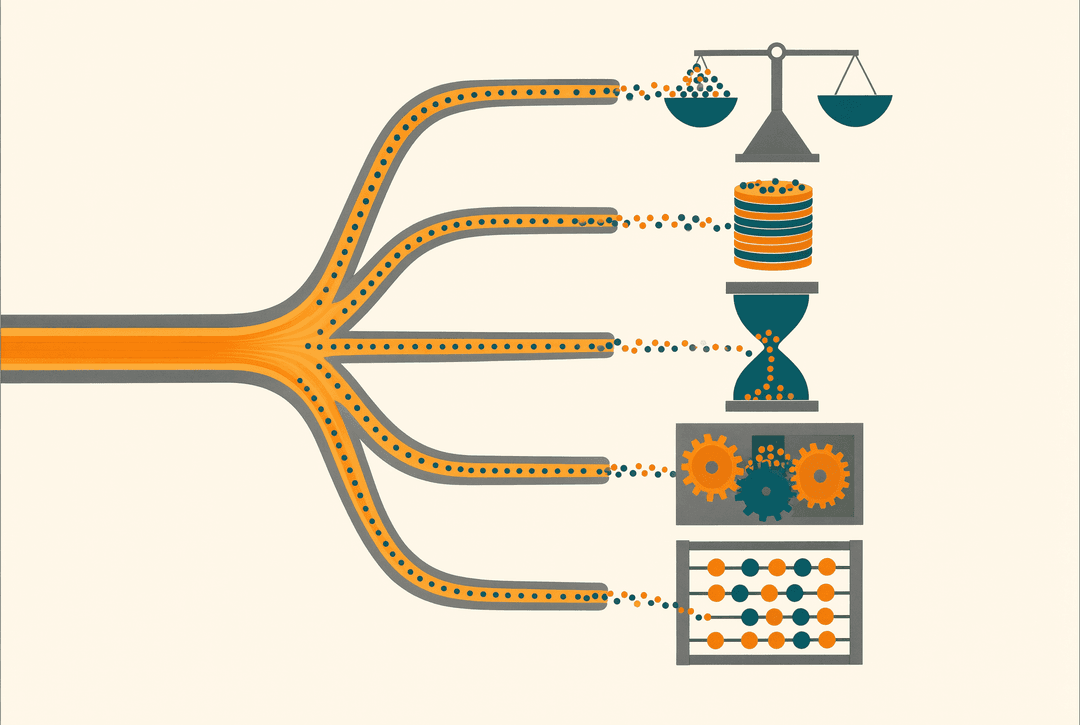
The units on offer
Zapier: tasks, with AI multipliers. Zapier keeps its per-step task as the single currency. In June the company moved AI by Zapier steps from a flat rate to model-tier pricing: a Standard-model step costs 1 task, an Advanced step 3, a Premium step 5, and each supported tool call is charged again at the same multiplier. Zapier's own worked example: a single Premium AI step that makes two tool calls consumes 15 tasks. Premium, the most expensive tier, is the default for new AI steps. Bring-your-own-key runs at 1x plus the provider's own invoice. Everything draws from one shared pool: Zap workflows, AI steps, code, MCP and the new SDK all consume the same task allocation. Entry Professional starts at $19.99 a month billed annually for 750 tasks, Team starts at $69.
The agent product sits outside that pool with its own meter. Zapier Agents bills "activities," which are not tasks and do not deplete them: 400 activities a month on Free, 1,500 on Pro at $50 a month ($400 billed annually), checked against Zapier's published plans in August 2026. One agent run can consume several activities. Chatbots have a third plan ladder of their own, from $160 a year for Pro.
n8n: executions, flat per run. n8n charges per workflow execution, no matter how many steps the run contains. Cloud Starter is 20 euros a month billed annually for 2,500 executions, Pro is 50 euros for 10,000, and Business (self-hosted only) runs 667 euros for 40,000. The self-hosted Community Edition is free and unmetered, which is why pricing comparisons for n8n always end with a server bill plus ops time instead of a subscription. AI arrives as two side-meters on top of executions: assistant credits that pay for n8n's own AI workflow builder (1,600 a month on Starter, per the pricing page), and gateway credits that let workflows call OpenAI or Anthropic models through n8n without an API key, billed per request.
Make: credits, mostly per module, sometimes per token. Make's official FAQ says most module actions consume 1 credit, while "some advanced features leveraging Make's AI Provider may use more." The arithmetic that surprises people is the iterator: every item an array emits gets processed by each downstream module, so a 50-row array through 3 modules costs 150 credits per run, as third-party teardowns of the tariff spell out. Routers and error handlers are free. A polling trigger that finds nothing still costs 1 credit. AI modules are priced by tokens, not runs, and Make split input and output token rates in August 2026 to cut costs on chat-style agents that re-send conversation history. Plan prices at the 10,000-credit selection run roughly $12 a month for Core, $21 for Pro, $38 for Teams, cheaper on annual terms. Make itself warns a single scenario run can consume from two credits to thousands.
Lindy: per-seat credit pools with banded task costs. Lindy sells AI agents directly and prices work in credits, roughly a cent each. Seats start at $29.99 a month for 3,000 credits, pooled across the workspace, reset monthly without rollover, with top-ups at $10 per 1,000 credits. The catch is the task bands Lindy publishes: everyday asks run 2 to 250 credits, deep work 250 to 1,000, big builds 1,000 to 2,500. A 125x spread inside the "everyday" band means the plan table cannot predict your bill; the only reliable number comes from a week of measured consumption.
Relevance AI: two meters, one of them at cost. Relevance splits the bill into Actions (platform work) and Vendor Credits (model compute). Pro is $29 a month ($19 annual) for 2,500 Actions plus $20 of Vendor Credits, Team $349 ($234 annual) for 7,000 Actions, and overage Actions cost $80 per 1,000. The unusual part is the Vendor Credit policy: model costs pass through at wholesale with no markup, and credits do not expire while you are subscribed. Bring-your-own-key is available on paid plans, which moves model spend off Relevance's invoice entirely and onto the provider's.
What the unit choice actually decides
The meter shape prices workloads differently, and the ranking flips depending on which shape you have.
Take a 10-module workflow that runs 5,000 times a month. On n8n that is 5,000 executions, comfortably inside the 10,000-execution Pro tier. On any per-step meter it is 50,000 units: Make would bill it module by module, and Zapier would bill it task by task before AI multipliers apply. Multiply by the number of steps and the two platforms' invoices diverge by 10x on identical work. The same comparison appears independently in n8n pricing teardowns.
Per-run pricing inverts the risk. n8n's execution is flat regardless of complexity, so a 3-step and a 30-step workflow cost the same, and the meter gives you no incentive to prune steps. Per-step pricing punishes iteration, polling and fan-out specifically: Make's iterator math, Zapier's per-tool-call multipliers and its 15-task Premium step all bill structural complexity, not just volume. Banded credit systems like Lindy's bill the platform's judgment call about how hard a task was, a number the buyer cannot verify until after the fact.
Three second-order effects decide real cost:
- Defaults are the bill. Zapier's new AI steps default to the 5x Premium tier. Whoever set the default priced your workflow for you.
- BYOK moves money, it does not remove it. Every bring-your-own-key option (Zapier, Make, Relevance, or n8n instead of its gateway) splits one bill into two invoices, and the model provider's is usually the larger one on token-priced work.
- Idle meters still tick. A Make poller that finds nothing costs 1 credit per check; at a 1-minute schedule that is tens of thousands of credits a month for a workflow that did nothing. Zapier does not count triggers against tasks and n8n counts only runs, so empty polling bills differently by platform, an unadvertised but real difference between per-run and per-operation meters.

The shakeout started at the two-meter end
The category's newest billing shapes are also proving its least durable businesses. Relay.app, which charged separately for steps and for AI credits, shut down free accounts on August 15, 2026 and paid accounts on September 14. Both Make and Zapier published dedicated migration capture pages, and Make's pitch to Relay refugees targets the split meter directly: on Make, "every action counts as one credit, whether it uses AI or not," so "you never get blocked because you ran out of the wrong kind of allowance."
That is the irony of the late-2026 shelf: the incumbents' answer to agent pricing is one pooled meter with multipliers (Zapier) or flat per-run billing (n8n), while the agent-native challengers sell variable credit bands (Lindy) or dual meters with at-cost pass-through (Relevance). Each vendor frames its own unit as the honest one, and the shutdown of a platform whose only sin was having two units shows the marketing has consequences.
A buyer's checklist before signing
- Count steps per run, then multiply by realistic monthly volume, including retries and iterator fan-out. On per-step meters, that number is the bill.
- Ask what a model call costs in your unit, at the tier that is the default, not the cheapest.
- Measure one week of real agent runs before trusting any credit band table. Lindy's own published bands allow a 125x spread within a single task class.
- Price the empty poll. Scheduled triggers that find nothing still bill on operation-based meters.
- Decide where the model bill should live. One pooled invoice is simpler; BYOK is usually cheaper on tokens and always more complicated.
- Check rollover. Lindy monthly credits expire; Make extra credits expire with the term; Relevance Vendor Credits persist while subscribed. Unused allowance is only an asset on some of them.
No unit is universally cheapest. But now you can pick the unit that matches your workload instead of the one that matches the ad.
Sources
- Zapier plans and shared task pool: https://zapier.com/pricing
- AI by Zapier model-tier pricing and worked examples: https://help.zapier.com/hc/en-us/articles/46425475442829-AI-by-Zapier-model-tier-pricing ; June 15, 2026 effective date: https://omidsaffari.com/blog/zapier-pricing-2026
- Zapier Agents activity pricing (verified August 2026): https://www.5minsystems.com/guides/5minsystems-zapier-agents-pricing-for-small-business-2026
- n8n plans, executions and assistant credits: https://n8n.io/pricing
- n8n self-hosted economics and gateway credits: https://www.cloudzero.com/blog/n8n-pricing and https://amplence.com/blog/n8n-pricing
- Make credits as billing unit, per-module rules, scenario ranges: https://www.make.com/en/pricing
- Make AI provider token-rate change (August 2026): https://help.make.com/2026
- Make iterator/polling credit mechanics and plan prices: https://www.activepieces.com/blog/makecom-pricing-2026-plans-credits-and-real-costs and https://www.automationwarrior.ai/blog/make-com-pricing
- Lindy credit bands, seat pricing, rollover: https://superkind.ai/blog/lindy-ai-pricing , https://www.notis.ai/blog/lindy-ai-pricing and https://www.jetadmin.io/blog/lindy-pricing
- Relevance AI dual meters and Vendor Credit policy: https://leadhaste.com/blog/relevance-ai-pricing and https://workagent.ai/relevance-ai-pricing
- Relay.app shutdown and migration capture: https://zapier.com/blog/relay-alternatives and https://www.make.com/how-to-guides/relay-app-alternative
- n8n ARR, valuation, SAP investment: https://sacra.com/c/n8n
- Per-run vs per-step comparison: https://www.autolearningagents.com/n8n-ai/pricing.php
