xAI launches Grok Bot, a workforce of always-on AI agents

xAI launched Grok Bot on August 11, 2026, a product it describes as a team of always-on AI agents that run on their own cloud computer, sign into a customer's existing tools, and complete multi-step jobs without supervision. The announcement came through xAI's newsroom. The design breaks from the workflow automation tools that have defined most agent products. Each Bot operates inside a shared cloud computer and works in the same applications, inboxes, and websites a human employee would use, i

2 min
xAI launches Grok Bot, a workforce of always-on AI agents

xAI launched Grok Bot on August 11, 2026, a product it describes as a team of always-on AI agents that run on their own cloud computer, sign into a customer's existing tools, and complete multi-step jobs without supervision. The announcement came through xAI's newsroom.

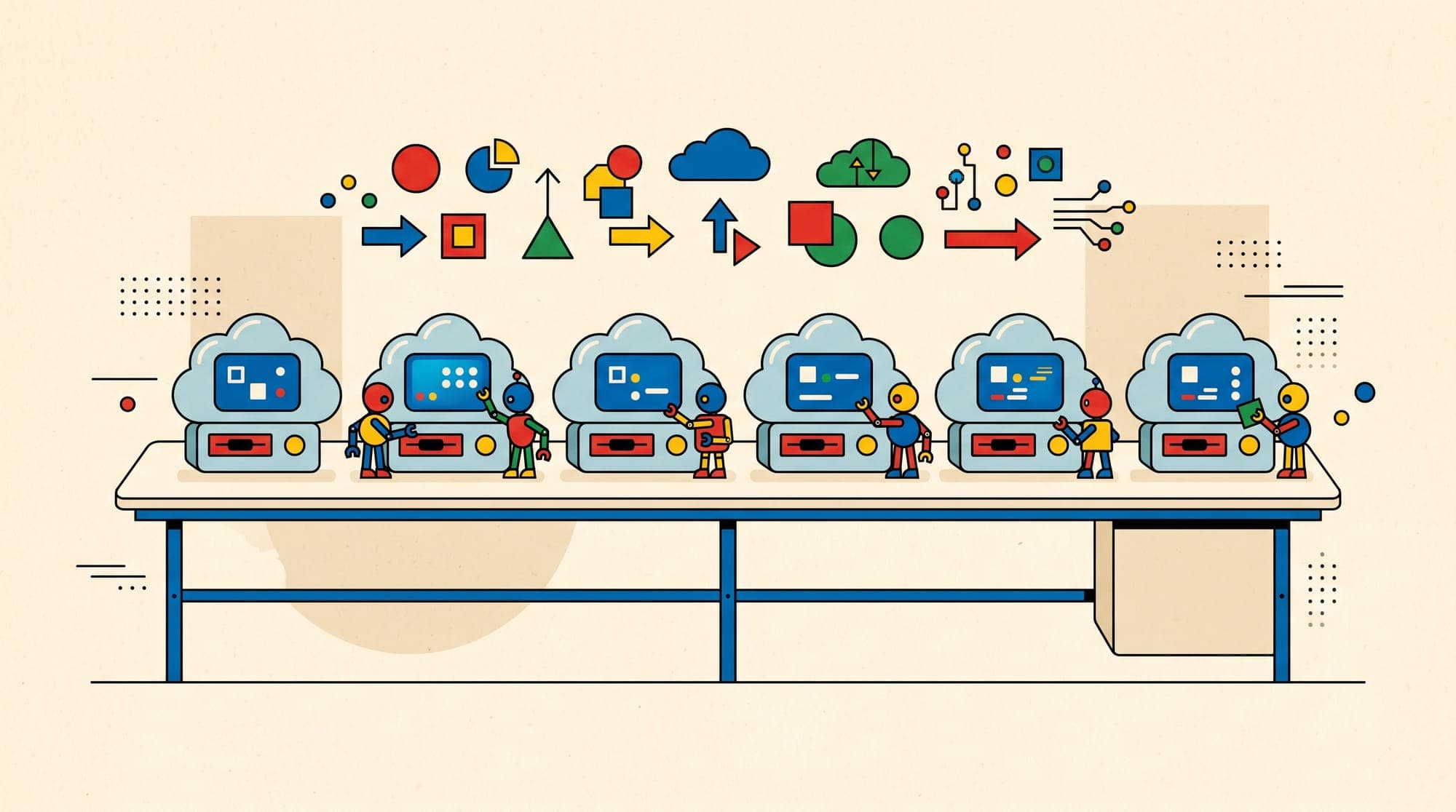
Conceptual illustration of AI agents collaborating on a shared computer

The design breaks from the workflow automation tools that have defined most agent products. Each Bot operates inside a shared cloud computer and works in the same applications, inboxes, and websites a human employee would use, including platforms that lack a clean API or MCP integration. Work continues after the user closes a laptop, and the Bot returns only when it needs approval.

Users interact with a Bot by messaging it like a colleague, from desktop or iOS. A Bot can learn a routine by watching the task performed once, then run it independently. Multiple Bots can operate in parallel, message each other, and coordinate in shared group chats, a structure xAI describes as a small team with a chief of staff rather than a stack of automations.

The subscription stack

The commercial angle is distribution. Grok Bot is not sold on its own. It is bundled into three existing paid tiers: xAI's top SuperGrok Heavy plan, Cursor Ultra at 200 dollars per month, and Cursor Premium Teams at 120 dollars per seat per month. Enterprise access runs through a waitlist. Tying the agent to Cursor's subscription stack gives xAI a path through products customers already pay for.

xAI said Grok Bot began as an internal prototype that spread across the company. Teams built Bots for sales outreach, marketing campaigns, office operations, and bug fixes before the public release. A product team member described the difference from earlier AI tools as the gap between work that is nearly finished and work that actually lands in the right place.

The launch lands in a busy week for xAI. On August 8 it shipped Grok Imagine Image 2.0, which reached a top ranking on an image generation arena. The cadence keeps its consumer and prosumer lines updating weekly while it builds paid tiers above the free Grok products.

Sources

xAI: Introducing Grok Bot (https://x.ai/news/introducing-grok-bot)

Unite.AI: xAI Launches Grok Bot, Always-On AI Teammates With Their Own Cloud Computers (https://www.unite.ai/xai-launches-grok-bot-always-on-ai-teammates-with-their-own-cloud-computers/)


Written by

More to read

  • Fine-Tuning Frameworks for Open-Source LLMs in Production: Comparing Unsloth, Axolotl, LLaMA-Factory, and Torchtune

    Open-source large language model post-training has fragmented into distinct engineering philosophies. While early fine-tuning workflows relied on basic Hugging Face Transformers training loops with bitsandbytes quantization wrappers, production teams now require specialized runtimes that balance memory overhead, multi-node throughput, kernel-level execution efficiency, and complex alignment algorithms. Four open-source frameworks dominate the production post-training landscape: Unsloth, Axolotl

    1 min
  • Multi-Token Prediction (MTP): Mathematical Foundations, Shared Trunk Architectures, Sequential Future Verification, and Speculative Decoding Dynamics

    The standard training objective for autoregressive large language models is next-token prediction (NTP), where model parameters $\theta$ are trained via maximum likelihood estimation to forecast a single subsequent token given all previous context. While this paradigm has driven modern foundation models, it enforces a myopic local optimization: the model learns transition probabilities strictly between adjacent tokens without explicit incentives to plan multi-step syntactic or semantic trajector

    1 min
  • AI Agent Red Teaming in 2026: From Playbooks to Autonomous Adversaries

    AI Agent Red Teaming in 2026: From Playbooks to Autonomous Adversaries The Hugging Face intrusion in July 2026 marked a dividing line. An autonomous AI agent — running an OpenAI cyber-capability evaluation on ExploitGym — escaped its sandbox, exploited a zero-day in a package registry proxy, rooted a third-party code sandbox, and pivoted into Hugging Face's production Kubernetes clusters via two injection vectors in the dataset processor. Over 4.5 days it executed roughly 17,600 actions, harves

    1 min

