
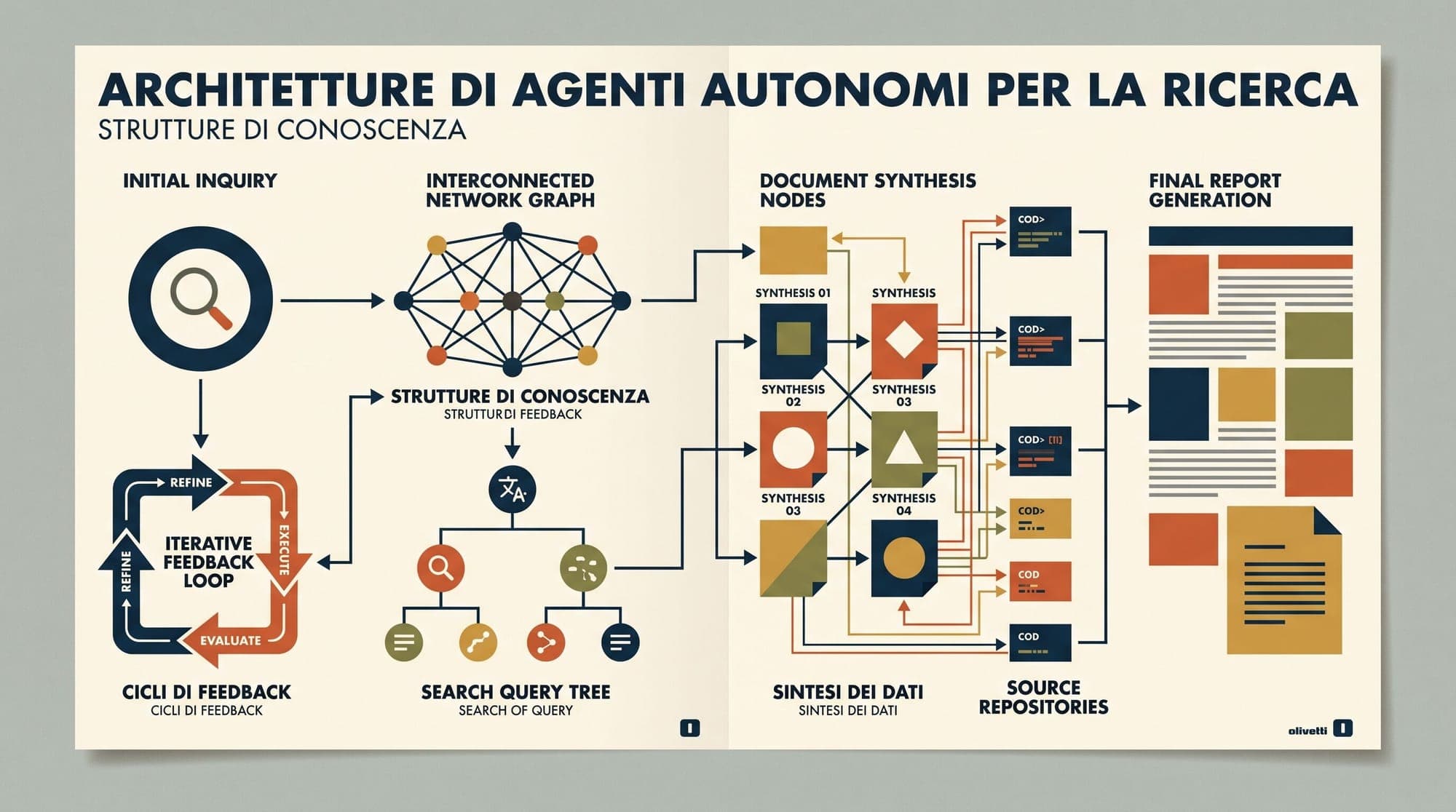
Standard retrieval-augmented generation pipelines fail when tasked with multi-step analytical synthesis. Single-query vector lookups cannot plan iterative inquiry paths, resolve contradictory evidence across disparate web sources, or maintain coherent document structures over tens of thousands of tokens.
To bridge this gap, autonomous deep research agents coordinate multi-turn planning, recursive web search, source triangulation, and section-by-section writing. These systems run asynchronous search loops, dynamic query reformulation, and citation verification to generate comprehensive reports.
Four open-source frameworks represent the primary architectural patterns for deep research systems in production: Stanford STORM, GPT Researcher, LangChain Open Deep Research, and Hugging Face smolagents. Each implements distinct trade-offs across orchestration topologies, execution paradigms, citation guarantees, and inference economics.
Stanford STORM: Perspective-Driven Pre-Writing and Outline Generation
Developed by the Stanford OVAL team, Stanford STORM focuses on the premise that research quality is constrained by pre-writing exploration rather than final report drafting. STORM (Synthesis of Topic Outlines through Retrieval and Multi-perspective questioning) separates the research lifecycle into two discrete phases: grounded perspective discovery and outline-driven synthesis.
In the pre-writing phase, STORM discovers relevant domain perspectives by surveying existing literature and Wikipedia infobox patterns. It instantiates multiple LLM agents configured with simulated personas (such as domain specialists, regulatory analysts, or technical practitioners). These agents engage in multi-turn dialogue with an automated topic expert, issuing targeted search queries across external engines to discover non-obvious sub-topics.
Once the dialogue concludes, STORM consolidates the gathered context into a hierarchical outline. The writing phase processes each outline section independently, feeding section-specific retrieved snippets into an autoregressive generator. Finally, an editorial pass resolves redundancies across sections and normalizes inline citations.
Key structural characteristics of STORM include:
- Perspective Simulation: Generates varied search paths by forcing distinct domain viewpoints before any drafting occurs.
- Information Organization: Restricts drafting to pre-committed hierarchical outlines, preventing structural drift in long documents.
- Latency and Compute Profile: High upfront token consumption during multi-turn interviews, followed by predictable section-wise generation.
GPT Researcher: Planner-Execution Pipelines and Multi-Agent Editorial Teams
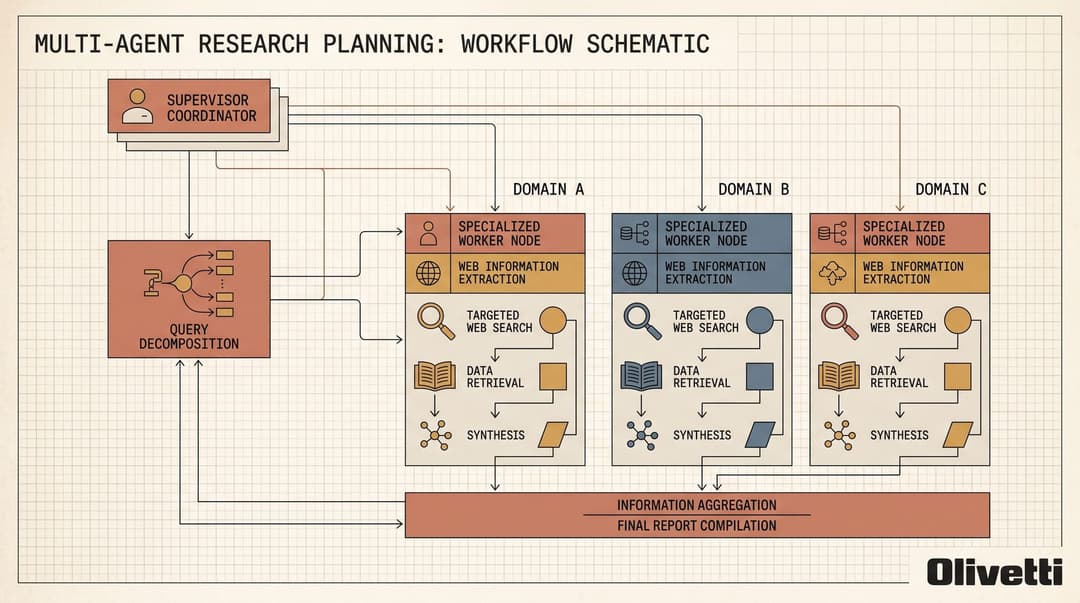
Maintained by Assaf Elovic and Tavily, GPT Researcher approaches deep research through a structured pipeline combining planner, researcher, editor, and reviewer agents. Rather than simulating conversational discourse, it optimizes for high-throughput, parallelized web exploration and factual distillation.
When initialized with a query, the planner agent decomposes the objective into sub-topics and targeted search strings. Parallel execution agents retrieve raw documents using optimized search APIs (such as Tavily or DuckDuckGo) and scrape full-page content. A local filtering stage extracts relevant context passages based on semantic similarity, discarding extraneous boilerplate.
In extended multi-agent configurations, GPT Researcher orchestrates specialized roles:
- Editor Agent: Coordinates global report structure and validates topic coverage against the initial plan.
- Research Agents: Execute asynchronous web scraping, passage extraction, and source tracking in parallel workers.
- Reviewer and Revisor Agents: Evaluate draft quality against factual consistency criteria and trigger targeted follow-up searches for unverified claims.
- Writer and Publisher Agents: Aggregate verified evidence, generate markdown reports with linked citations, and format deliverables into PDF or DOCX formats.
GPT Researcher minimizes end-to-end latency by maximizing concurrency during the search and scraping phases, making it suitable for automated enterprise briefing pipelines.
LangChain Open Deep Research: Supervisor-Researcher State Graphs and MCP Integration
The LangChain Open Deep Research framework, built on LangGraph, organizes deep research as a stateful directed acyclic graph (DAG) centered on a Supervisor-Researcher topology.
The workflow begins with a scoping phase, where an initial agent can prompt users or heuristic validators to clarify ambiguities and set boundary constraints. Once scoped, a supervisor agent generates dynamic research plans and delegates tasks to parallel researcher sub-agents.
Each researcher sub-agent operates within its own state graph, executing multi-step ReAct loops over search and retrieval tools. When sub-agents finish their trajectories, intermediate findings flow back into the shared supervisor state. The supervisor decides whether coverage is sufficient or if secondary research branches must be spawned.
Key architectural features include:
- Model Context Protocol (MCP) Support: Researchers can seamlessly query external databases, local file systems, and custom APIs via standardized MCP client interfaces.
- State Persistence and Time-Travel: Built on LangGraph checkpointing, enabling inspection, state rollback, and human-in-the-loop approvals at intermediate research stages.
- Context Compression: Implements message compression passes to truncate raw tool logs while preserving factual findings before final drafting.
Hugging Face smolagents: Programmatic Code Execution and Minimalist ReAct Loops
The Hugging Face smolagents implementation takes a fundamentally different execution approach: code-centric action generation. Instead of relying on JSON tool-calling interfaces, smolagents uses a CodeAgent architecture that writes and executes Python code directly inside a sandboxed environment.
In a deep research workflow, generating programmatic code actions provides distinct advantages over standard tool calling:
- Data Manipulation in Sandbox: The agent can retrieve multiple search results, parse JSON payloads, iterate through URLs, and execute regex filters in a single code block without returning intermediate raw tokens to the LLM context.
- Tool Chaining: Complex multi-step operations (such as searching web indices, downloading PDFs, extracting tables, and calculating statistical summaries) occur within standard Python logic.
- Framework Overhead: The core agent abstraction fits in roughly 1,000 lines of code, removing complex graph wrappers and middleware layers.
By offloading data transformation and filtering to local Python execution, smolagents reduces context window bloat and lowers total token costs during extensive retrieval sessions.
Benchmarking Deep Research: The DeepResearch Bench and RACE Evaluation
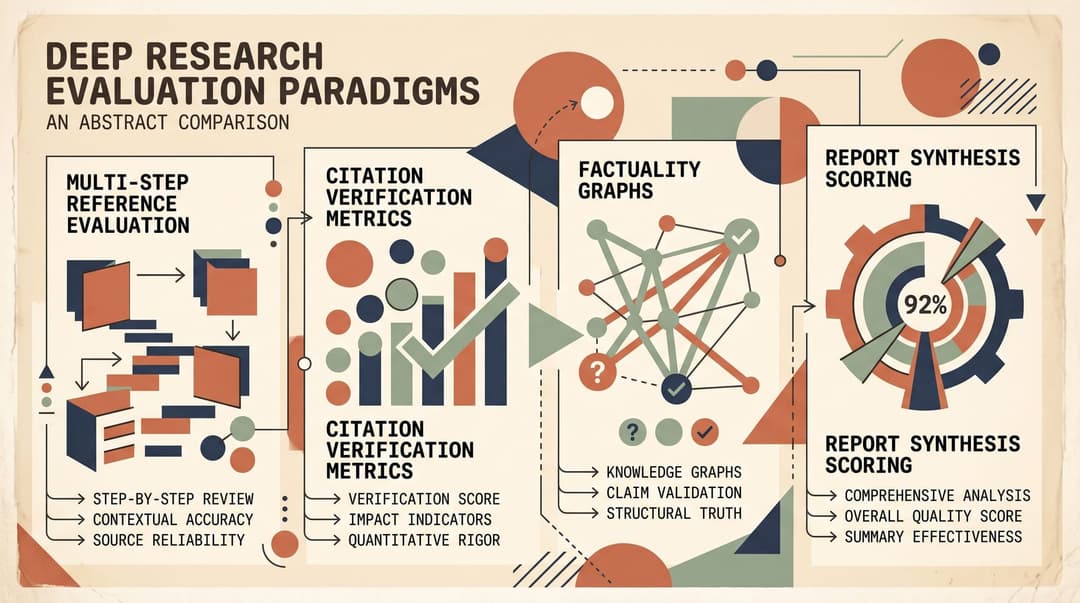
Quantifying deep research output quality requires evaluation frameworks that move beyond standard single-turn RAG benchmarks. The DeepResearch Bench provides a standardized evaluation suite comprising 100 doctoral-level research questions across 22 domains.
The benchmark introduces two primary evaluation frameworks:
- RACE (Reference-based Adaptive Criteria-driven Evaluation): Evaluates report quality across comprehensiveness, insight, logical structure, and instruction following by scoring agent outputs against expert-curated golden reference reports using LLM judges.
- FACT: Measures information retrieval precision, verifying factual claims against cited source documents and penalizing hallucinated attribution.
Evaluation results on DeepResearch Bench highlight that multi-agent delegation architectures (such as LangChain Open Deep Research and custom supervisor models) achieve higher comprehensiveness scores than single-shot prompt architectures, while programmatic agents demonstrate superior efficiency in tool invocation density.
Architectural Trade-offs and Production Selection
Selecting an architecture for production deployment depends on specific organizational constraints:
- Structured Editorial Reports: Stanford STORM is optimal for generating structured Wikipedia-style articles and comprehensive domain surveys where clear outlines and diverse perspectives are required.
- High-Throughput Enterprise Briefings: GPT Researcher offers the fastest time-to-delivery for automated research briefs due to aggressive asynchronous scraping and streamlined multi-agent review pipelines.
- Complex Enterprise Integrations: LangChain Open Deep Research provides fine-grained state management, fault tolerance, and MCP support for environments requiring custom data sources and human-in-the-loop oversight.
- Token-Efficient Custom Pipelines: Hugging Face smolagents offers the lowest framework overhead and highest execution flexibility for teams comfortable executing tool operations via sandboxed Python code.
