
For most of 2025, an AI agent that needed access to company data was authenticated the same way a cron job was: a service account, an API key, or someone's OAuth token quietly copied into an environment variable. Nobody had a system for answering basic questions: which agent is calling, on whose behalf, with what permissions, and who offboards it when the project dies.
That gap is now being closed, and quickly. In the past twelve months Microsoft, Okta, and Auth0 all shipped dedicated identity products for AI agents, the Model Context Protocol standardized its authorization layer on OAuth, and security researchers started counting how badly enterprises are failing to use any of it. Here is where the stack stands in late 2026.
The numbers say the house is not ready
A March 2026 survey of 285 IT and security professionals run by the Cloud Security Alliance and Strata Identity found that only 18% of security leaders report high confidence that their current IAM infrastructure can handle AI agent identities, while 84% doubt they could pass a compliance audit focused on agent behavior or access controls (CSA research note).
The mismatch is structural. Human identity systems assume a person who logs in, gets bored, and leaves. Agent identity systems have to assume thousands of ephemeral, programmatic actors that provision their own credentials on demand. Okta's own framing of non-human identities notes the difference: these identities are often created automatically, rarely retired, and frequently lack a defined owner (Okta, identity 101). An API key shared between a finance bot and a marketing bot is not an identity; it is a liability with no audit trail.
The protocol layer: MCP picked OAuth and inherited its gaps
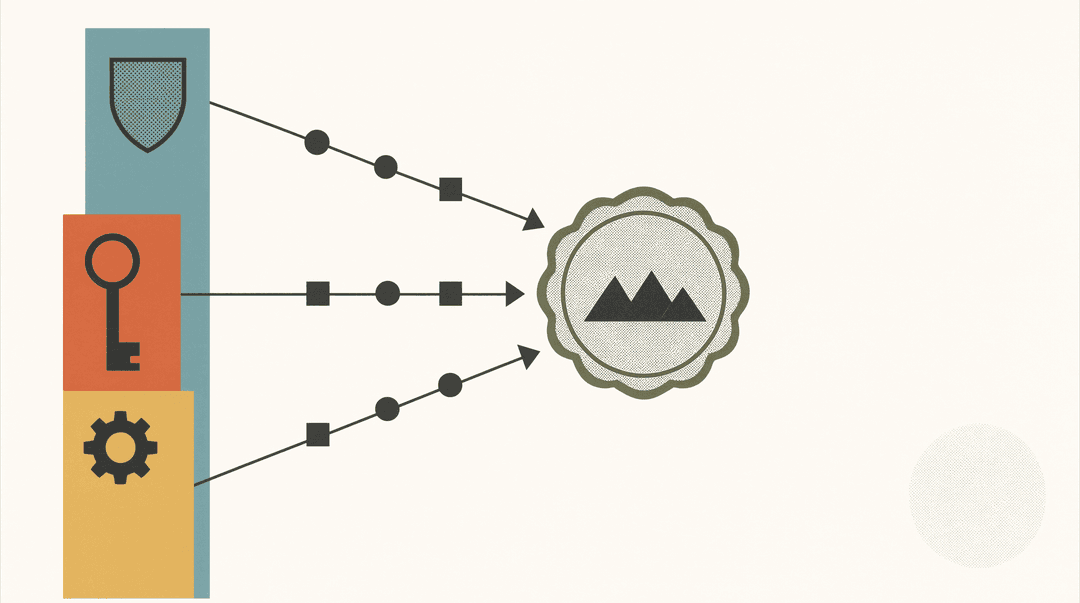
The Model Context Protocol became the de facto way agents connect to tools, and its authorization specification deliberately invented nothing: HTTP-based MCP servers act as OAuth 2.1 resource servers, clients must use Protected Resource Metadata (RFC 9728) for discovery, authorization servers must publish standard metadata (RFC 8414), and dynamic client registration (RFC 7591) is recommended so agents can connect to servers they never knew about in advance.
The spec is honest about its limits. It mandates that MCP servers validate the audience claim on every token and forbids passing a received token downstream unmodified, precisely because both failures produce confused-deputy attacks where a stolen or mis-targeted token quietly gets more reach than its owner consented to. And it does not solve the harder problem: OAuth proves which client and user a token was issued to, not which agent or runtime is currently holding it. Security vendors like Aembit argue that verifiable workload identity (SPIFFE-style attestation, in their framing) still has to sit underneath the protocol.
One practical consequence: dynamic client registration turned out to be operationally painful, and the ecosystem is already patching around it.
The vendors: three different answers to the same question
The three major identity platforms entered the agent market with visibly different products.
Microsoft Entra Agent ID launched in May 2025, went to public preview at Ignite 2025, and is now generally available. Its answer is a new identity construct: agent identities are first-class accounts in Entra ID, distinct from human users and from classic service principals, created from reusable "agent identity blueprints" that define a class of agents and its permissions. Disable a blueprint and every agent built from it stops. Agent identities hold no passwords or secrets; they authenticate with tokens issued to the runtime the agent runs on. At Ignite 2026 Microsoft added automated lifecycle policies (including an out-of-the-box rule that disables agent identities inactive for 60 days) and previewed discovery of roughly 60 local coding-agent types, including Claude Code, OpenAI Codex, and GitHub Copilot CLI, each getting an Agent ID when detected (Microsoft Entra blog, Ignite 2026). Agent registries are converging under a separate product, Microsoft Agent 365, while Entra remains the identity foundation.
Okta answered with a suite rather than a construct. Its Oktane 2026 materials pitch governing "every agent from a single control plane," with customers like Snowflake describing how they secure MCP workflows and non-human identities through Okta (Okta, Oktane 2026). The product pieces: an Okta MCP server that exposes scoped management APIs to agents with least-privilege enforced per tool call, Identity Security Posture Management that discovers AI agents and flags risky service accounts, API keys, and OAuth tokens, and Cross-App Access (XAA), a protocol meant to stop credential sprawl when agents move across apps (Okta press release). Okta's pitch is strongest where agent lifecycle matters: registration and approval before deployment, access reviews on the same cadence as human identities, automated deprovisioning at retirement.
Auth0, Okta's developer-facing sibling, took the MCP angle directly. Its Auth for MCP went from early access in November 2025 to generally available on May 6, 2026, giving MCP server owners authentication, on-behalf-of token exchange for downstream API calls, and Client ID Metadata Document (CIMD) registration, a replacement for dynamic client registration that sidesteps the DCR pain point the MCP ecosystem complained about. The product advertises working with Claude, Cursor, VS Code, and ChatGPT as agent clients (Auth0 GA announcement). Auth0's architectural writing is the most explicit about the conceptual shift: its AI Agents Are Not Users post argues that an agent's identity credential and its execution-context credential must be separate things, with short-lived, operation-scoped tokens minted through a central control plane (its Token Vault) so that revocation propagates immediately and every token is logged against both an agent and the user it acts for.
What the stack still does not solve
Read across the vendor materials and the standards documents and three holes are consistent.
First, authorization is not authentication. An OAuth token proves who is calling; it says nothing about whether this specific user may touch this specific record through an agent. The Authzed and Oso explainers both land on the same point: per-resource checks have to happen downstream of the transport layer, which is why relationship-based and fine-grained authorization engines are being marketed as the missing second half of the stack.
Second, governance features trail provisioning features. The industry landscape review by Iden notes that the big identity providers ship strong authentication but do not yet govern the full agent lifecycle, and that offboarding is the question most vendors cannot answer (Iden, 2026 landscape). Microsoft's 60-day inactivity disable is the first mainstream attempt; Okta's access reviews are borrowed from human governance and unproven at agent scale.
Third, nobody has settled the multi-tenancy of agent identity. Enterprise identity platforms are lock-in by design, and heterogeneous agent stacks need federation workarounds. The CSA note suggests SPIFFE/SPIRE-based service mesh foundations as the portable path for extending cryptographic workload identity to agents, but that is a builder's answer, not a buyer's.
The boring checklist
For teams running agents against real systems in late 2026, the practical advice does not need any of the above to be settled:
- Give each agent its own identity. Shared service accounts between bots destroy attribution, and attribution is what audits ask for.
- Scope tokens per operation, not per deployment. The MCP resource parameter exists for exactly this.
- Validate token audience at every hop and never pass a token through unchanged.
- Write an offboarding plan before the agent ships. Most agent credentials today have no retirement path.
- Check for shadow agents: local coding agents are identity-bearing workloads too, and Entra, Okta, and Auth0 all now offer discovery tooling for exactly that audit.
The identity industry spent twenty years building a passport system for humans. It is now, very visibly, building a second one for machines that write their own itineraries. The interesting question for 2027 is not whether that stack gets built, but whether agent authors actually attach their agents to it before an audit forces the issue.
Sources
- Cloud Security Alliance / Strata Identity research note on the agent IAM gap, March 2026: https://labs.cloudsecurityalliance.org/wp-content/uploads/2026/03/CSA_research_note_okta_ai_agent_iam_framework_enterprise_gap_20260318-csa-styled.pdf
- Model Context Protocol authorization specification: https://modelcontextprotocol.io/specification/2025-06-18/basic/authorization
- Microsoft Entra Agent ID, what's new: https://learn.microsoft.com/en-us/entra/agent-id/whats-new-agent-id
- Microsoft Entra blog, Ignite 2026 announcements: https://techcommunity.microsoft.com/blog/microsoft-entra-blog/ai-is-changing-access-see-how-microsoft-entra-helps-you-stay-ahead-/4556456
- Okta, Securing Human and Agentic Identity at Oktane 2026: https://www.okta.com/blog/customers-and-partners/securing-human-agentic-identity-oktane-2026
- Okta press release, agent identity innovations and Cross-App Access: https://www.okta.com/newsroom/press-releases/new-okta-innovations-secure-the-ai-driven-enterprise-and-combat-
- Okta, What Are Non-Human Identities: https://www.okta.com/identity-101/what-are-non-human-identities
- Auth0 Changelog (Auth for MCP GA, May 6, 2026): https://auth0.com/changelog
- Auth0, Auth for MCP Generally Available: https://auth0.com/blog/auth0-auth-for-mcp-servers-generally-available
- Auth0, AI Agents Are Not Users: https://auth0.com/blog/ai-agents-are-not-users
- Aembit, MCP Authorization: OAuth 2.1, PKCE, and Agent Identity: https://aembit.io/blog/mcp-oauth-2-1-pkce-and-the-future-of-ai-authorization
- Authzed, MCP and OAuth 2.1: https://authzed.com/learn/mcp-oauth-2-1-authentication
- Oso, Authorization for AI Agents and MCP: https://www.osohq.com/learn/authorization-for-ai-agents-mcp-oauth-21
- Iden, AI Agent Identity Management 2026: Standards and Gaps: https://www.idenhq.com/en/blog/ai-agent-identity-management-2026
