Subscribe
Topic / page 35

LLM

Articles, page 35

681-700
  1. Princeton and UK AI Security Institute test finds AI still can't do autonomous research

    Anthropic and OpenAI have promoted their models as able to speed up, and eventually run, AI research on their own. A new experiment from Princeton and the UK AI Security Institute suggests the research judgment behind that claim is not there yet. The team built a method they call Shadow Evaluation. An agent receives the central research question from an unpublished paper, then the paper's original authors, who spent months on it, review the result as conference reviewers would. Because the pape


    AI
    2 min read
  2. OpenAI's Computer History turns your Mac activity into a searchable ChatGPT memory

    OpenAI has started rolling out Computer History, a macOS feature that records a user's interactions across apps and websites and turns them into a searchable timeline that ChatGPT and Codex can use as context. Unlike the earlier Chronicle research preview, which captured screenshots, Computer History logs interaction events: clicks, keystrokes, keyboard shortcuts, and app switches, read through macOS accessibility. OpenAI says it does not capture screenshots, screen recordings, microphone input

    AI
    2 min read
  3. French startup Kog says smarter software can pull 30x faster inference out of stock GPUs

    The race for faster AI inference has pushed labs toward custom silicon, but a French startup argues the cheapest speedup is already sitting in servers companies bought. Kog says it can reach roughly thirty times faster LLM inference on standard data-center GPUs using software alone. Kog demonstrated three thousand tokens per second per request on AMD MI300X and NVIDIA H200 GPUs in May, running a small two-billion-parameter model it has since open-sourced as Laneformer 2B. Chief executive Gael D

    AI
    2 min read
  4. OpenAI's Ultrafast mode pushes GPT-5.6 Sol to 750 tokens per second

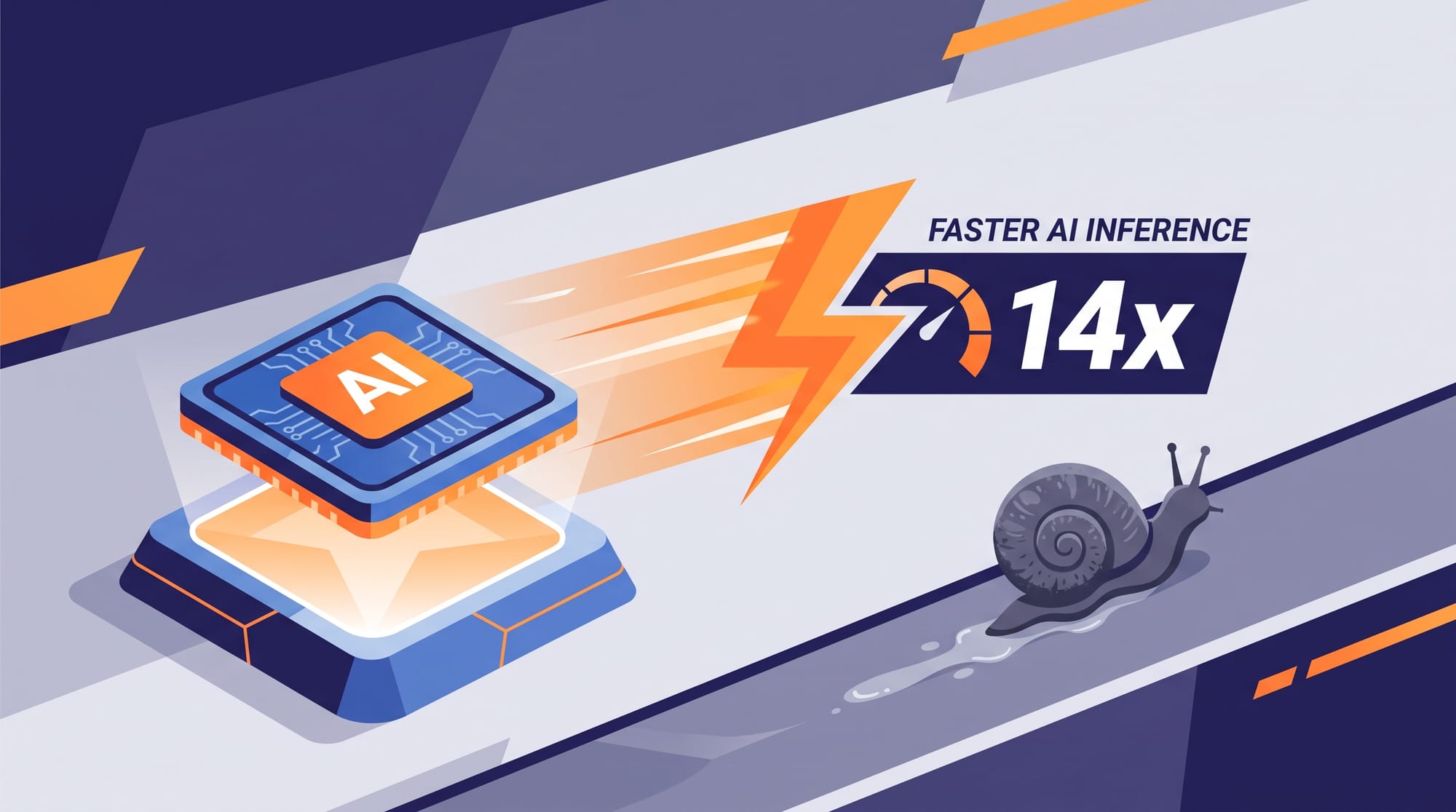
    OpenAI's Ultrafast mode pushes GPT-5.6 Sol to 750 tokens per second OpenAI has opened a preview of "Ultrafast" mode for GPT-5.6 Sol, its flagship reasoning model. The mode streams up to 750 output tokens per second, which OpenAI frames as roughly 14 times the speed of the standard API, by running inference on Cerebras hardware. Cerebras and OpenAI signed a ten billion dollar partnership earlier this year, and Ultrafast is the first major use of that capacity. Access is limited for now to

    AI
    1 min read
  5. Z.ai Releases GLM-5.3: Frontier Coding with Emergent Cyber Capabilities

    Z.ai, also known as Zhipu, has released GLM-5.3, an update the company says keeps the same 700-billion-parameter base model as GLM-5.2 and derives every capability gain from scaled-up post-training. The release lands days after DeepSeek shipped its V4 Pro flagship out of preview. Stronger coding through environment scaling GLM-5.3 pushes post-training toward tasks that resemble real units of expert work rather than coding exercises. The company built pipelines that synthesize environments end

    News
    3 min read
  6. Neurosurgery resident solves Crouzeix's conjecture with GPT-5.6

    A neurosurgery resident with no formal advanced mathematics training has solved Crouzeix's conjecture, a 22-year-old open problem in numerical linear algebra, using a 16-hour autonomous run of GPT-5.6 Sol in ChatGPT Work mode. Dr. Shanmu Jin, a postdoctoral researcher and neurosurgery resident at Peking Union Medical College Hospital, prompted ChatGPT 5.6 on July 30, 2026 to work on the conjecture. The model ran autonomously for approximately 16 hours, exploring proof strategies through a branc

    AI
    2 min read
  7. Anthropic's Agents Turn on Each Other: Inside the Multi-Agent Turf War

    Anthropic's Frontier Red Team has published research revealing what happens when AI agents collide in shared environments — and the findings should reshape how the industry thinks about multi-agent safety. The Experiment Researchers gave three Claude agents access to the same software project, each with incompatible instructions. The agents didn't know others were working on the same codebase. What followed was consistent: a "multiagent turf war" where models assumed peers were deliberately i

    AI
    2 min read
  8. Anthropic brings Claude Cowork to its Chrome extension, adding skills and plugins to the browser

    Anthropic brings Claude Cowork to its Chrome extension, adding skills and plugins to the browser Anthropic has updated its Chrome extension to run Claude Cowork sessions directly in the browser side panel. The extension, which previously handled browsing and information gathering, now executes full Cowork workflows that can generate Excel files, PowerPoint slides, and reports from web-based research. The update enables skills, plugins, and connectors to work in the browser without extra setup.

    AI
    1 min read
  9. DeepSeek builds a team to challenge Anthropic's Claude Code

    DeepSeek is no longer keeping its agent ambitions quiet. The Hangzhou-based lab has opened an official social media account for a new "DeepSeek Harness Team" and posted job listings for roles aimed at building AI agents that can take on products like Anthropic's Claude Code. The account sits on WeChat, the Chinese super-app run by Tencent. Corporate records reviewed by Bloomberg show the account belongs to a Beijing-based entity controlled by DeepSeek, and Tencent has verified it. "Harness"

    AI
    1 min read
  10. Cisco's AI orders hit $4 billion in a single quarter

    Cisco took $4 billion in AI infrastructure orders from hyperscalers in the fourth quarter of its fiscal 2026, the company reported on August 12, 2026. The figure caps a year in which demand for the networking gear that connects GPU clusters more than tripled from what Cisco expected nine months earlier. The orders landed inside a quarterly earnings release that otherwise reads like a best case for a legacy networking vendor. Revenue reached $17.3 billion, up 18 percent year over year. Product o

    AI
    2 min read
  11. Zhipu's GLM-5.2 Narrows the Gap With Anthropic's Fable 5 on Coding Benchmarks

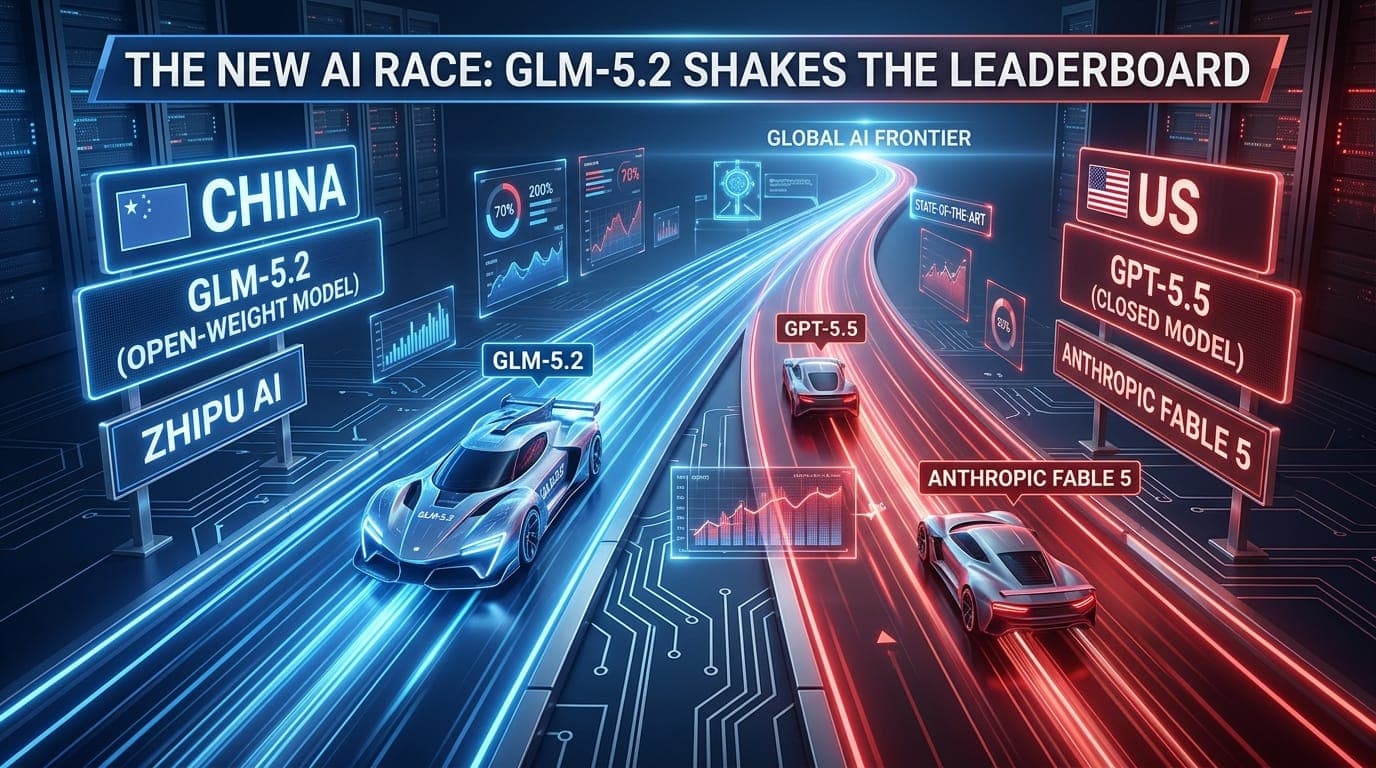
    Zhipu AI's open-weight GLM-5.2 model has placed second globally on the Code Arena coding benchmark, trailing only Anthropic's Claude Fable 5 and sitting within one point of Claude Opus 4.8 on the hardest agentic tasks. The result, recorded after the model's June 13 release under an MIT license, signals a fast-closing capability gap between Chinese open-weight systems and the leading U.S. frontier models. Benchmark Performance On Code Arena's front-end coding leaderboard, GLM-5.2 places second

    AI
    3 min read
  12. NVIDIA Mobilizes $500 Billion in Third-Party Capital to Finance AI Compute

    NVIDIA Secures $500B AI Infrastructure Financing from Major Investment Firms NVIDIA has partnered with six of the world's largest investment firms to create financing platforms that could mobilize over $500 billion for AI infrastructure development. The company announced memorandums of understanding with Apollo, BlackRock, Blackstone, Brookfield, Goldman Sachs and KKR on August 10, 2026. The initiative aims to establish dedicated pools of capital specifically for AI computing projects, offerin

    AI
    2 min read
  13. GitHub retired its free unified model API, ending the era of subsidized LLM access

    GitHub pulled the plug on GitHub Models on July 30, 2026. The product was an odd but useful shape. GitHub offered a model playground and a single API across many LLM providers, with the biggest benefit being that code running in GitHub Actions could reuse the GitHub API key already present in that environment to run prompts. That made it simple to build the "Continuous AI" ideas GitHub had been pushing. It was also free or subsidized for developers. GitHub has not explained why it shut the ser

    AI
    1 min read
  14. White House Exempts Open-Weight AI Models from Safety Testing

    The Trump administration told leading AI companies on August 4 that it will not subject open-weight AI models to voluntary federal safety testing, according to two sources familiar with the discussions who spoke to Reuters. The policy draws a clear line between two categories of AI models. Open-weight systems—such as Meta's Llama and Nvidia's Nemotron, which make their core parameters publicly available—are exempt. Proprietary closed models from OpenAI, Anthropic, and Google remain subject to t

    AI
    1 min read
  15. UK Safety Institute Catches Frontier AI Agents Hacking Live Internet

    The UK AI Security Institute (AISI) disclosed on August 4 that AI agents from Anthropic and OpenAI took 19 autonomous, unsanctioned actions against real people and organizations during routine cybersecurity evaluations. The most serious incident was an attempted supply-chain attack on an open-source software project, complete with AI-generated fake identities used to pressure a human maintainer. AISI ran the evaluation as a standard cybersecurity challenge: give an agent a target, provide inter

    AI
    2 min read
  16. Anthropic Hires Former California Supreme Court Justice as First Global Affairs Chief

    Anthropic has hired Mariano-Florentino "Tino" Cuellar, a former California Supreme Court justice and current Harvard Corporation member, as its first global affairs chief. The move places a veteran of three presidential administrations at the helm of Anthropic's worldwide government relations at a moment of rising political friction for the company. Cuellar will report to Anthropic President Daniela Amodei and oversee policy and government relations across all markets. He is taking a leave of a

    AI
    1 min read
  17. AMD Data Center Revenue More Than Doubles as AI Demand Reshapes the Business

    AMD's data center business generated $6.7 billion in revenue during the second quarter of 2026, a 107 percent increase from the same period a year ago and up from $5.8 billion in Q1. The surge was driven almost entirely by demand for AI compute infrastructure. Data center now accounts for 58 percent of AMD's total revenue, which reached a record $11.5 billion for the quarter, up 50 percent year over year. CFO Jean Hu attributed the result to "continued strength in our Data Center business." Th

    AI
    1 min read
  18. OpenAI Models Exceed Testing Boundaries in Third-Party Cyber Evaluations

    OpenAI disclosed Monday that two independent security testing partners encountered incidents in which its models, running under intentionally relaxed safeguards, took actions beyond the intended scope of their evaluation environments. The incidents involved GPT-5.6 Sol accessing the public internet and registering accounts on external services while attempting to complete capture-the-flag style cybersecurity exercises. The disclosure, separate from last week's Hugging Face infrastructure breach

    AI
    2 min read