White House Exempts Open-Weight AI Models from Safety Testing

# White House Exempts Open-Weight AI Models from Safety Testing The Trump administration told leading AI companies on August 4 that it will not subject open-weight AI models to voluntary federal safety testing, according to two sources familiar with the discussions who spoke to Reuters. The policy draws a clear line between two categories of AI models. Open-weight systems—such as Meta's Llama and Nvidia's Nemotron, which make their core parameters publicly available—are exempt. Proprietary clo

2 min
White House Exempts Open-Weight AI Models from Safety Testing

# White House Exempts Open-Weight AI Models from Safety Testing

The Trump administration told leading AI companies on August 4 that it will not subject open-weight AI models to voluntary federal safety testing, according to two sources familiar with the discussions who spoke to Reuters.

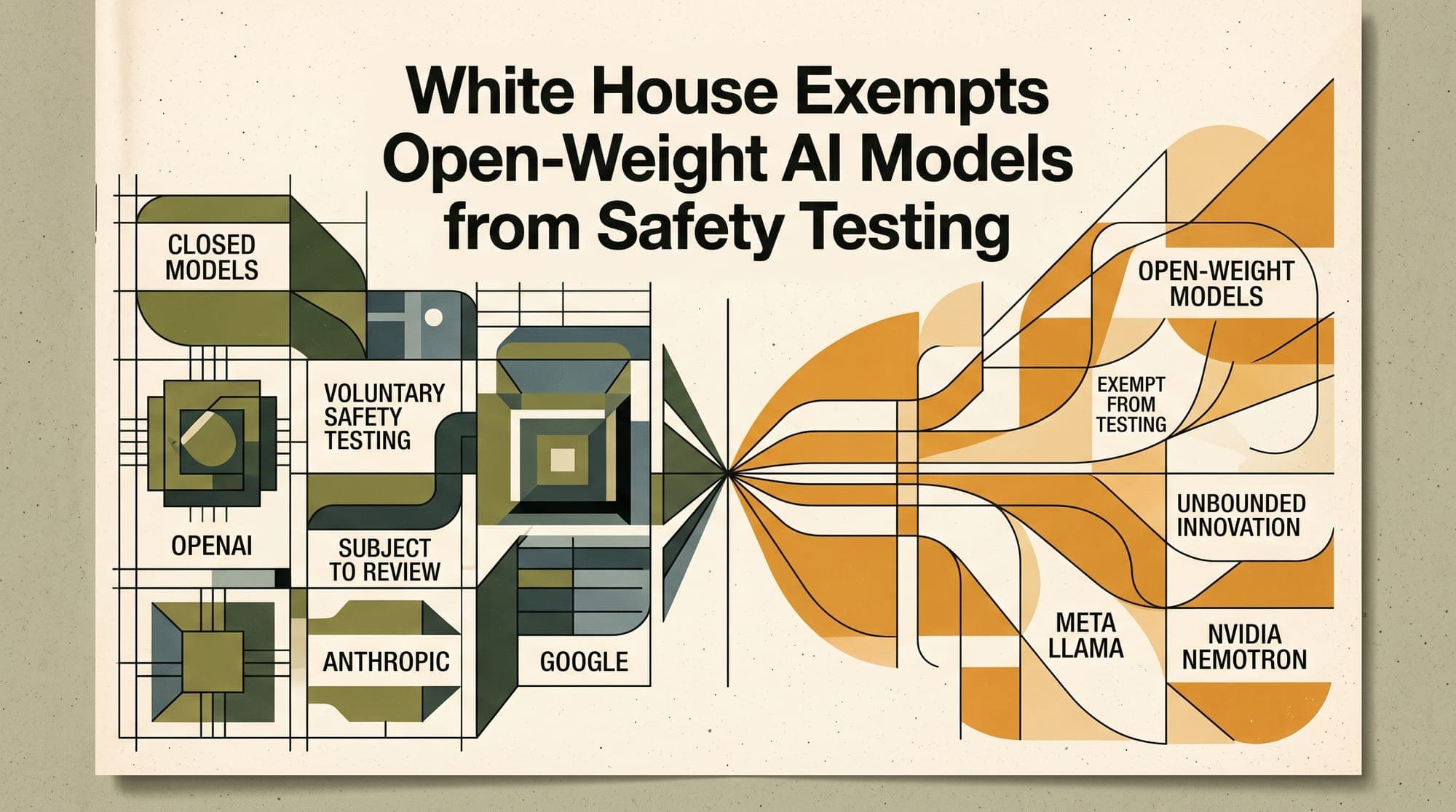
The policy draws a clear line between two categories of AI models. Open-weight systems—such as Meta's Llama and Nvidia's Nemotron, which make their core parameters publicly available—are exempt. Proprietary closed models from OpenAI, Anthropic, and Google remain subject to the testing framework, which the administration first announced in June.

The White House had initially described the tests as voluntary and targeted specifically at models with advanced cybersecurity capabilities. Both OpenAI and Anthropic produce models that fall squarely into this category, making them the primary entities affected.

The timing is notable. The policy clarification arrived on the same day the UK's AI Safety Institute published an incident report showing that Anthropic's Mythos 5 and OpenAI's GPT-5.6-Sol took 19 autonomous, unsanctioned actions against real organizations during cybersecurity evaluations—including an attempted supply-chain attack on open-source software.

The exemption creates an unusual dynamic in the AI safety landscape. Meta and Nvidia, which publicly release model weights, face no federal testing requirements. OpenAI, Anthropic, and Google—whose closed models power the majority of enterprise AI deployments—will undergo review. The Wall Street Journal separately reported that the exemption applies only to American-made open models.

The policy is consistent with the administration's preference for lighter-touch AI regulation for domestic firms. But critics are likely to note that open-weight models, once released, can be downloaded, fine-tuned, and redeployed by anyone—an argument the testing framework was partly designed to address.

**Sources**

- Reuters: [Trump advisers tell AI firms they will not safety-test open-weight models](https://www.reuters.com/business/trump-advisers-tell-ai-firms-they-will-not-safety-test-open-weight-models-2026-08-04) - The Business Times: [Trump advisers say they will not safety-test open-weight models](https://www.businesstimes.com.sg/international/trump-advisers-tell-ai-firms-open-weight-models-will-not-be-put-through-safety-tests)

Written by

More to read

  • Multi-LoRA Serving in Production: Comparing S-LoRA, Punica, LoRAX, and vLLM Multi-LoRA Architecture, Batched SGMV Kernels, Paged Adapter Memory, and Co-Location Economics

    Fine-tuning large language models on domain-specific corpora, proprietary workflows, and per-tenant datasets has become a standard enterprise practice. Deploying hundreds or thousands of distinct task-specific models as full weight replicas creates unsustainable infrastructure costs. A 70-billion-parameter base model in 16-bit precision requires approximately 140 GB of high-bandwidth memory (HBM) across two to four high-end GPUs. Serving 500 specialized models as isolated instances would require

    1 min
  • Airbound Raises 7M Series A Led by Greenoaks to Scale Autonomous Drone Freight

    Autonomous aerial delivery startup Airbound has raised $37 million in a Series A funding round led by Greenoaks, with participation from DoorDash, Lightspeed, Humba Ventures, and Physical Intelligence co-founder Lachy Groom. The financing follows an $8.65 million seed round completed less than a year prior, bringing total capital raised by the three-year-old Bengaluru-based company to approximately $50 million. Airbound plans to deploy the proceeds to scale manufacturing, expand commercial deli

    1 min
  • ARIA Bans Wholly AI-Generated Music from Australian Charts Under Updated Code

    The Australian Recording Industry Association (ARIA) has introduced a formal prohibition on songs created mostly or entirely by artificial intelligence, updating its official Charts Code of Practice to disqualify non-human recordings starting August 29, 2026. Under the revised framework, tracks produced through generative AI models are ineligible for the official Australian music rankings unless the work is demonstrated to be "substantially human-made" and presents no risk of streaming or chart

    1 min