
Z.ai, known as Zhipu AI inside China, released GLM-5.4 on November 23, billing it as its first flagship model built on a Loop Transformer: a 750-billion-parameter mixture-of-experts model that Z.ai says reaches intelligence levels comparable to systems with 2 trillion to 3 trillion parameters. The trick is not more weights. Part of the network runs twice.
Weight sharing, but adapted, not trained from scratch
In a standard Transformer, every layer executes once per forward pass. GLM-5.4 takes 28 layers of the GLM-5 base and runs them for two iterations, the second pass refining the hidden states of the first. That makes the effective network deeper without adding stored parameters.
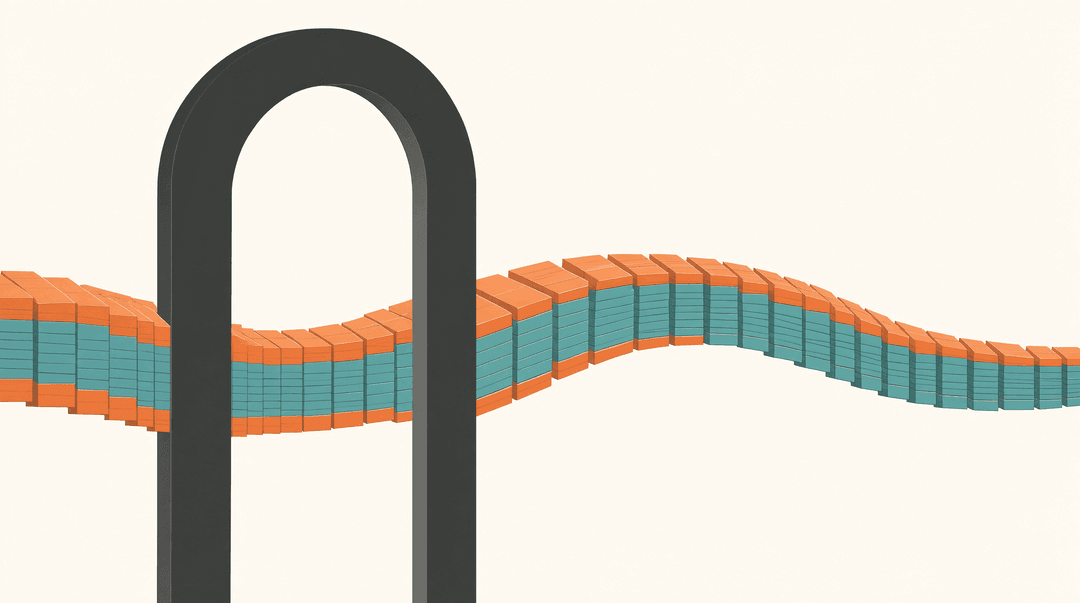
The idea is old. The 2018 Universal Transformer proposed weight-shared depth, and recent recurrent-depth work showed gains at small scale. Z.ai's own caveat is that looped models trained from scratch still lag unshared models under the same pre-training compute budget. So the company did not train a loop from zero. It converted an already pre-trained GLM-5 base through continued training, which it frames as raising the intelligence ceiling with relatively small compute overhead.
Three changes make the loop work at 750B scale, according to the technical blog:
- Gated progressive updates. Per-token gates control how much each pass writes back into the residual stream, preventing activation norms from blowing up across iterations. Z.ai says the gates develop a division of labor: the first pass writes conservatively to build global context, the second opens up to refine, and harder tokens get more aggressive first-pass writes.
- Hybrid KV cache. The second loop reuses the sparse KV entries selected in the first pass and keeps only a sliding-window cache of its own, so an extra loop costs one window rather than a full context cache. This is what keeps a 1-million-token context affordable.
- Sparse attention index reuse. The second pass reuses the first pass's attention indices, adding zero indexing overhead and performing nearly identically to recomputation.
Z.ai says it validated the architecture progressively at 1B, 4B, 30B and 750B before committing the flagship. The controlled iso-parameter test on a 30B model is the clearest published evidence: with identical parameters and about 10% more total training compute, the looped version gained 3.3 to 11.3 points on math, scientific reasoning and long-context benchmarks, while average output length dropped 10 to 14% because some reasoning moved from explicit tokens into the implicit depth of the loop.
What is actually available
GLM-5.4 accepts text, images, video and files, supports a 1-million-token context window and up to 128,000 output tokens, and runs at up to 200 tokens per second off-peak (70 to 80 at peak load). It is live in Z.ai Chat, ZCode and the GLM Coding Plan subscription, with entry tiers around $18 a month.
What is missing: a model card, published benchmark tables for the 750B flagship itself, API pricing, and open weights. Z.ai says API access is coming soon and weights will be released after safety hardening, with no date. The company also acknowledges a quirk of its own architecture: the model sometimes gets caught in excessively long "marathon thinking" loops, though it argues the resulting self-correction improves accuracy beyond its parameter count. Independent evaluations are, for now, absent.
One detail arrived three days later and changes how the release reads. Reuters reported that Z.ai's next flagship, the roughly 3-trillion-parameter GLM-5.5 planned for this month, has slipped toward early 2027 under US compute restrictions and anti-distillation pressure. GLM-5.4 is an architectural bet. It is also a bridge.
Sources
- Z.ai blog: GLM-5.4 - https://z.ai/blog/glm-5.4
- Technology.org - https://www.technology.org/2026-11-25/zhipu-glm-5-4-loop-transformer-vision-1m-context
- Trending Topics - https://www.trendingtopics.eu/glm-5-4-z-ai-loop-transformer-en
- Datacamp - https://www.datacamp.com/blog/glm-5-4
- Reuters (via Unite.AI) - https://www.unite.ai/moonshot-ai-begins-distilling-from-google-and-meta-models-amid-delays
