
For most of its history, artificial intelligence made one bet: that reasoning is the hard part, and seeing and moving are the easy part. The bet was backwards. In the 1950s, machines could already multiply ten-digit numbers, something almost no human can do unaided. It took until the 2010s for algorithms to match people at drawing boxes around every cat in a photograph. The name for this inversion is Moravec's paradox.
What the paradox says
Hans Moravec, a robotics researcher at Carnegie Mellon, stated it in his 1988 book Mind Children: "it is comparatively easy to make computers exhibit adult level performance on intelligence tests or playing checkers, and difficult or impossible to give them the skills of a one-year-old when it comes to perception and mobility."
Moravec was not alone in the observation. Marvin Minsky wrote in 1986 that "we're least aware of what our minds do best," and that we notice the processes that fail more readily than the ones that work flawlessly. Steven Pinker drew the practical lesson in 1994: "the main lesson of thirty-five years of AI research is that the hard problems are easy and the easy problems are hard."
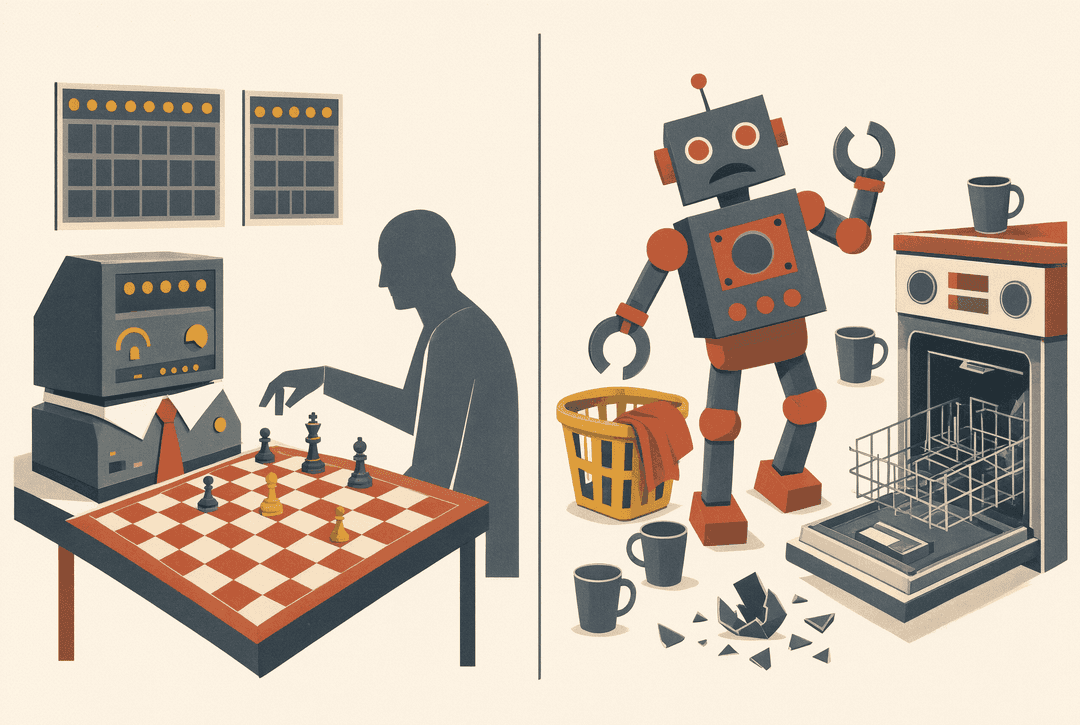
The pattern has a domestic version too. A chatbot proves a lemma and produces fluent text in seconds; ask a robot to walk into an unfamiliar kitchen and put a cup in a dishwasher, and researchers are still publishing about it.
Why: evolution got there first
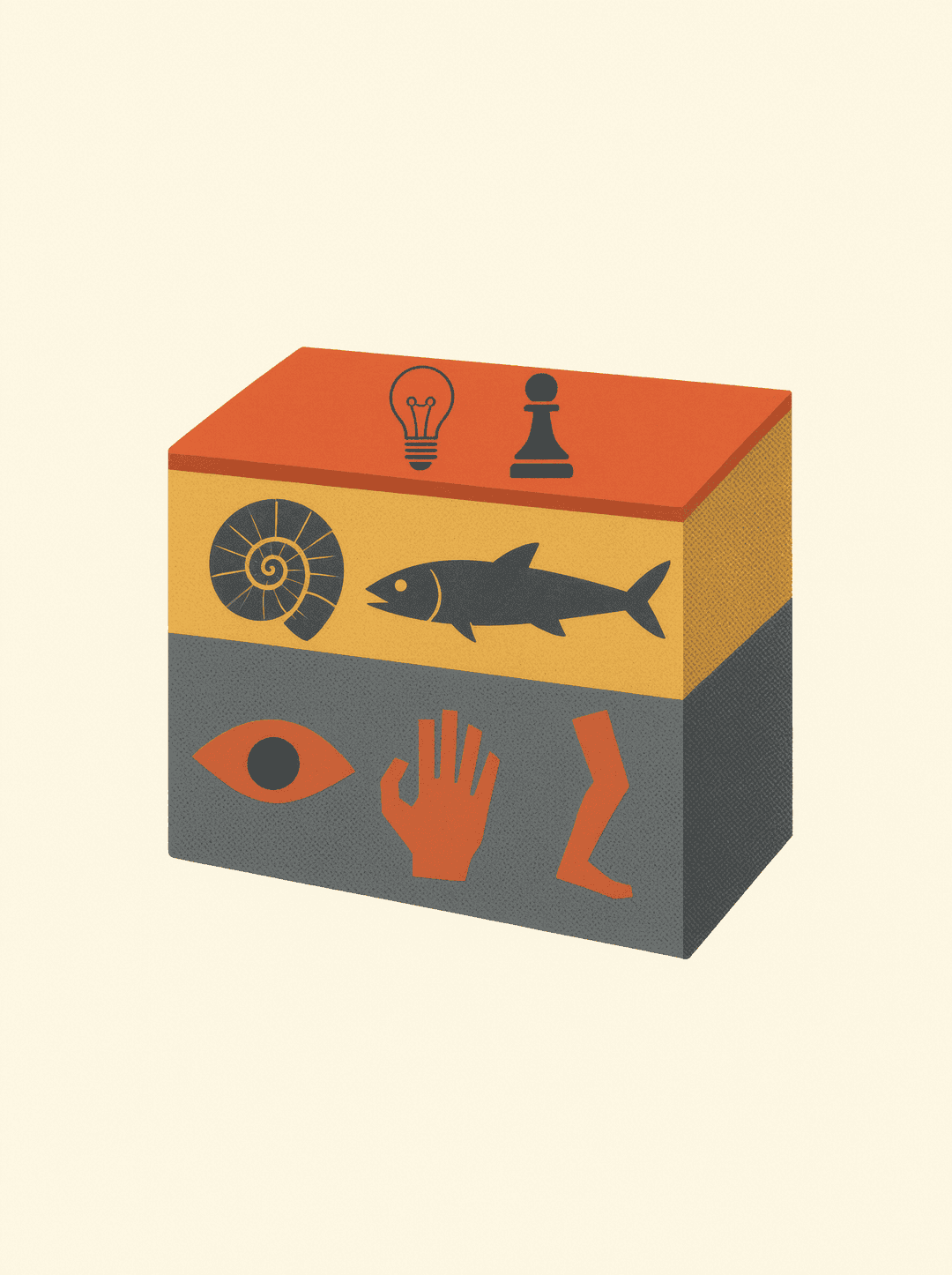
Moravec's own explanation was evolutionary. Perception and motor control are ancient. Vertbrates have been solving problems of sight, balance and grasping for hundreds of millions of years, and natural selection optimizes whatever it selects on for that long. Abstract reasoning, by contrast, is "a new trick, perhaps less than 100 thousand years old," as Moravec put it. His conclusion: "we are all prodigious olympians in perceptual and motor areas, so good that we make the difficult look easy."
The argument compresses into a syllogism. Reverse-engineering a human skill is roughly as hard as the time that skill spent evolving. The oldest skills are unconscious, so they feel effortless. Therefore the things that feel easiest to us are the hardest to build.
An Epoch AI analysis by Ege Erdil sharpens the mechanism with numbers. The human brain has on the order of 100 billion neurons and 100 trillion synapses; information at that scale would fill roughly 100 terabytes. The genome does not contain anything close to that: compressing human-to-human genomic differences leaves only about 4 megabytes of instruction. Evolution therefore cannot hand down the weights of a visual system. What it hands down is the architecture, the learning algorithm and a bundle of instincts, and the individual brain then fills itself in from experience, at an estimated lifetime training budget equivalent to 10^23 to 10^25 FLOP.
Erdil's practical rule: the older a skill is in evolutionary terms, and the more selection pressure it faced, the harder it will be to automate. He also explains why the paradox feels so strange. Evolved skills show little variance between people, and humans judge a task's difficulty by how much the best performers exceed the median. A grandmaster may be hundreds of times better at chess than the average person, but nobody is fifty times better than average at recognizing faces. So chess looks hard and vision looks easy, and the machine finds exactly the opposite.
The scoreboard
The historical record follows the rule. Deep Blue beat Garry Kasparov in a six-game match in May 1997, decades before any general-purpose robot could reliably clean a table. Language, an evolutionary newcomer, produced fluent chatbots. Segmentation, an ancient perception problem, took decades of deep learning to settle.
Modern benchmarks put a number on the pattern's remaining edge. On GPQA, a graduate-level physics exam designed so that non-experts cannot answer it, frontier models now score in the 80s, according to a 2025 survey of physical AI.
The nuance, and this is where loose hype-talk about "reasoning" misleads, is which reasoning machines find easy. Formal, symbolic tasks with huge training corpora fall first. Genuinely novel abstraction has not fallen: on the ConceptARC benchmark of visual analogy puzzles, humans score 95 percent and the best GPT-4 configurations managed 69 percent, as the Stanford AI Index reported in 2024. On PHYBench, a 500-problem benchmark aimed at physical perception and reasoning in language models, the best-performing model, Gemini 2.5 Pro, reached 36.9 percent while a baseline of 81 physics students averaged 61.9 percent. Seeing the situation, then reasoning about it, still breaks the machine in the seeing.
Where the paradox bites in 2026
Robotics remains the clearest test site. Vision-language-action (VLA) models, the family that includes π0, GR00T N1 and Gemini Robotics, inherit fluent semantic understanding from vision-language backbones and still struggle to convert it into dependable physical behavior. The physical-AI survey's framing: these models excel at semantic generalization while real deployment imposes latency, jitter, energy and safety constraints that the models themselves cannot absorb. A hardware industry piece points at the sensing layer: when joint-torque signals are distorted by gear friction and thermal drift, learned policies simply ignore that channel and lean on vision, which is exactly the kind of implicit distrust of a sensor that a human hand resolves without noticing.
The paradox has a digital mirror. Browser and computer-use agents, which have no physics to solve, still fail roughly a third of structured benchmark attempts, according to Turing Post's review. And that same piece reports the counter-pressure: 1x CEO Bernt Bornich announced a progress update and wrote that "Moravec's paradox might be debunked, and we just didn't have the data," betting that multimodal foundation models plus real robot data invert the ranking.
Arvind Narayanan's fact-check of the paradox is the useful skeptic's take: the paradox made early AI focus on the wrong problems, and its intuitive appeal can smuggle in a false certainty about which problems are permanently hard. The honest version is a claim about optimization pressure and data, not about essence. Tasks get automated when there is either an algorithmic trick or a corpus. Language had the corpus of the internet. Manipulation has no equivalent: a toddler gets billions of seconds of embodied practice, and nobody sells that dataset.
What it implies for work
Erdil uses the paradox to project an automation order that contradicts the conventional one. Jobs dominated by formal-symbolic work, including much office and analytical labor, should automate comparatively early, because those skills are young, variable across people, and data-rich for AI. Jobs dominated by sensorimotor dexterity, car mechanics, plumbers, surgeons, should resist automation longest. The original guess of the 1960s, that robots would take factory jobs while accountants were safe, is the guess Moravec's paradox retired.
For readers of this site the takeaway is narrow and practical: a model that aces a physics exam is not one step from doing your manual job, and a robot that folds laundry is not evidence about reasoning. The two capability curves run on different clocks, measured by different bottlenecks, and most product claims that conflate them are marketing.
Sources
- Wikipedia: Moravec's paradox (includes the Mind Children quotations and the Minsky and Pinker passages)
- Hans Moravec, Mind Children (1988), quoted via Wikipedia
- Ege Erdil, Moravec's paradox and its implications, Epoch AI Gradient Updates, Dec 27, 2024
- Deep Blue, IBM Corporate History
- Aligning Perception, Reasoning, Modeling and Interaction: A Survey on Physical AI, arXiv:2510.04978 (GPQA and VLA assessment figures)
- Stanford HAI, AI Index Report 2024, Chapter 2 (ConceptARC: humans 95%, best GPT-4 configurations 69%)
- PHYBench project page (Gemini 2.5 Pro 36.9% vs 81-student human baseline 61.9%)
- Turing Post, Debunking Moravec's Paradox (computer-use agent failure rate, 1x quote)
- Arvind Narayanan, Fact checking Moravec's paradox, Normal Tech
- VPG Sensors, Moravec's paradox explains why physical AI needs a sense of touch
