
For two decades the most consequential object in artificial intelligence has not been a model. It has been a folder of pictures. ImageNet, a dataset of 14.2 million labeled photographs, decided which research programs got funded in 2012, made GPUs the center of gravity for the entire field, and then spent its final years being dismantled by the same scrutiny it inspired. Every conversation about benchmarks, data quality, and bias in labels that AI people have today is a footnote to what ImageNet taught everyone.
What ImageNet is
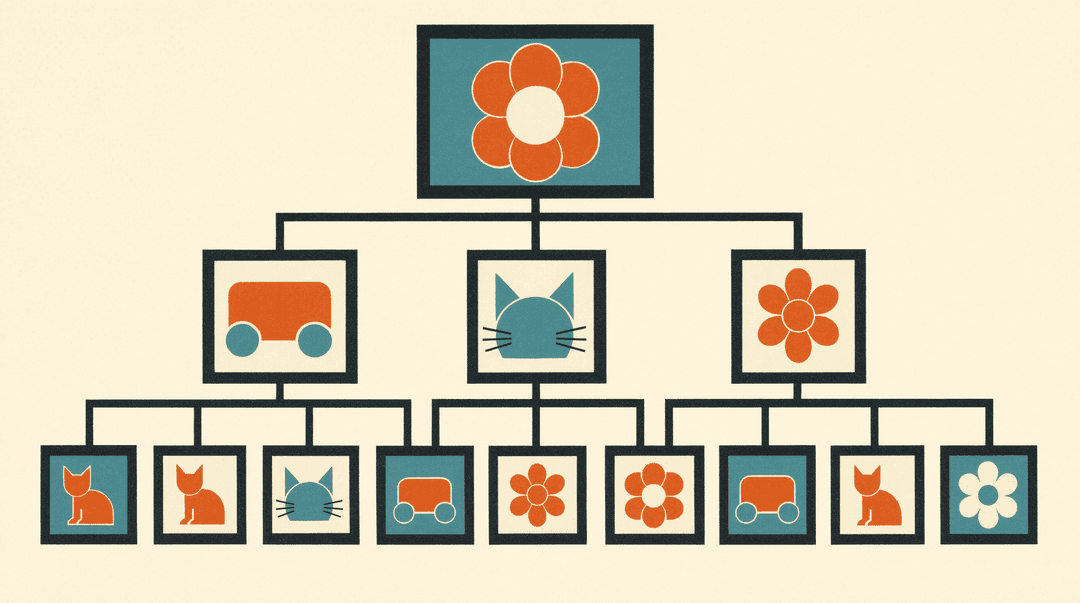
ImageNet is an image dataset organized according to the WordNet hierarchy, the catalog of English word meanings built at Princeton University starting in the 1980s. In WordNet each concept is a "synset," a group of synonyms standing for one thing: "auto" and "car" belong to the same synset. ImageNet borrowed that structure and attached photographs to it. Each synset in the dataset carries roughly 500 to 1,000 full-resolution images that human annotators verified against the concept's definition. At full growth the dataset counted 14,197,122 images across 21,841 synsets, arranged in a tree that runs from nine top-level categories (person, animal, artifact, plant, and so on) down to distinctions like one specific breed of dog among about 120.
The version that shaped history was a subset. The ImageNet Large Scale Visual Recognition Challenge (ILSVRC) used about 1.2 million training images in 1,000 classes, and teams competed to classify them with the lowest top-5 error rate: a prediction counted as wrong only if the correct label was absent from the model's five best guesses. The metric was deliberately generous because the classes are hard, and a photograph usually contains several objects at once.
The 19-year problem, solved for pennies
The project began in 2006 in Fei-Fei Li's lab at Stanford, on a bet that recognition systems were limited by the amount of labeled data rather than by clever algorithms. The arithmetic of manual labeling was prohibitive: at the time, one of Li's estimates put the job at roughly 19 years for a small team. In 2008 the group found its answer in Amazon Mechanical Turk, the crowdsourcing marketplace that let researchers pay anonymous workers cents per image check. The 2009 paper described the pipeline: harvest candidate images from search engines using the synset name, present them to multiple online workers with the dictionary definition attached, then model worker behavior statistically to filter out gaming and mistakes. By the paper's publication the database held 3.2 million images in 5,247 synsets, assembled in about two and a half years, and the target was tens of millions.
Two things deserve noting. First, the labels were not free: Mechanical Turk distributed real wages, mostly to workers in the United States and India, for what was effectively a new kind of invisible labor. Second, the scale was the point. Nothing else publicly available came close, and the CVPR 2009 paper spent most of its length proving ImageNet was larger, more diverse, and more accurate than the dozens-of-images-per-category datasets the field had used before.
The race that converted the field
From 2010 to 2017, ILSVRC functioned as the annual scoreboard of computer vision, and its history reads like a single cliff.
- 2010: the winning system, from NEC, misclassified the correct answer 28.2% of the time at top 5, using hand-designed features and conventional classifiers.
- 2011: Xerox Research improved features and reached 25.8%.
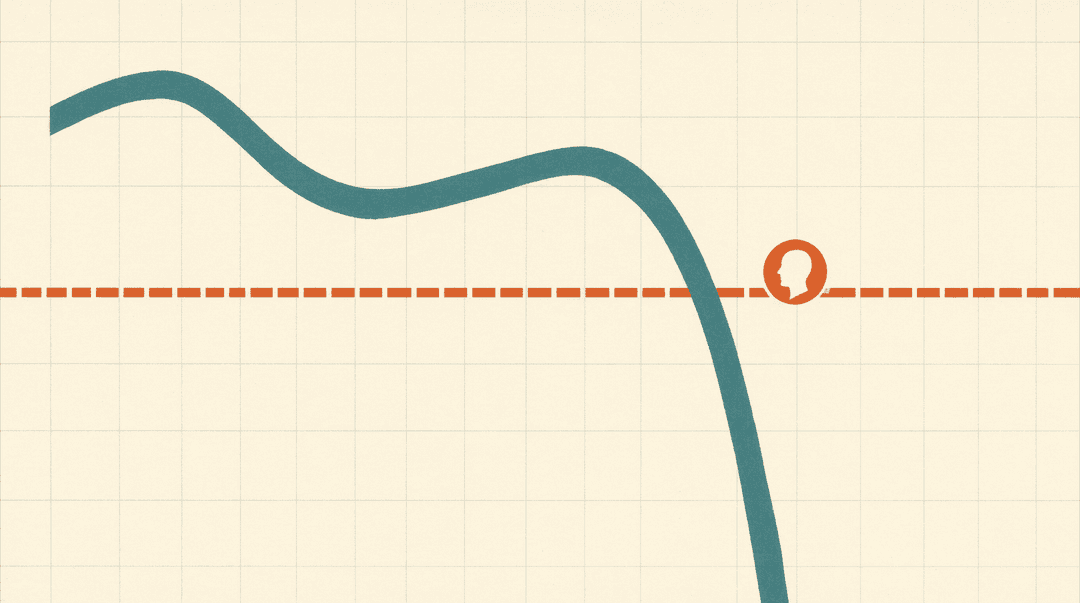
- 2012: AlexNet, a convolutional neural network from Alex Krizhevsky, Ilya Sutskever, and Geoffrey Hinton, posted a top-5 test error of 15.3%. The runner-up, still using handcrafted features, managed 26.2%. That eleven-point gap in one year is the number most histories of deep learning treat as the starting gun.
- 2014: Google's GoogLeNet cut the error to 6.7%.
- 2015: Microsoft Research's ResNet, 152 layers deep, reached 3.57% with an ensemble. The organizers had separately measured a trained human annotator at 5.1% top-5 error on a 1,500-image sample, so 2015 is when the scoreboard said the machine had passed the person.
- 2017: the last official contest was won by SENet with 2.251% top-5 error. With 29 of 38 entrant teams above 95% accuracy, the organizers declared the benchmark solved and retired it. A promised successor on 3D images never appeared.
AlexNet is also the reason the current hardware economy exists. The paper reports training for five to six days on two GTX 580 GPUs, possible because the team wrote the convolution code to run on graphics cards. The 2012 result sent the whole field down that path, and Nvidia's later datacenter business grew on the demand it created. The GPUs that eventually trained large language models served an industry ImageNet had convinced to bet on deep networks.
The cracks show
In 2021, Curtis Northcutt, Anish Athalye, and Jonas Mueller published Pervasive Label Errors in Test Sets Destabilize Machine Learning Benchmarks, using algorithmic flagging and human validation to audit ten famous datasets. The findings for ImageNet: at least 2,916 images, about 6% of the 50,000-image validation set commonly used as its test set, were mislabeled, and the authors' later estimates with a corrected method put the figure closer to 20%. On the subset where they fixed labels, model rankings reordered sharply. A benchmark that had steered a decade of research had a several-percent noise floor nobody had audited.
The harder criticism was about the labels themselves, not their accuracy. In 2019 the artist Trevor Paglen and the researcher Kate Crawford built Excavating AI, a long study of how training datasets inherit the assumptions of their makers. ImageNet's skeleton came from WordNet, an English dictionary, and dictionaries carry their culture with them. Among the synsets were racial classifications and derogatory terms for people, so when a classifier met a photograph of a person it could pick from that menu. Their companion piece, ImageNet Roulette, went viral in September 2019 by letting anyone upload a selfie and see which ImageNet label a face classifier chose. ImageNet removed its problematic categories that January and announced the deletion of more than 600,000 images of people days after Roulette launched, later shipping a face-obfuscation tool for anyone republishing the person subtree.
What replaced it
Web-scale supervision did. OpenAI's 2021 CLIP model showed the exit: trained on 400 million image-and-caption pairs scraped from the internet, it matched the ImageNet accuracy of a fully supervised ResNet-50 zero-shot, without touching the 1.28 million hand-labeled images that model had learned from. No curation, no taxonomy, no annotation bill. The noisy pair, matched automatically by co-occurrence on the web, became the default training material for everything from text-to-image models to multimodal assistants.
ImageNet still ships, still downloads, and still appears in the fine-tuning tables of open vision encoders. But its real legacy is methodological rather than statistical. It proved that dataset scale could be a breakthrough in itself, that a fixed public benchmark could coordinate an entire field for a decade, that benchmarks decay the moment they are won, and that whatever humans write down, including the dictionary underneath the labels, ships in the box.
Sources
- ImageNet project page (about and counts)
- Deng, Dong, Socher, Li, Li, Fei-Fei: ImageNet: A Large-Scale Hierarchical Image Database, CVPR 2009
- Krizhevsky, Sutskever, Hinton: ImageNet Classification with Deep Convolutional Neural Networks, NeurIPS 2012
- He, Zhang, Ren, Sun: Deep Residual Learning for Image Recognition, CVPR 2016
- Russakovsky et al.: ImageNet Large Scale Visual Recognition Challenge, IJCV 2015
- Northcutt, Athalye, Mueller: Pervasive Label Errors in Test Sets Destabilize Machine Learning Benchmarks, NeurIPS 2021 Datasets and Benchmarks
- Crawford and Paglen: Excavating AI: The Politics of Images in Machine Learning Training Sets, AI & Society 2021
- Artforum: Image Database Purges 600K Photos After Trevor Paglen Project Reveals Biases, September 2019
- Radford et al.: Learning Transferable Visual Models From Natural Language Supervision (CLIP), ICML 2021
- Fei-Fei Li: How we're teaching computers to understand pictures, TED 2016
- Wikipedia: ImageNet
