
The ELIZA effect is the tendency to project human traits, such as understanding or empathy, onto software that lacks them. First identified by MIT scientist Joseph Weizenbaum in 1966 with his ELIZA program, this cognitive illusion occurs even when users are fully aware they are interacting with a machine. It highlights how human attention creates the perception of intelligence rather than any actual capability within the system.
In 1966, Joseph Weizenbaum, a computer scientist at MIT, published a program called ELIZA. It was roughly 200 lines of code. Its most famous script simulated a Rogerian psychotherapist, mostly by turning statements back into questions. A user wrote "my boyfriend made me come here" and ELIZA answered "Your boyfriend made you come here?" There was no world model, no memory, no understanding. Weizenbaum built it to show how shallow machine conversation was.
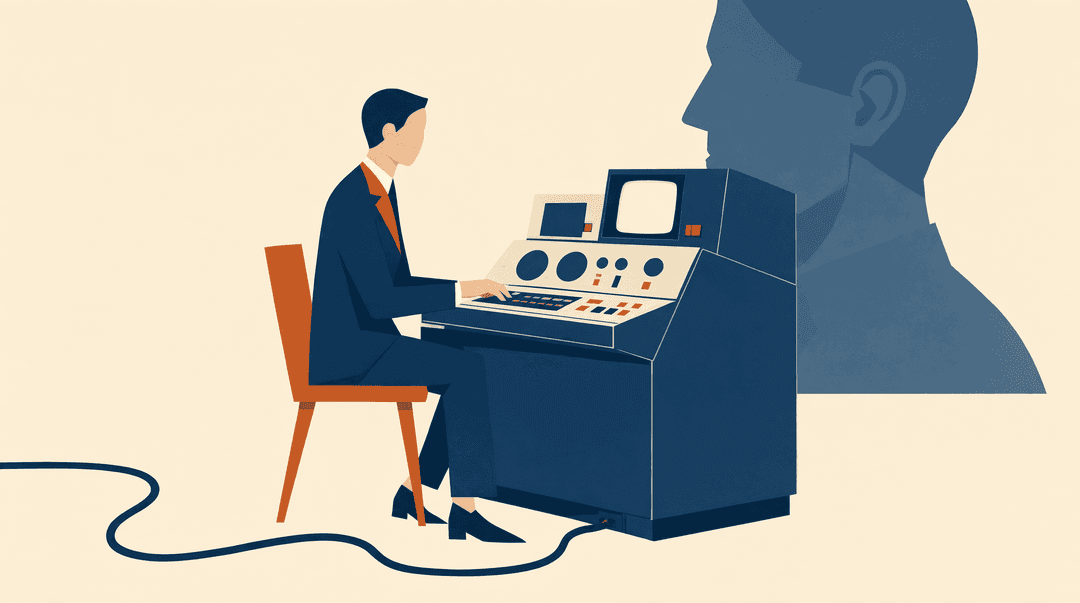
The experiment backfired. People confided in it. They got angry at it. They asked for privacy while talking to it. His secretary, who had watched him build the program over many months and knew exactly what it was, typed a few exchanges, then turned to Weizenbaum and asked: "Would you mind leaving the room, please?" Writing in the original paper, Weizenbaum conceded that "some subjects have been very hard to convince that ELIZA (with its present script) is not human," and observed that ELIZA "shows, if nothing else, how easy it is to create and maintain the illusion of understanding." Years later he put it more bluntly: "I had not realized ... that extremely short exposures to a relatively simple computer program could induce powerful delusional thinking in quite normal people."
The name for what happened is now the ELIZA effect: the tendency to project human traits, such as understanding, experience or empathy, onto software that has none of them. It is one of the oldest phenomena in computing, and it is the frame through which a lot of modern arguments about chatbots should be read.
The illusion does not require ignorance
What surprised Weizenbaum was that disclosure did not help. His users generally knew they were typing to a program. As the phenomenon was later summarized, people who are fully aware that they are talking to a simple computer program will nonetheless treat it as if it were a thinking being that cared about their problems. The MIT scientist's own secretary, fully aware the program was a machine, asked him to leave the room so she could continue her conversation with ELIZA in private.
Douglas Hofstadter, who kept the term alive in his writings, defined the effect as the susceptibility of people to read "far more understanding than is warranted" into strings of symbols strung together by computers. His example was trivial and telling: an automated teller machine that prints THANK YOU at the end of a transaction. The machine is not grateful. It is printing a pre-programmed string. People still feel thanked.
The sociologist Sherry Turkle popularized the term "ELIZA effect" in her 1984 book The Second Self. She noted that most users go out of their way not to break the spell: instead of asking questions that would make the program talk nonsense and expose itself, they avoid them, in order to maintain the illusion that ELIZA could respond to them. Even in the 19th century, Charles Babbage had observed that people naturally describe mechanical operations in psychological terms, whatever the engineer means to imply.
The practical point: the ELIZA effect is a property of human attention, not of machine capability. You cannot vaccinate against it by telling someone the model is "just" statistics. Sixty years of evidence says the label barely matters to the experience of being answered.
What modern models give the projection to work with
ELIZA had a few dozen pattern-matching rules. A 2024 study in PNAS gave a large language model something ELIZA never had: behavioral realism across economic games. Researchers ran trust games, ultimatum-style bargaining and prisoner's dilemma experiments and found the model's behavior statistically indistinguishable from that of human participants. The authors framed it as a behavioral Turing test, and it passed.
A second line of research removed the veil entirely. Work from Stanford's Social Media Lab found that people cannot reliably tell AI-generated self-presentations from human ones, because they judge authorship using intuitive but flawed heuristics, such as expecting AI text to read oddly formal. The researchers showed that AI systems can exploit those heuristics deliberately and produce text that is perceived as "more human than human."
And on the disclosure side, the mirror looks even more human. A review of relationship-science research describes experiments in which participants asked to reveal a secret disclosed secrets of comparable intimacy to a chatbot and to a human conversation partner, and field surveys in which an AI companion framed as an AI was rated as more available and less judgmental than the human alternative. Weizenbaum's secretary would have recognized the mechanism. The software just has more to say now.
Where the effect shows up in the numbers
The largest controlled test so far is a joint MIT Media Lab and OpenAI study published in March 2025: a four-week randomized experiment with 981 participants and more than 300,000 messages. The assigned conditions, text versus voice, small talk versus personal topics, produced no significant effects on loneliness, real-world socializing, emotional dependence or problematic use. What mattered was what participants did with their own choice. People who voluntarily used the chatbot more showed consistently worse outcomes, and people who reported higher trust in and social attraction to the chatbot were the ones who developed emotional dependence and problematic usage patterns.
In other words, the ELIZA effect is not evenly distributed. It selects. The users most likely to be drawn into treating a companion model as a friend are already predisposed to find the machine trustworthy and attractive as a conversational partner, and the more capable the conversational partner becomes, the more fuel the projection gets.
The clinical evidence is more pointed. A 2025 Brown University study had trained peer counselors and clinicians evaluate mental-health chats prompted to use evidence-based therapy techniques, and found that the tested LLMs, from OpenAI, Anthropic and Meta, systematically violated the ethical standards of the profession: mishandling crisis situations, reinforcing users' negative beliefs, and, in the study's phrasing, creating a false sense of empathy. A survey of research cited by the American Psychological Association notes that heavy use of digital companions can leave some users more isolated, not less.
Why it matters for how you use AI today
Three implications follow from the record, none of which require taking a position on whether models are conscious.
First, the human-perceived empathy of a chatbot is a user-side event, not a system-side property. A model that produces fluent, contingent, warm responses triggers the same social cognition that ELIZA did with a handful of keyword rules, and modern triggers are thousands of times richer. Designers of companion products know this, which is why availability, warmth and personalization are the features they sell.
Second, transparency labels are a weak defense. The effect survived full disclosure in 1966 and survives it now. The evidence supports structural guardrails, such as usage limits, crisis routing and honest product framing, far more than warnings on the screen.
Third, for individuals the useful heuristic comes from the study designs themselves. In the MIT-OpenAI experiment, the variable that tracked harm was not the technology's behavior but the user's relationship to it: time spent, and whether the system was treated as a friend or as a tool. Task use showed no such pattern. Keeping the label accurate, tool, not companion, is the part a user can actually control.
Weizenbaum spent the rest of his career as computing's most prominent internal critic, and his central warning was not that machines would think. It was that humans would stop distinguishing being understood from being answered. That warning cost almost nothing to make in 1966. It is the main export of a 200-line program.
Sources
- Weizenbaum, J. (1966). "ELIZA: A Computer Program for the Study of Natural Language Communication Between Man and Machine," Communications of the ACM (paper PDF, DOI)
- ELIZA effect, Wikipedia, including Hofstadter's definition, the Turkle quotation and the Babbage note
- Marwaha, R. (2023). "Why People Demanded Privacy to Confide in the World's First Chatbot," IEEE Spectrum (spectrum.ieee.org) for the secretary episode and the code-length figure
- Billings, L. (2007), "Rise of Roboethics," Seed magazine, quoted via Wikipedia for the fully-aware users finding
- Mei, Q., Xie, Y., Yuan, W., Jackson, M. (2024). "A Turing test of whether AI chatbots are behaviorally similar to humans," PNAS 121(9) (pnas.org)
- Jia, I. et al. (2024). "Human heuristics for AI-generated language are flawed," Stanford Social Media Lab (sml.stanford.edu)
- Fang, C.M. et al. (2025). "How AI and Human Behaviors Shape Psychosocial Effects of Extended Chatbot Use: A Longitudinal Controlled Study," MIT Media Lab and OpenAI (media.mit.edu, arXiv)
- Brown University (2025). "New study: AI chatbots systematically violate mental health ethics standards" (brown.edu)
- "Can Generative AI Chatbots Emulate Human Connection? A Relationship Science Perspective" (PMC review) covering the secret-disclosure and AI-vs-human companion experiments
- American Psychological Association (2026). "AI chatbots and digital companions are reshaping emotional connection" (apa.org)
Frequently asked questions
Who discovered the ELIZA effect?
Joseph Weizenbaum, a computer scientist at MIT, discovered the phenomenon in 1966 while developing the ELIZA program, which simulated a Rogerian psychotherapist.
Does knowing an AI is a machine prevent the ELIZA effect?
No, disclosure does not prevent the effect. Users who were fully aware they were typing to a simple computer program still treated it as if it were a thinking being that cared about their problems.
How does the ELIZA effect impact trust in modern AI chatbots?
The effect selects users who are already predisposed to find machines trustworthy and attractive, leading those individuals to develop emotional dependence and problematic usage patterns when using companion models.
Is transparency labeling effective against the ELIZA effect?
Transparency labels are considered a weak defense because the effect survived full disclosure in 1966 and continues to persist despite modern warnings about the nature of statistical models.
