
Every answer a language model gives is assembled from text it read during training. The model has no ledger of which text. Ask it why it wrote a sentence in a particular way and the honest answer is: some document, somewhere, in a corpus of trillions of tokens, nudged the weights in that direction, and nobody tracked which one. There is a research field that tries to keep that ledger. It is called data attribution, and it answers the one question no model card answers: which training examples shaped this output?
The question costs a retraining
The naive version of attribution is a counterfactual. To learn how much one web page mattered, delete it from the training set, retrain the model from scratch, and compare the outputs. This is called leave-one-out analysis, and its cost is obvious. A frontier pre-training run takes months and tens of millions of dollars. A corpus contains hundreds of billions of sequences. You cannot run one training job per document to grade the documents.
So the field has spent three decades building approximations that never retrain anything.
Influence functions: the original trick
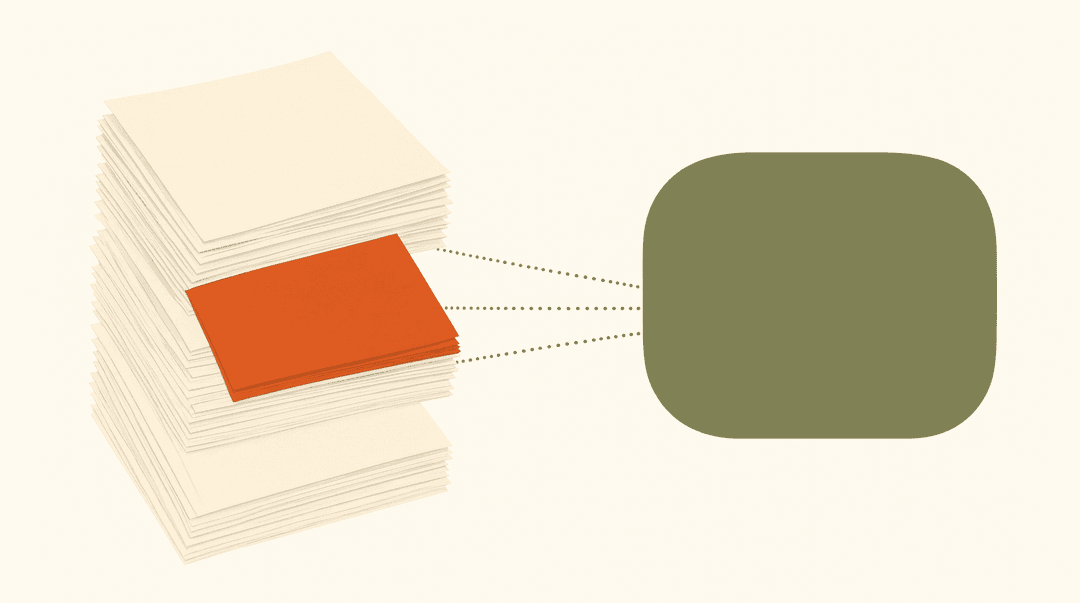
The oldest approximation comes from statistics, not machine learning. Influence functions were developed in the 1970s by robust statistics researchers (the classic reference is Hampel) asking how much one outlier in a dataset shifts a fitted regression. Pang Wei Koh and Percy Liang ported the idea to neural networks in an ICML 2017 paper and made it the template for everything that followed.
The setup: the model is the minimizer of a loss over the training data. An influence function estimates, without retraining, how the loss on a chosen test example would change if one training example were given slightly more weight. The estimate needs two quantities: the gradient of the test loss and the gradient of the training example's loss, connected through the inverse of the model's Hessian matrix. That inverse is the hard part: for a model with billions of parameters, the Hessian is a square matrix with as many entries as the parameter count squared, and actually inverting it is out of the question. Koh and Liang showed you only need Hessian-vector products, computable without ever writing the matrix down. They also admitted the honest caveat that the theory assumes a convex loss, which deep networks violate, and that the approximation still seemed to provide useful signal anyway.
TracIn: reading the receipt
TracIn, published by Google researchers at NeurIPS 2020, dropped the Hessian entirely. The idea is bookkeeping: if training used stochastic gradient descent, then at every step in which an example was part of the batch, that example pushed the loss on any test point slightly up or down. TracIn measures the gradient inner product between a training example and a test point at checkpoints that standard training already saves, sums across steps, and calls the total the example's influence. It needs nothing exotic, just gradients, checkpoints, and the loss function, and it works for any model trained by SGD. In influence-analysis parlance, examples that reduced the test loss come out positive, examples that raised it come out negative, and the score of an example against itself is a useful detector of mislabeled data, because a wrong label fights the model the whole way through training.
Data Shapley: pricing the dataset
Another lineage treats attribution as accounting. Data Shapley (Ghorbani and Zou, ICML 2019) applies the Shapley value from cooperative game theory, the Nobel-recognized method for splitting a payoff among players, to splitting credit for a model's performance among its training points. The value of one image is its average marginal contribution across all possible subsets of the dataset, approximated by retraining on many subsets. It is far more principled than gradient tricks and far more expensive. The payoff can be real: Stanford researchers reported that on an image classification dataset, images of minorities and women carried the highest Shapley values and images of white men the lowest, and reweighting training by those values measurably improved accuracy. A fast variant, TRAK (ICML 2023), combines the gradient-similarity idea with random projections and has become a standard baseline for large vision models, with extensions covering diffusion models.
What it showed about LLMs
For years these methods ran on small networks. The scale jump came in 2023, when a team from Anthropic and the University of Toronto applied influence functions to language models with up to 52 billion parameters. The trick was EK-FAC, an approximation of the inverse Hessian that exploits the structure of transformer layers, plus TF-IDF filtering so candidate training documents only get graded on the words they actually share with the probe.
The findings were among the first direct evidence of how LLMs generalize:
- Influence is sparse. A given output traces to a small number of training sequences, not a diffuse average of the corpus.
- Bigger models generalize from more abstractly similar text. As scale grows, the training documents that most influence a passage are less and less the ones that superficially resemble it.
- And a brittle limitation: influence collapsed to near zero when researchers merely flipped the order of key phrases in the probe. Paraphrase too aggressively and the model's "understanding" stops matching the training documents that produced it.
Attribution is not extraction
Attribution answers which data shaped an output. A separate line of work asks whether the model will hand back training data verbatim, and the answer is also yes. In the landmark 2021 USENIX Security study, Carlini and colleagues probed GPT-2 by generating candidates and ranking them by how much more likely the target model found them than a reference model. Of 1,800 inspected candidates, over 600 were confirmed verbatim training data, including names, postal addresses, phone numbers, IRC logs, code, and 128-bit UUIDs that had appeared in exactly one training document. Larger models memorized more, killing the comfortable assumption that models trained on vast data never overfit.
The gap between the two results is where the money argument lives. Extraction proves a document was in the corpus. Attribution tries to prove it mattered to an output. But a third strand of research shows how weak the tools are: Maini and colleagues reported that because LLMs train for a single epoch over trillions of tokens, membership inference (asking whether a specific text was in a model's training set from black-box access alone) degenerates toward a coin flip, and proposed "dataset inference" as a substitute. For authors and publishers seeking credit or compensation in copyright disputes, neither attribution nor membership testing is currently reliable in court. This is also why a model that can be audited for influence matters commercially: the same machinery that finds the mislabeled example can find the document that licensed data agreements say to remove.
Using attribution to train better

Attribution also eats its own tail: you can use influence scores to choose training data before it is training data. LESS (Xia et al., ICML 2024) estimates influence in the low-rank gradient space introduced by LoRA and selects instruction-tuning examples whose gradients match a handful of few-shot examples of the target skill. The headline result: models trained on a LESS-selected 5% of the instruction data often beat models trained on all of it, and the selections made with smaller models transfer to larger ones. If five percent of a labeled dataset carries most of the value, the other ninety-five percent is a bill, not an asset.
Reality check: the 2025 DATE-LM benchmark, which evaluated attribution methods on data selection, toxicity filtering and factual grounding, found that no single method dominates across tasks and that simple non-attribution baselines often beat the expensive methods. The field is real and useful; it is not yet a solved tool you point at a corpus.
Why no lab ships this today
Three obstacles. Cost: per-query attribution means computing and storing gradients for every example, at every checkpoint, for every probe; at frontier scale nobody does it for the whole corpus. Accuracy: every fast method is an approximation of an approximation, and benchmarks like DATE-LM show the rankings still wobble. And incentives: an attribution ledger is a liability. If your model's answer about a news story traces measurably to one publisher's article, that fact is worth nothing to your legal team and something to everyone else's. So labs publish model cards describing intended uses while the per-output provenance stays unrecorded.
The takeaways
- Data attribution asks which training examples shaped a given model output. The exact answer requires retraining per example, which nobody can afford.
- The workhorses are influence functions (Koh and Liang 2017), checkpoint bookkeeping (TracIn 2020), and Shapley-style pricing (Data Shapley 2019, TRAK 2023).
- Anthropic-scale work in 2023 showed LLM influence is sparse, becomes more abstract with scale, and breaks when key phrases are reordered.
- Memorization extraction (Carlini et al. 2021) proves data was present; attribution tries to prove it mattered. Neither is yet reliable enough for copyright proceedings.
- Influence-scored data selection (LESS) can beat training on the full dataset with 5% of the data, but benchmarks show no method wins everywhere.
Sources
- Koh & Liang, Understanding Black-box Predictions via Influence Functions, ICML 2017 - https://proceedings.mlr.press/v70/koh17a.html
- Pruthi et al., Estimating Training Data Influence by Tracing Gradient Descent (TracIn), NeurIPS 2020 - https://arxiv.org/abs/2002.08484
- Ghorbani & Zou, Data Shapley: Equitable Valuation of Data for Machine Learning, ICML 2019 - https://arxiv.org/abs/1904.02868
- Stanford School of Engineering & Applied Sciences on Data Shapley and image valuation - https://ee.stanford.edu/news/2021/feb/james-zou-and-amirata-ghorbani-phd-candidate-extend-and-adapt-shapley
- Park et al., TRAK: Attributing Model Behavior at Scale, ICML 2023 - https://arxiv.org/abs/2303.14186
- Grosse et al., Studying Large Language Model Generalization with Influence Functions, Anthropic, 2023 - https://arxiv.org/abs/2308.03296
- Carlini et al., Extracting Training Data from Large Language Models, USENIX Security 2021 - https://www.usenix.org/conference/usenixsecurity21/presentation/carlini-extracting
- Maini et al., LLM Dataset Inference: Did you train on my dataset? 2024 - https://arxiv.org/abs/2406.06443
- Xia et al., LESS: Selecting Influential Data for Targeted Instruction Tuning, ICML 2024 - https://arxiv.org/abs/2402.04333
- DATE-LM: Benchmarking Data Attribution Evaluation for Large Language Models, 2025 - https://arxiv.org/abs/2507.09424
