
Reinforcement learning gets the headlines: models discover strategies by trial, error and reward. But most practical AI systems that act, robots folding laundry or assistants writing code, were first trained by a simpler method that needs no reward function, no simulator and no exploration. It is called behavior cloning, and its modern form is a supervised learning problem: show the model what an expert did in a situation, and teach it to predict the expert's next move.
This post covers what behavior cloning is, the failure mode that has haunted it since 1988, the three fixes the field converged on, and why the same algorithm that drives robot fleets is also the first step of instruction tuning at the major labs.
The idea in one mechanism
A decision-making system sees the world as a stream of states and emits actions. An autonomous vehicle sees a camera frame and emits a steering angle. A language model sees a prompt and emits a reply. A robot sees a bin and emits a joint trajectory.
Behavior cloning treats each of those decisions as a labeled example. You record an expert (a human driver, a teleoperator, a skilled annotator) producing actions, and you keep the pairs: observation in, expert action out. Then you fine-tune a network on those pairs with ordinary supervised learning, exactly like image classification. There is no reward signal anywhere in the pipeline. The label is not "this was good," the label is "this is what the expert did."
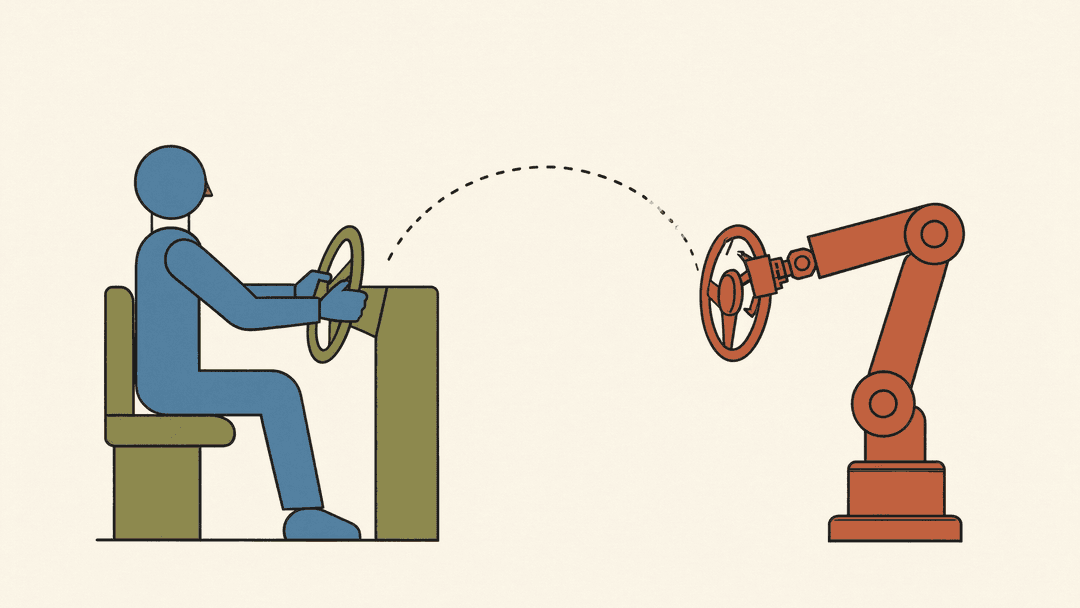
The contrast with reinforcement learning is stark. RL needs a reward function, which is often impossible to write down for a dexterous task, and it needs the policy to explore, which is slow and dangerous on physical hardware. Cloning needs neither. It needs demonstrations, and demonstrations are a byproduct of normal human work: the steering wheel angle during a drive, the leader-arm joint positions during a teleoperation session, the written reply of a human annotator. That asymmetry, free labels versus engineered rewards, is why cloning keeps winning the practical trade.
What it looked like in 1988
The canonical early system is ALVINN, Dean Pomerleau's Autonomous Land Vehicle In a Neural Network at Carnegie Mellon. It was a three-layer backpropagation network controlling the Navlab, a modified Chevy van. The training data came from a human driving the route: the network took preprocessed camera images as input and the driver's steering position as the label.
The numbers are still striking for their cheapness. Pomerleau's follow-up paper reports training on 1,200 synthetic road snapshots presented 30 to 40 times, taking under five minutes on CMU's Warp supercomputer, after which the network drove the test road at up to 1.8 meters per second, roughly 4 miles per hour. A human driver had produced the entire training signal as a side effect of doing their job. That is the pitch of behavior cloning, unchanged in almost four decades.
The failure mode: your mistakes take you somewhere new
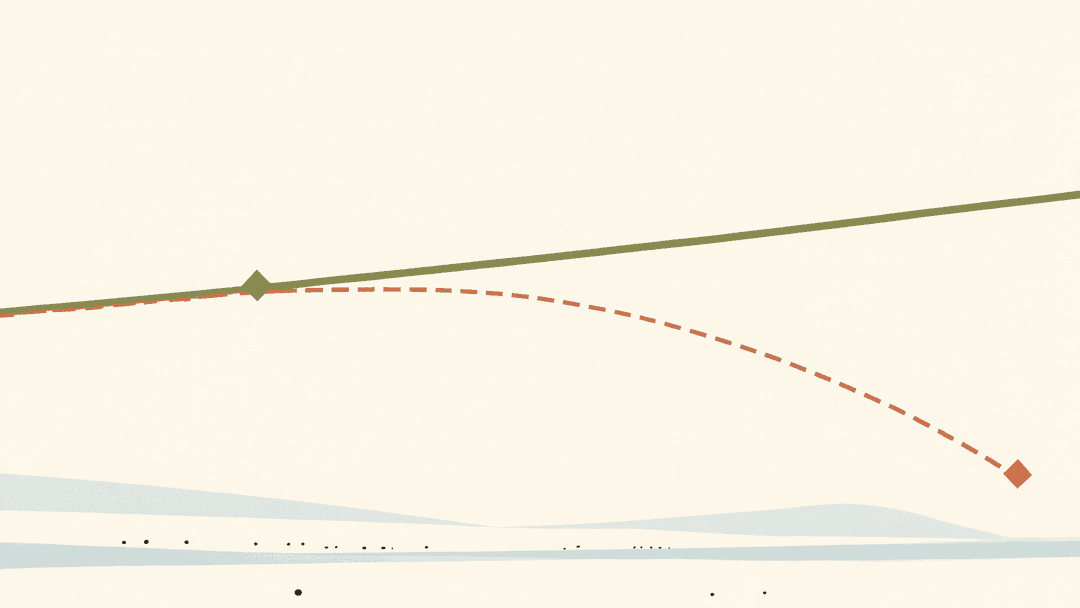
Cloning has one structural weakness, and it comes from how the dataset was made. The expert only demonstrates on states the expert visits. A good human driver never appears in the ditch, so the dataset has no examples of what to do from the ditch.
Once the cloned policy drives, it will make small errors, and each error moves it slightly off the distribution of states it was trained on. Slightly off-distribution is still survivable; but the new situation then produces a fresh, bigger error, which moves it further off-distribution. The model is not trained on the consequences of its own mistakes, so mistakes compound. Stéphane Ross, Geoffrey Gordon and Drew Bagnell formalized this in 2011: with a per-step error rate of epsilon against the expert, the worst-case cost over a task of T steps grows on the order of T squared times epsilon. The task length itself is the enemy. A policy that is 99% faithful per step can still fail almost surely on a 100-step task.
Fix one: visit your own states
Ross and Bagnell's answer, DAgger (Dataset Aggregation), is conceptually clean. Run the cloned policy. Whenever it wanders into a state the expert would never visit, ask the expert what to do from that exact state. Add those pairs to the training set and retrain. The policy now has recovery examples for its own failure modes, and the authors prove this reduces the error cost from quadratic to roughly linear in the horizon under standard assumptions.
The catch is operational: DAgger needs the expert available while the learned policy runs, and in robotics that means a human teleoperator relabeling the robot's mistakes in real time. It works, it is used, and it is expensive. Much of what the industry now buys as "data" for robot and agent training is, at bottom, a paid way to run this loop at scale.
Fix two: copy several steps at once
Action Chunking with Transformers (ACT), introduced with the ALOHA low-cost bimanual robot system by Tony Zhao and colleagues at Stanford, attacks compounding error from the other side: make each decision cover more of the task. Instead of predicting one motor command per observation, the policy predicts a short chunk of future actions. If the first predicted action is slightly wrong, the rest of the chunk still carries the plan, which lowers the effective number of decision points where drift can enter.
ACT also handles a subtlety that naive cloning misses: human demonstrations are multimodal. On the same task, one person's demonstrations might pass left of an obstacle and another's might pass right. Least-squares regression over both steers straight into the obstacle, the average of two valid strategies is often not valid. ACT therefore trains as a conditional variational autoencoder so it can commit to one mode of the demonstrated behavior rather than averaging between them. With around 50 demonstrations per task, it succeeded at fine-grained work like inserting a battery, and it is now a standard baseline policy shipped in Hugging Face's LeRobot library.
Fix three: just get a lot more demonstrations
The industrial answer is scale. Google's RT-1 Robotics Transformer trained on roughly 130,000 teleoperated episodes covering more than 700 tasks, collected by a fleet of 13 robots over 17 months, and reported 97% average success on known instructions. Physical Intelligence's pi0 pre-trained on 10,000 hours of dexterous manipulation data across 7 robot configurations and 68 tasks, plus open-source robot datasets, and used that base to fine-tune behaviors as delicate as laundry folding. Both treat demonstrations the way language models treat web text: the distribution problem is attacked with volume. This is the same bet behind the recent shift in robot training toward human video, where the demonstration stream is effectively free.
The language model twist: step one of post-training is cloning
Here is the part most coverage of robot data misses. InstructGPT, the 2022 paper that set the template for chat-model training, describes its first step as collecting "labeler demonstrations of the desired model behavior" and fine-tuning GPT-3 on them with supervised learning. The dataset was about 13,000 training prompts. That is behavior cloning, verbatim: observation is the prompt, expert action is the human-written reply. The later RLHF steps, reward model and PPO, sit on top of it.
Instruction tuning at every major lab is cloning of human replies. Meta's LIMA experiment pushed the point to its limit: a 65B model fine-tuned on only 1,000 curated prompt-response pairs, 750 harvested from community Q&A sites like Stack Exchange and wikiHow and 250 written by hand, with no reinforcement learning at all, produced outputs human raters rated equal or strictly preferred to GPT-4 in 43% of cases. The authors' conclusion, the "superficial alignment hypothesis," is that pre-training does the heavy lifting and the cloning stage mostly teaches format and style.
Why does cloning fare so much better in text than in driving? A 2024 NeurIPS paper, "Is Behavior Cloning All You Need?", gives a theoretical answer: the quadratic penalty in the horizon is not fundamental. It bites when errors in early steps compound through reward-bearing state transitions. When the cumulative payoff of a task is bounded, one final reward for the whole answer, behavior cloning's sample complexity does not have to grow with the sequence length at all. A chat reply is closer to that regime than a drive down a wet highway: the model emits tokens, but the task succeeds or fails once, at the end. The same paper's experiments deliberately include autoregressive language generation alongside classic control tasks to make this point.
What cloning will never get you
Cloning has a hard ceiling by construction: the student is, at best, the teacher. It cannot discover a strategy the expert never demonstrated, because there is no signal that would reward trying one. That is why the frontier recipes pair the two methods: demonstrations to reach the human level cheaply, then reinforcement learning on verifiable outcomes to go past it. Claude's computer-use capability, for instance, was trained on a handful of simple programs like a calculator and a text editor and generalized to unseen software, a demonstration-efficiency result Anthropic reported at 14.9% on OSWorld against 7.7% for the next-best model, still far from the human range of 70 to 75%. The gap between clone and expert, and between expert and best-possible, is where the rest of post-training happens.
Key takeaways
- Behavior cloning is supervised learning on (observation, expert action) pairs. No reward function, no exploration, labels for free as a byproduct of human work.
- Its core failure is compounding error: the policy is never trained on the states its own mistakes create, and loss grows with the square of the horizon.
- The three fixes: DAgger (label the policy's own states), action chunking (predict sequences to shorten the effective horizon), and demonstration scale (RT-1's 130k episodes, pi0's 10,000 hours).
- In language models, the SFT stage of instruction tuning is behavior cloning of human demonstrations; LIMA showed 1,000 pairs can carry most of it.
- Theory says cloning is safest when payoff is bounded at the end of the task, which describes a chat reply better than a drive.
Sources
- Pomerleau, ALVINN: An Autonomous Land Vehicle in a Neural Network, NeurIPS 1988
- Pomerleau, Efficient Training of Artificial Neural Networks for Autonomous Navigation, Neural Computation 1991
- Ross, Gordon, Bagnell, A Reduction of Imitation Learning and Structured Prediction to No-Regret Online Learning (DAgger), AISTATS 2011
- Zhao et al., Learning Fine-Grained Bimanual Manipulation with Low-Cost Hardware (ACT/ALOHA), RSS 2023
- Hugging Face, ACT documentation in LeRobot
- Brohan et al., RT-1: Robotics Transformer for Real-World Control at Scale, RSS 2023; Google Research blog summary
- Black et al., pi0: A Vision-Language-Action Flow Model for General Robot Control, arXiv 2410.24164
- Ouyang et al., Training language models to follow instructions with human feedback (InstructGPT), arXiv 2203.02155
- Zhou et al., LIMA: Less Is More for Alignment, arXiv 2305.11206
- Zhang et al., Is Behavior Cloning All You Need? Understanding Horizon in Imitation Learning, NeurIPS 2024
- Anthropic, Developing a computer use model
