
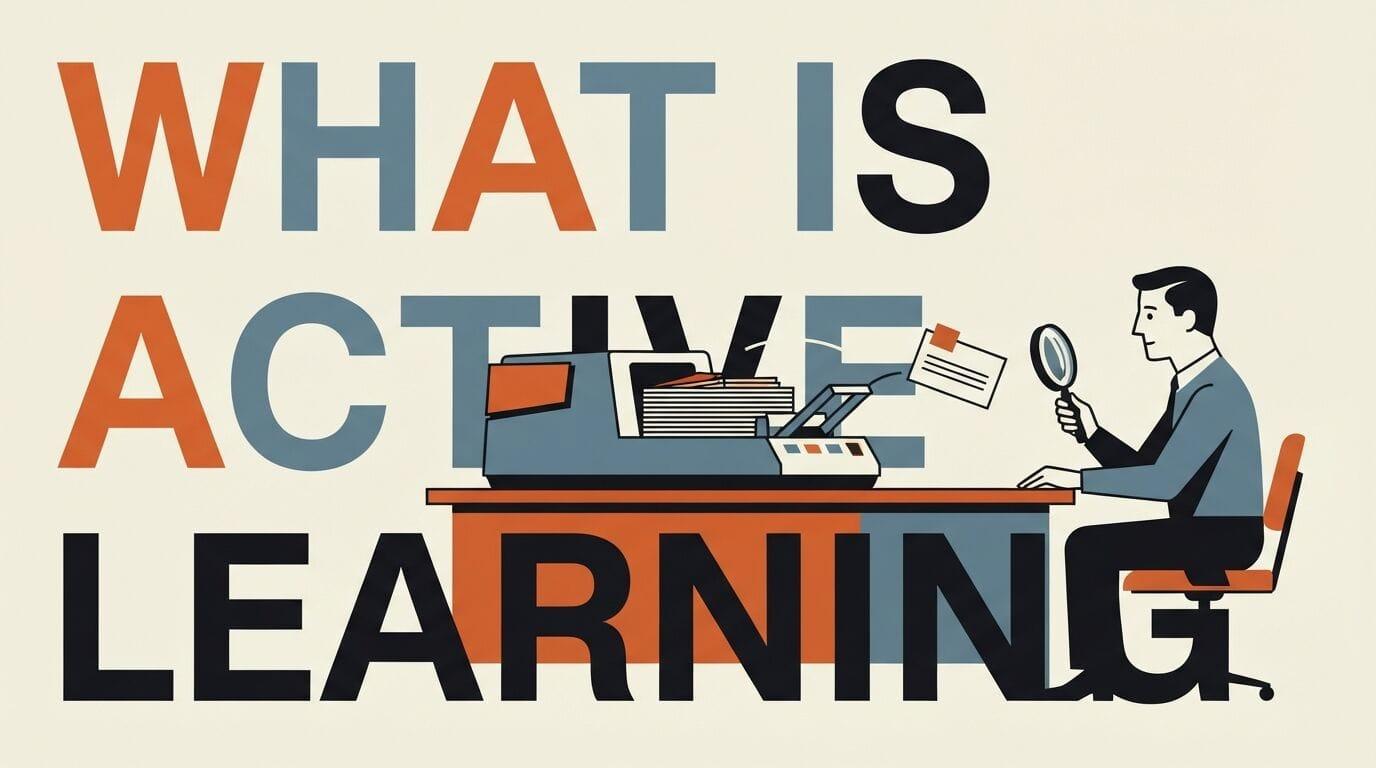
Every AI story starts with data, and every dataset has a price. Not the compute price, which falls every year, but the label price: the cost of a human deciding what the right answer is. In many real tasks that cost is dominated by waste. Randomly sampled examples are mostly easy and mostly redundant. The model already knows how to label them, so the annotation budget buys almost nothing.
The fix is an old idea with a deceptively simple statement. As Burr Settles put it in his widely cited Active Learning Literature Survey, a machine learning algorithm can achieve greater accuracy with fewer training labels if it is allowed to choose the data from which it learns. That is active learning: instead of handing the model a pile of pre-labeled examples, you hand it a pile of unlabeled ones, let it flag the examples it finds most confusing, and spend your human experts only on those.
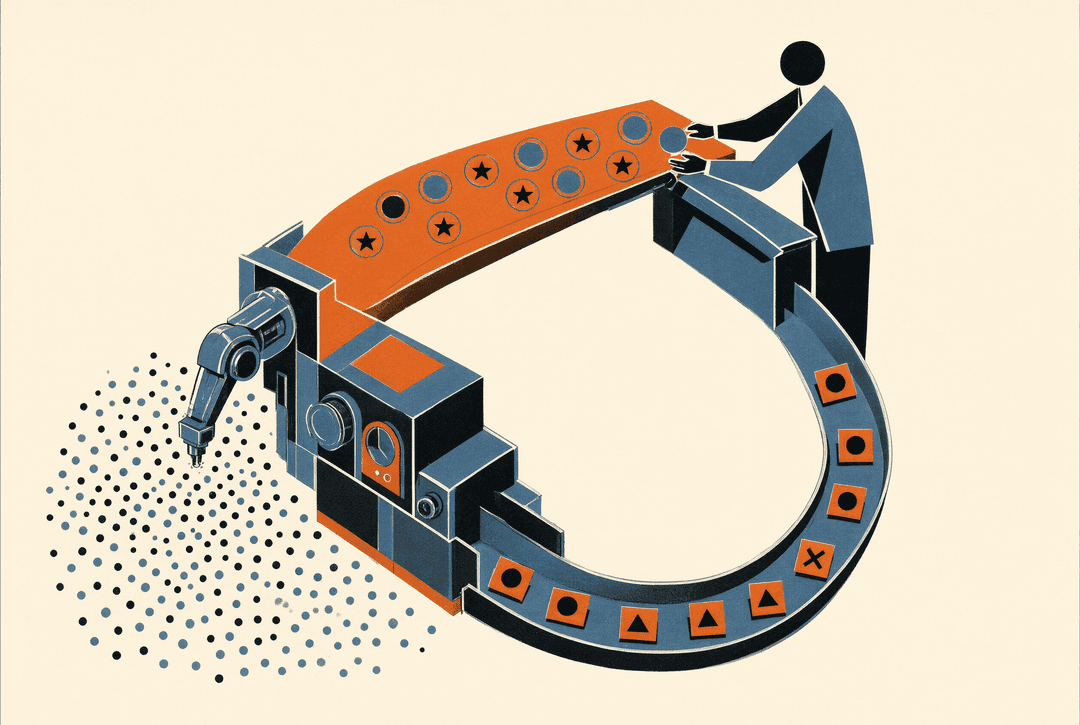
The contrast with standard supervised training is structural. In passive learning, the data pipeline picks examples, usually at random from some distribution, and the model just consumes them. In active learning, the model participates in data selection. It runs a loop: train on the labeled set you have, score every item in the unlabeled pool with some acquisition function, send the top-scoring batch to an oracle (a human annotator, usually, or increasingly another model), fold the new labels in, and repeat. The labels you pay for are exactly the ones that change the model.
Where the idea came from
The formal starting point is usually dated to a 1992 paper at the ACM Workshop on Computational Learning Theory, "Query by Committee" by H. Sebastian Seung, Manfred Opper, and Haim Sompolinsky. Their scheme: train several hypotheses ("a committee of students") on the same small labeled set, then look at the unlabeled stream and ask for a label only where the committee members disagree the most. Where everyone agrees, the answer is already implied by the data the committee shares. Where they split, one label resolves a genuine ambiguity. Freund, Seung, Shamir, and Tishby showed the same year that if each query carries a positive amount of information this way, the prediction error can fall exponentially with the number of queries rather than polynomially, which is the theoretical prize active learning goes after. The exponential-decrease argument appears in the committee line of work rather than for all strategies, but it explains the appeal: halving the error per label instead of per ten thousand.
Uncertainty sampling, the simpler cousin, arrived with Lewis and Gale's 1994 work on text classification: query the instances where the model is least certain, where its posterior probability sits nearest a coin flip. Settles's 2009 survey organized the field into a taxonomy that textbooks still follow: uncertainty sampling and query-by-committee, expected model change, expected error reduction, variance reduction, and density-weighted methods. The last group, developed by Settles and Mark Craven in 2008, adds a correction that the pure uncertainty rules ignore. An informative instance should be uncertain and representative of the input distribution at once. A bizarre, noisy outlier sits at maximum uncertainty and teaches the model nothing, so the density term down-weights lonely points in feature space.
How the scoring actually works
Acquisition functions in practice are mostly cheap. Margin sampling ranks candidates by the gap between the top two predicted probabilities. Entropy sampling uses the Shannon entropy of the full predicted distribution, so it catches cases where the model is spread thin across many classes rather than confused between two. Committee variants vote and measure disagreement, often via Jensen-Shannon divergence. None of this requires training anything new; it is inference you were doing anyway, reinterpreted as a question about what to ask next.
Batch selection adds one more wrinkle. Labeling arrives in batches, and the most uncertain 100 points in an embedding space are often 100 near-duplicates of the same confusing case. Modern query rules therefore mix informativeness with coverage, picking points that are uncertain and mutually distant, which is why papers on the topic describe the good curated set as both "informative" and "diverse."
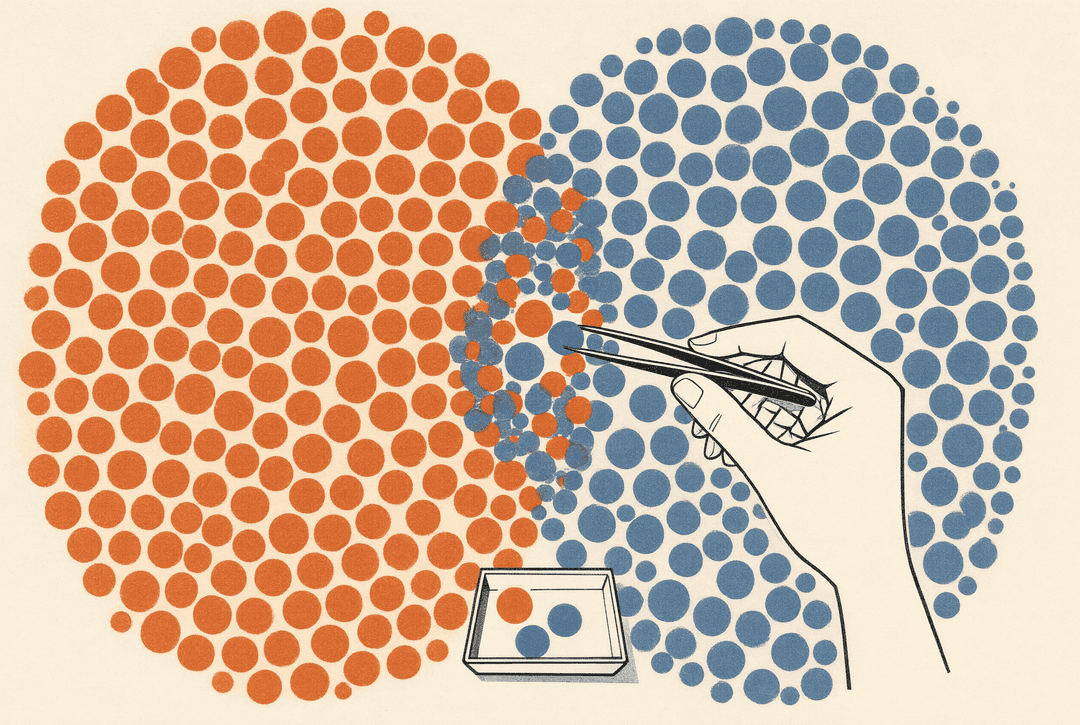
The reason all of this can work is information concentration. Google Research's Ads team described exactly that problem in a blog post from August 2025. Production ad traffic is overwhelmingly benign, under 1% of ads in their example actually violate a clickbait policy, so uniform sampling yields datasets that are ~95% examples every model classifies correctly without instruction. The useful examples cluster along the decision boundary, where "clickbait" and "benign" blur into each other, and finding them at scale is itself the engineering problem.
What it looks like now, in the LLM era
The Google Ads curation process is the cleanest published case of active learning operating on large language models. The steps, as described by Markus Krause and Nancy Chang: run a zero- or few-shot LLM over a pool of hundreds of billions of ad examples; separately cluster the examples it calls clickbait and the ones it calls benign; overlapping cluster pairs mark confusion zones; pull the nearest example pairs that carry different labels from each confusion zone; send those to human policy experts, prioritizing pairs that cover more of the search space when the review budget binds. The expert labels then split into fine-tuning and evaluation sets, and the loop repeats until model-expert agreement matches the agreement experts have with each other.
The reported numbers are unusually concrete. On two classification tasks, the curated sets needed 250 to 450 expert-rated examples per model where crowdsourced baselines used roughly 100,000, a reduction of about three orders of magnitude, and the larger fine-tuned model improved alignment with experts by 55% to 65%, measured as pairwise Cohen's Kappa. In production systems using bigger models, the team reported up to four orders of magnitude less training data at maintained or improved quality. The metric choice matters too: in content policy there is no ground truth, even experts disagree, so the ceiling for model quality is expert-expert agreement, around Kappa 0.78 to 0.81 in their experiments, and curated labels cleared that bar while bulk crowdsourced labels landed at 0.41 to 0.59 against experts.
The pattern generalizes beyond one ad-safety team. An ACL 2025 survey of LLM-based active learning, "From Selection to Generation" catalogues the current uses: selecting which data to label for fine-tuning, adapting models to new domains under budget, choosing evaluation subsets that cover edge cases, and generating entirely new informative examples rather than selecting from a pool. The survey also notes the inversion that LLMs created: the oracle itself is now often a language model, so active learning frequently means deciding where human experts should overrule the machine labelers, not whether to label at all.
Two more directions worth knowing. First, active learning applied to evaluation instead of training. Berrada and colleagues' 2025 paper "Scaling Up Active Testing to Large Language Models" builds on active testing, selecting which test instances to run a model on so that an accuracy estimate costs fewer evaluations at the same statistical confidence. When a benchmark run on a reasoning model burns millions of tokens per question, spending the evaluation budget where scores are least predictable is the same old idea in a new accounting column. Second, test-time versions. The ADAPTIVE SIFT line of work ("Efficiently Learning at Test-Time: Active Fine-Tuning of LLMs", 2024) adapts a model to each incoming test instance by actively choosing how much fine-tuning compute to spend, stopping when further updates stop paying for themselves. Related work, including the M-RARU method from a Federal Reserve working paper, uses uncertainty-driven selection to distill expensive LLM labels into cheap student models over giant text corpora.
The failure modes researchers keep finding
Active learning is easy to specify and easy to break. Three known traps:
Cold start. The selection signal comes from a model, so the model must already be good enough to know what it does not know. A query rule applied to a nearly random initial model mostly finds noise, and the literature on evaluating query strategies flags the starting budget as a parameter that decides whether active learning helps at all.
Outliers. Pure uncertainty sampling gravitates to anomalous, mislabeled, or genuinely ambiguous junk and can return to the same junk forever. This is the failure mode density weighting was invented to damp.
Assumptions about cost and distribution. Classic results assume every label costs the same and that the unlabeled pool resembles the training distribution. NeurIPS 2023 work on the pitfalls of active learning evaluation showed published gains often vanish or reverse depending on unreported design choices like query batch size and class imbalance in the pool, and a line of cost-sensitive active learning research going back to Settles's own work on real annotation costs exists precisely because expensive questions are not automatically worth asking.
One distinction to keep straight: active learning is not curriculum learning. Curriculum learning reorders fixed labeled data from easy to hard, a training-schedule decision. Active learning spends oracle attention, deciding which new labels to acquire in the first place. The two can nest, and the Google pipeline effectively does both, ordering experts through the confusable regions of the boundary.
The 1992 version is now a line item in frontier-lab and enterprise data budgets. Labeling remains the part of the pipeline that does not deflate with Moore's law, and letting the model ask its own questions is the standard mechanism for making each human answer count.
Sources
- Burr Settles, Active Learning Literature Survey, University of Wisconsin-Madison, 2009
- H. S. Seung, M. Opper, H. Sompolinsky, Query by Committee, COLT 1992
- Y. Freund, H. S. Seung, E. Shamir, N. Tishby, Information, Prediction, and Query by Committee, NIPS 1992
- B. Settles, M. Craven, An Analysis of Active Learning Strategies for Sequence Labeling Tasks, EMNLP 2008 (referenced via the survey above)
- Markus Krause, Nancy Chang, Achieving 10,000x training data reduction with high-fidelity labels, Google Research, August 7, 2025
- From Selection to Generation: A Survey of LLM-based Active Learning, ACL 2025
- G. Berrada et al., Scaling Up Active Testing to Large Language Models, 2025
- Efficiently Learning at Test-Time: Active Fine-Tuning of LLMs, 2024
- Navigating the Pitfalls of Active Learning Evaluation, NeurIPS 2023
- Federal Reserve, LLM on a Budget: Active Knowledge Distillation for Efficient Classification of Large Text Corpora
- Active learning for data streams: a survey, 2023
