
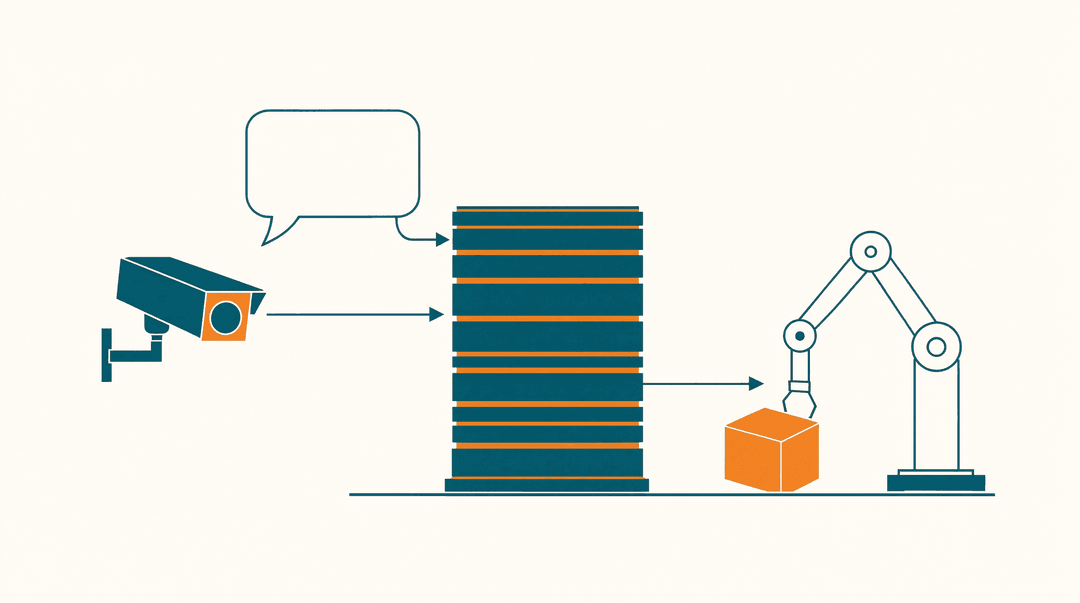
A vision-language-action model (VLA) is a neural network that takes in camera images and a text instruction and outputs robot actions: joint angles, gripper commands, the movements of an arm or a whole upper body. It is the same idea behind a chatbot — predict the next token — pointed at motors instead of a screen. The category matters because it is how the frontier-model playbook (pretrain on enormous data, inherit general knowledge, fine-tune to a niche) is being transplanted into physical robots.
The term comes from Google DeepMind's RT-2 paper of July 2023, which coined "vision-language-action models" for networks trained on both Internet-scale vision-language data and robot demonstrations (arXiv 2307.15818). The recipe was deliberately simple. Take a pretrained vision-language model, and retrain it so that robot actions are emitted as text tokens, in the same output stream as words. "In order to fit both natural language responses and robotic actions into the same format, we express the actions as text tokens and incorporate them directly into the training set of the model," the authors wrote.
Why the web data helps
The bet was that a model which has seen billions of image-caption pairs knows things no robot dataset contains: what a coffee machine looks like, what "closest to the red block" means, what an icon of a number depicts. RT-2's evaluation — about 6,000 real-robot trials — showed what the authors called emergent capabilities: placing objects onto particular numbers or icons absent from the robot training data, picking the smallest object or the one nearest another, and rudimentary multi-stage reasoning when chain-of-thought prompting was added. Semantic knowledge from the web transferred into motor behavior.
One caveat worth keeping: RT-2 was never released. As the OpenVLA paper put it, existing VLAs were "largely closed and inaccessible to the public" (arXiv 2406.09246).
The data problem, and the dataset that answered it
Robotics does not have an Internet of robot demonstrations. Conventional practice, as the Open X-Embodiment team described it, was to train "a separate model for every application, every robot, and even every environment" (arXiv 2310.08864). The answer was to pool what existed. The Open X-Embodiment collaboration assembled trajectories from 22 different robot types across 21 institutions, covering 527 skills and 160,266 tasks, in one standardized format. Their RT-X models showed positive transfer: a robot got better at its own tasks by training on other robots' data.
That corpus became the commons on which the open VLA era was built.
Three architectural answers
Since 2023, the field has converged on three design choices that are worth understanding, because they trade off against each other.
Discrete tokens. OpenVLA (mid-2024) is the reference open model: a 7-billion-parameter network built on Llama 2 with visual features fused from DINOv2 and SigLIP, trained on 970,000 real-world robot demonstrations. It outperformed the closed, 7-times-larger RT-2-X (55B) by 16.5 percentage points in absolute task success across 29 tasks and multiple embodiments. Treating actions as vocabulary entries keeps the architecture simple — one transformer, one loss — but inherits the cost of autoregressive decoding: each action element is generated one step at a time.
Continuous flow. Physical Intelligence's pi-0 (October 2024) kept the pretrained VLM backbone but added a separate "action expert" that outputs continuous actions via flow matching, the same generative technique behind modern image models (arXiv 2410.24164). The model was trained across single-arm, dual-arm and mobile manipulators and handles tasks like laundry folding and table bussing. In the paper's own comparison, the autoregressive token scheme "does not support action chunks" — predicting blocks of future actions at once — and trailed on dexterous bimanual work. Smooth, high-rate control argues against quantizing movement into words.
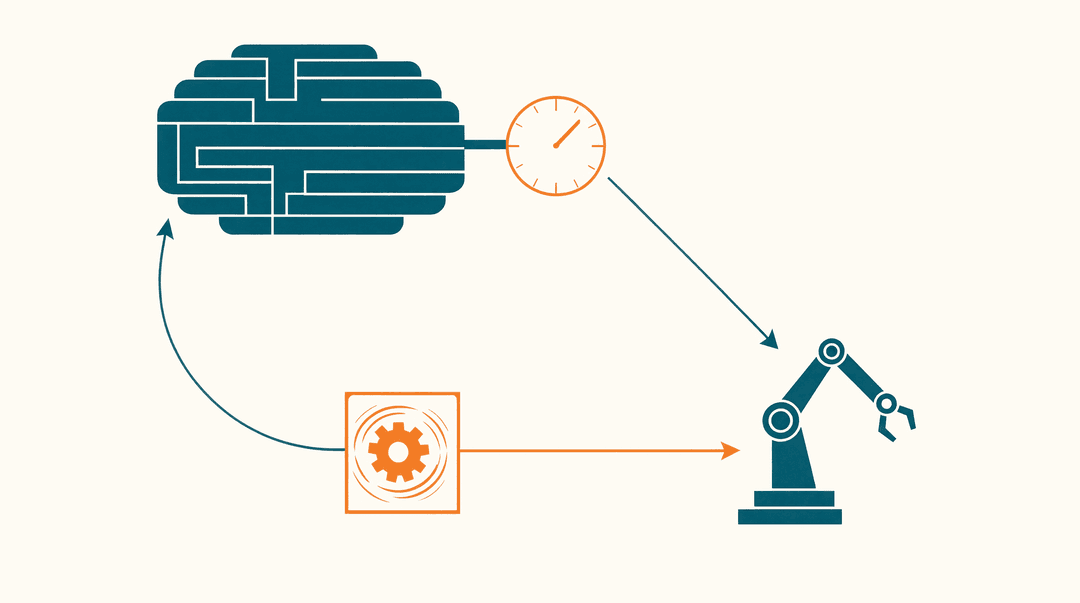
Two systems. Figure's Helix (February 2025) splits the model in time rather than in output format: a "System 2" vision-language model running at 7-9 Hz for scene and language understanding, feeding a "System 1" visuomotor policy that emits continuous whole-upper-body control at 200 Hz (Figure, Helix). One set of weights picks items, opens refrigerators, and lets two robots collaborate, running entirely on onboard embedded GPUs. Notably, Helix was trained on roughly 500 hours of supervised data — a tiny number by LLM standards — which Figure presents as evidence that VLM semantics plus a little robot data goes a long way.
Frontier labs joined
Google DeepMind's Gemini Robotics family (March 2025) adapted Gemini 2.0 directly into a VLA that controls robots, paired with Gemini Robotics-ER, an embodied-reasoning model that does detection, pointing, trajectory and grasp prediction (arXiv 2503.20020). The reported specialization numbers are the kind LLM users already recognize: long-horizon dexterity after fine-tuning, new short-horizon tasks from as few as 100 demonstrations, and adaptation to completely novel robot embodiments. NVIDIA's GR00T and smaller open models like Octo — trained on 800,000 Open X-Embodiment trajectories and fine-tunable "within a few hours on standard consumer GPUs" (arXiv 2405.12213) — fill out the ladder between the labs and the hobbyist bench.
What is still hard
The pi-0 paper states the obstacles plainly: data, generalization, robustness (arXiv 2410.24164).
- Data. Robot demonstrations must be produced by teleoperating or instrumenting physical hardware. The entire Open X-Embodiment corpus is roughly a million trajectories; LLM pretraining corpora are measured in trillions of tokens. Cross-embodiment pooling helped, but the modality has no equivalent of the web.
- Latency and control rate. Token-by-token decoding fights control loops. This pushed three separate groups toward continuous or hierarchical action generation.
- Reliability. Physical error compounds: a grasp two centimeters off is not a typo, it is a dropped object. Evaluation in VLAs still runs on tens to hundreds of trials per task, not automated benchmarks with millions of items.
- Safety. The Gemini Robotics report devotes explicit attention to safety considerations for this model class; real actuators move real things, and a model failure mode that is funny in chat can be expensive on a bench.
Why LLM readers should care
A VLA is the cleanest test yet of the claim that web-scale pretraining produces transferable world knowledge, not just fluent text. If a model that read the Internet can be fine-tuned with a few hundred demonstrations to fold laundry, the scaling argument has moved from pixels and prose into physics — and the same token-versus-continuous, single-brain-versus-two-systems design debates now play out in robots that chat and agents already run in browsers. The architecture wars that shaped language models are being rerun at 200 Hz. A broader technical survey of the field is available in the VLA literature review on arXiv (arXiv 2405.14093).
Sources
- RT-2: Vision-Language-Action Models Transfer Web Knowledge to Robotic Control — arXiv 2307.15818
- OpenVLA: An Open-Source Vision-Language-Action Model — arXiv 2406.09246
- Open X-Embodiment: Robotic Learning Datasets and RT-X Models — arXiv 2310.08864
- pi-0: A Vision-Language-Action Flow Model for General Robot Control — arXiv 2410.24164
- Octo: An Open-Source Generalist Robot Policy — arXiv 2405.12213
- Gemini Robotics: Bringing AI into the Physical World — arXiv 2503.20020
- Helix: A Vision-Language-Action Model for Generalist Humanoid Control, Figure — figure.ai/news/helix
- A Survey on Vision-Language-Action Models for Embodied AI — arXiv 2405.14093
