
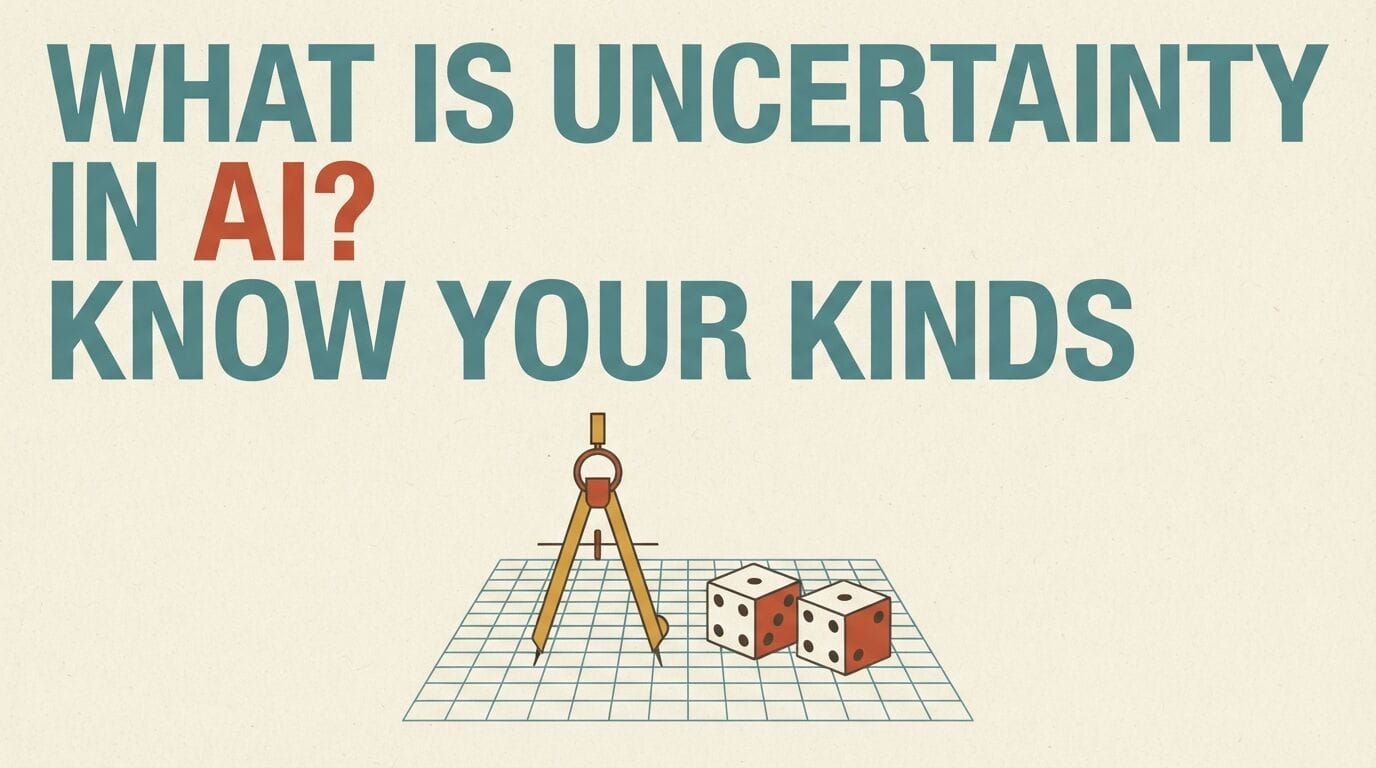
Every AI assistant expresses confidence, and almost none of them mean it the same way. A model that says "I'm 90% sure" may be reporting a calibrated estimate of its own accuracy, or recycling a number it learned to attach to fluent sentences. A model that hesitates may genuinely detect its own knowledge gap, or it may have discovered that hedging reads better to human raters. The research literature has spent a decade sorting these cases, and the core distinction is old, simple, and mostly absent from product demos: there are two kinds of uncertainty, and they require opposite responses.
Two kinds of not knowing
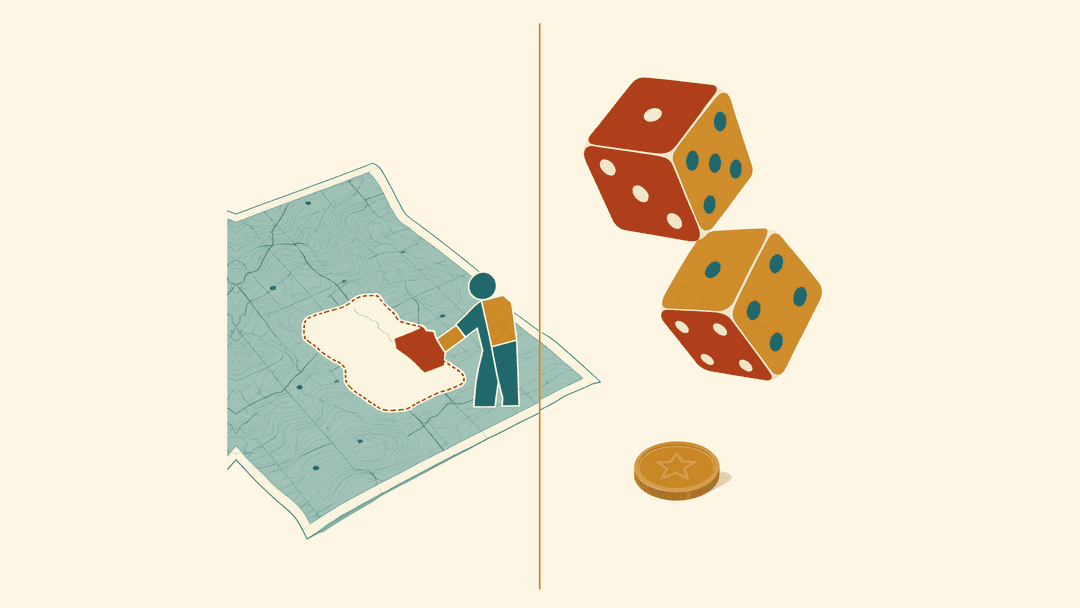
The machine learning community's standard vocabulary comes from a 2017 paper by Alex Kendall and Yarin Gal, who split predictive uncertainty into two parts. Aleatoric uncertainty is noise in the data itself. If a question has multiple acceptable answers, ambiguous wording, or a genuinely random outcome, no smarter model will resolve it. The word traces to alea, Latin for the dice game, and that connotation is precise: this uncertainty is a property of the situation, not of the system facing it.
Epistemic uncertainty is different. It is the model's own missing knowledge, and it shrinks as the model sees more relevant data. Kendall and Gal's experiments showed the behavioral signature: aleatoric uncertainty stays roughly constant across test datasets, while epistemic uncertainty drops as test data comes closer to the training distribution. One can be learned away. The other cannot.
The distinction matters because the fixes are opposite. More training data, more retrieval, and a bigger context window address epistemic uncertainty. Nothing addresses aleatoric uncertainty except refusing to commit: abstaining, hedging, or asking the user a clarifying question. A system that cannot tell the two apart will either chase noise forever or guess on questions it could actually have researched.
The numbers were never honest to begin with
Neural networks produce confidence scores by default: the softmax layer turns raw scores into a probability distribution over next tokens, and the probability assigned to the chosen answer is the cheapest available confidence signal. In 2017, Chuan Guo and colleagues published the foundational measurement problem: modern neural networks, unlike those from a decade earlier, are poorly calibrated, and depth, width, weight decay, and Batch Normalization all push them toward overconfidence. A network that claims 99% accuracy on wrong answers is more common than a network that earns its 99%.
Their remedy became the field's workhorse: temperature scaling, a single post-hoc parameter that divides the logits before the softmax, which Guo et al. found surprisingly effective at making reported probabilities track actual correctness rates. Calibration here has a strict definition. A model is calibrated if, among the questions it labels 70% confident, roughly 70% of its answers are right.
Anthropic's 2022 study of P(True) self-evaluation pushed this further in a direction that surprised skeptics: sufficiently large models, queried in the right answer format, are well calibrated on multiple-choice and true/false questions. The model's own probability that its proposed answer is true tracks its actual accuracy, and the ability improves with scale. The paper also found limits: a separate estimate of whether the model knows the answer at all (P(IK)) partially generalizes across tasks but struggles to stay calibrated on new tasks, and it rises appropriately when relevant source material sits in the context window. Self-knowledge exists, but it is format-dependent and fragile.
Can a model say it out loud?
Logit probabilities are an internal signal. What users see is language. Stephanie Lin, Jacob Hilton, and Owain Evans showed in 2022 that a GPT-3 model can be trained to express uncertainty in words ("90% confidence," "high confidence") with levels that map to well-calibrated probabilities, and that the ability appears to lean on latent representations correlated with epistemic uncertainty rather than on imitation of human examples. Their CalibratedMath suite became a standard test of whether verbalized numbers behave like probabilities.
More recent evidence is less flattering for chat assistants. Gal Yona and colleagues formalized faithful uncertainty expression as the gap between a model's intrinsic confidence and the decisiveness with which it states an answer, penalizing both over-hedging and over-committing, and found that modern aligned LLMs are poor at conveying uncertainty faithfully. Kaitlyn Zhou and colleagues tested deployed models and their users and reported three compounding problems: language models are reluctant to express uncertainty even when they are wrong; when prompted to state confidence, they tend to be overconfident, with an average error rate of 47% among confident responses; and human users lean heavily on certainty markers whether or not they are earned. Their analysis of preference-annotation datasets found the training pipeline itself biased against text containing uncertainty, which helps explain why RLHF-era assistants sound surer than their logits.
There is also a measurement trap specific to text. Two samples that differ in wording but agree in meaning are one answer, not two, so naive consistency checks overstate uncertainty. Lorenz Kuhn, Yarin Gal, and Sebastian Farquhar addressed this with semantic entropy, which clusters generated answers by shared meaning before measuring how spread out they are. It is unsupervised, uses a single model, and predicted question-answering accuracy better than comparable baselines.
Abstention, the behavior nobody grades
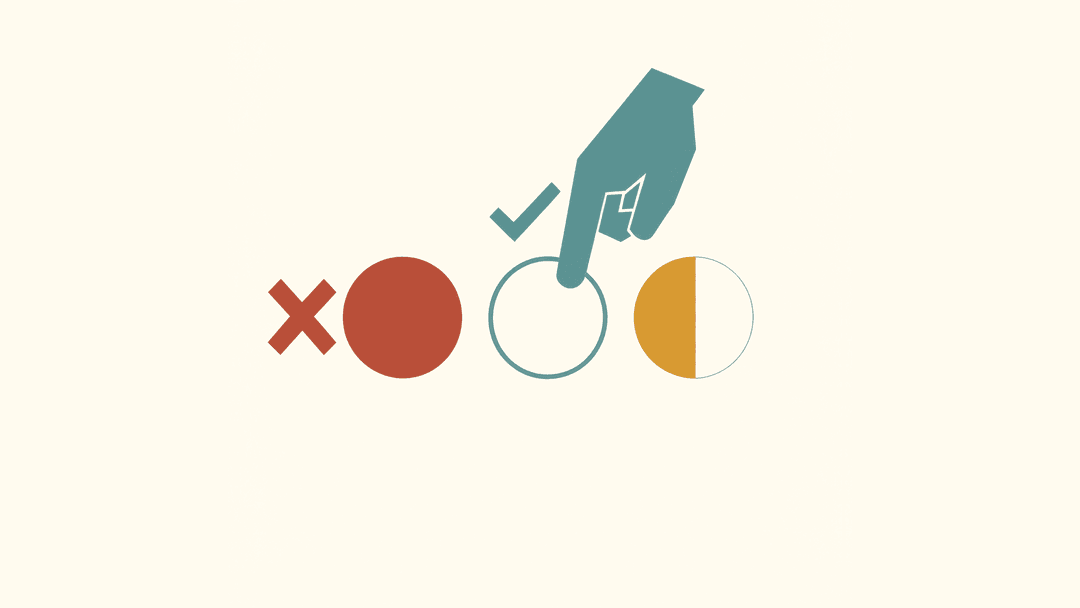
The cleanest response to epistemic uncertainty is to decline: answer when you know, say you do not know when you do not. Amita Kamath, Robin Jia, and Percy Liang studied selective question answering under domain shift and found that abstention policies built on raw softmax probabilities fare poorly because models are most overconfident exactly on out-of-domain questions. A separate trained calibrator that flags likely errors let their SQuAD model answer 56% of a mixed-domain question set at 80% accuracy, against 48% at the same accuracy when using the model's own probabilities.
Why is abstention so rare in shipped systems? OpenAI's September 2025 essay (based on this paper by Adam Kalai and colleagues) argues the incentive structure of evaluations makes confident guessing optimal. If a model guesses a birthday, it has a 1-in-365 shot at full credit; "I don't know" guarantees zero. Their worked example from the GPT-5 system card: on SimpleQA, OpenAI's older o4-mini abstained on just 1% of questions, scoring 24% accuracy but a 75% error rate, while gpt-5-thinking-mini abstained on 52% of questions with similar accuracy (22%) and only a 26% error rate. Same accuracy range, radically different reliability profile. The essay's broader point is that calibration is computationally cheaper than accuracy, so small models can know their limits, and that the fix is grading: penalize confident errors more than abstentions, and give partial credit for appropriate expressions of uncertainty.
What works today
There is no single accepted uncertainty meter. A systematic evaluation from October 2025 compared four families of methods on question answering: verbalized confidence estimates, maximum softmax probability, sample consistency across generations, and CoCoA, a hybrid. Each metric captured a different facet of confidence, and the hybrid approach produced the best overall calibration and discrimination between correct and wrong answers. That is the honest state of the field: the components are known, no one method wins everywhere, and stacking them helps.
For builders, the practical recipe that falls out of this literature is short. Measure uncertainty by sampling answers and clustering them semantically, not by trusting raw token probabilities. Calibrate the resulting numbers against ground truth before letting them drive anything, following the temperature-scaling playbook. Detect distribution shift, because calibration is worst precisely where the model is least qualified. And if you grade your models on accuracy alone, you are running an ablation study on trustworthiness with the abstention column deleted.
For users, the implication is humbler: an assistant's confidence is a claim, not a measurement, and the questions where hedging would help most are the ones where its training made hedging least likely to survive.
Sources
- Alex Kendall and Yarin Gal, What Uncertainties Do We Need in Bayesian Deep Learning for Computer Vision? (NeurIPS 2017): https://arxiv.org/abs/1703.04977
- Chuan Guo et al., On Calibration of Modern Neural Networks (ICML 2017): https://arxiv.org/abs/1706.04599
- Saurav Kadavath et al., Language Models (Mostly) Know What They Know (Anthropic, 2022): https://arxiv.org/abs/2207.05221
- Stephanie Lin, Jacob Hilton, Owain Evans, Teaching Models to Express Their Uncertainty in Words (2022): https://arxiv.org/abs/2205.14334
- Gal Yona et al., Can Large Language Models Faithfully Express Their Intrinsic Uncertainty in Words? (2024): https://arxiv.org/abs/2405.16908
- Kaitlyn Zhou et al., Relying on the Unreliable: The Impact of Language Models' Reluctance to Express Uncertainty (2024): https://arxiv.org/abs/2401.06730
- Lorenz Kuhn, Yarin Gal, Sebastian Farquhar, Semantic Uncertainty: Linguistic Invariances for Uncertainty Estimation in Natural Language Generation (ICLR 2023): https://arxiv.org/abs/2302.09664
- Amita Kamath, Robin Jia, Percy Liang, Selective Question Answering under Domain Shift (ACL 2020): https://arxiv.org/abs/2006.09462
- Adam Kalai et al., Why Language Models Hallucinate (OpenAI, September 2025): https://openai.com/index/why-language-models-hallucinate/ and https://arxiv.org/abs/2509.04664
- Anna-Carolina Haensch et al., Systematic Evaluation of Uncertainty Estimation Methods in Large Language Models (2025): https://arxiv.org/abs/2510.20460
- Merriam-Webster, word history of aleatory from Latin alea (dice): https://www.merriam-webster.com/word-of-the-day/aleatory-2021-07-09
