
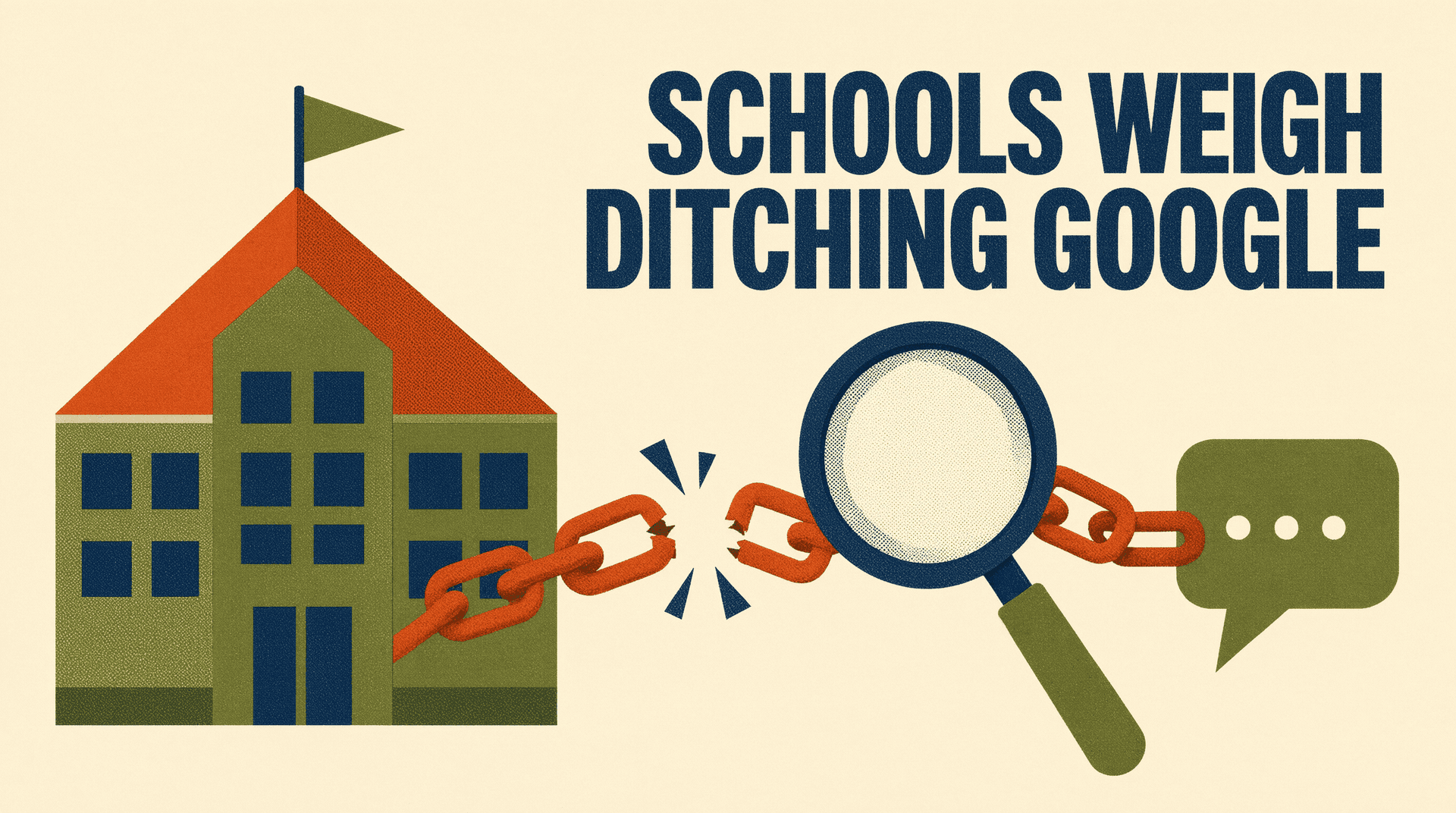
New York City, Los Angeles and Chicago, the three largest public school districts in the US, are considering alternatives to Google Search after Google this month refused to offer schools a version of search without AI chatbot features, the New York Times reported.
The policy: starting next year, Google will stop turning AI products on automatically for school accounts, and administrators will choose which services to enable. That sounds like opt-in consent, but Google education vice president Chris Phillips told the Times that "Search and AI are deeply integrated," and that schools which turn off the AI features "will not have access to Search." An AI-free school search does not exist, and will not.
The backlash was immediate
Mayor Zohran Mamdani and Senator Bernie Sanders have both called the tie-in extortion. Mamdani recently barred students in grades K-8 from using AI in New York City classrooms, which makes Google's bundling decision a direct test against his policy. Schools chancellor Kamar Samuels told the Times that "if Google doesn't reconsider their position, we will explore other search options." Chicago Public Schools told Google in writing that if no AI-free arrangement can be reached, "the district will look to other search solutions."
Los Angeles Unified moved first on the details, announcing Wednesday that it has disabled Google's AI Overviews for students while it evaluates whether Google Search actually supports student learning. The Times reports districts looking at DuckDuckGo and Microsoft's Bing, both of which offer ways to turn off AI-generated answers. No district has fully dropped Google Search yet.

What Google is offering instead
A Google spokesperson told The Verge the company is piloting "Guided Learning" features in Search this month, and that next year the Gemini app, Gemini Notebook and Search will be off by default until schools decide what to enable. Google's position is that default-off plus integration is a responsible middle path: students get modern search, schools get a switch. The district response so far is that a switch that also destroys the product it controls is not consent.
Why this matters beyond schools
This is the first serious test of whether AI feature bundling survives contact with a public buyer large enough to walk away. Regulators have watched app-store and search unbundling arguments stall in court for years; three municipal school systems issuing RFP-shaped threats move faster. If NYC, LA or Chicago actually migrate 100,000-plus students to Bing or DuckDuckGo for compliance reasons, Google's school bundle becomes a precedent problem across every vertical where it ships AI Overviews. And the buyers' logic here, protecting children from unexamined chatbot output, is the least defensible vertical for Google to hold the line in.
Google is betting that switching search engines for an entire school system is too painful to actually happen. The districts' betting that "extortion" gets expensive to defend. The next budget cycle will settle it.
Sources
- New York Times: U.S. School Districts Weigh Breaking Up With Google Search Over A.I.
- The Verge: Google is entirely disabling Search in schools that don't want AI
- The Verge: Google spokesperson Laura Breen on Guided Learning and default-off controls
- MLQ.ai summary: New York, Los Angeles and Chicago school districts weigh dropping Google Search over AI features
