
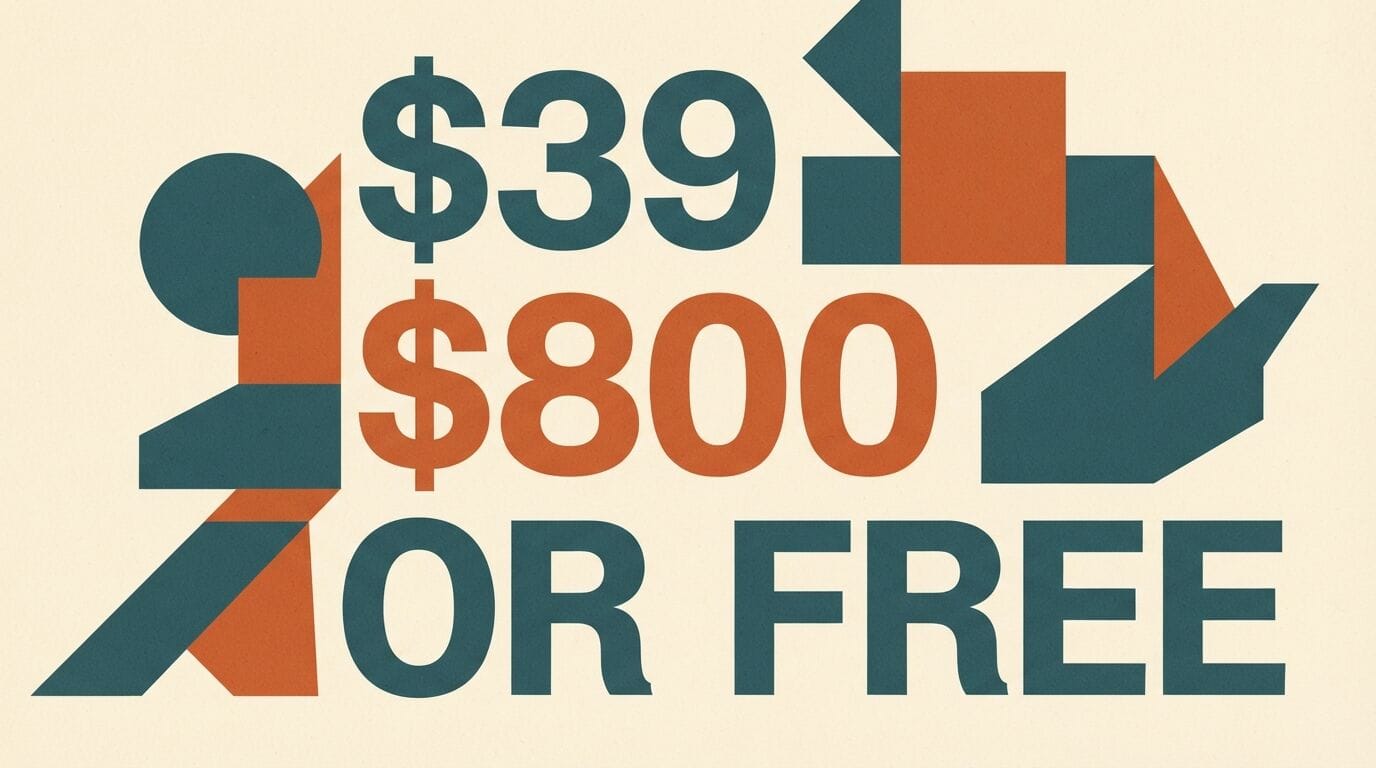
The ambient AI scribe market has split into three price tiers, and the middle one is the hardest to defend.
A clinical note drafted by an AI that listens to a doctor's conversation with a patient can now be bought for $39 a month from a self-serve startup, quoted at several hundred dollars per provider per month by an enterprise vendor, or picked up for free inside an EHR subscription a practice already pays for. The output is the same genre of artifact: a draft note, flagged for clinician review. What differs is everything wrapped around it, and the wrap is starting to look expensive.

The evidence baseline
The adoption numbers are no longer speculative. In the American Medical Association's 2026 Physician Survey on Augmented Intelligence, 81% of nearly 1,700 respondents said they use AI professionally, up from 38% in 2023. A January 2026 study in the American Journal of Managed Care found that roughly two-thirds of U.S. hospitals on Epic, about 1,744 of them, had already implemented at least one ambient AI documentation tool by mid-2025.
The most rigorous effectiveness data to date cuts the other way on scale. A JAMA study published April 1, 2026 (Rotenstein et al., Ambient Clinical Documentation Collaborative) tracked 8,581 ambulatory clinicians at five academic health systems between June 2023 and August 2025. AI scribe adoption was associated with 13.4 fewer minutes of total EHR time per day and 16.0 fewer minutes of documentation time, relative decreases of 3% and 10%, plus 0.49 more patient visits per clinician per week. Real, modest, and consistent across sites that used Abridge, Ambience and the predecessor of Microsoft Dragon Copilot.
Sixteen minutes a day is the number to hold onto, because every price tier now has to justify itself against it.
Tier one: published prices, $39 to $150
The self-serve segment is the only one with list prices you can read. Freed charges $39 a month for its Starter plan, capped at 40 notes; $79 for Core with unlimited notes; $119 ($104 billed annually) for Premier, which adds EHR push, dictation and ICD-10/CPT coding suggestions. Heidi Health runs a free tier with capped usage and paid clinician plans around $150 a month billed monthly, per vendor comparisons that checked its pricing pages in October 2026. Nabla, Sunoh and a dozen smaller tools fill the $49 to $150 band, mostly EHR-agnostic, mostly copy-paste or browser-push into the chart, mostly a solo clinician signing up with a credit card at midnight.
The cap is the tell. Freed's Starter tier metering notes rather than seats is the first sign that the standalone scribe is being rebuilt as a consumption product.
Tier two: quote-only, reportedly $200 to $800
The enterprise vendors that defined the category publish nothing. Abridge, Suki, DeepScribe, Ambience Healthcare and Commure route pricing through sales conversations; none shows a per-provider figure. The independent estimates that do circulate cluster in the hundreds: Abridge reportedly lands somewhere between about $200 and $800 per provider per month depending on source and scope, Suki around $299 to $400, Microsoft's Dragon Copilot cited between $369 and $830-plus, Ambience at $300 to $500-plus. These are analyst and procurement-blog figures, not list prices, and the vendors neither confirm nor deny them.
What the premium nominally buys: native EHR embed rather than clipboard gymnastics, billing-code and revenue-cycle modules, organization-wide BAAs, security attestations, rollout management, and a named account team. Abridge's credential is third-party rather than contractual: it was named Best in KLAS for Ambient AI in both the 2025 and 2026 reports, the only vendor to repeat, and it says it will support 80 million clinician-patient conversations this year across more than 250 health system partners.
Microsoft is the interesting case, because it publishes exactly one number. Its licensing guidance declines to state the seat price (at launch in March 2025 the company would only say pricing would be "competitive") but meters the usage: on the Physician Flex license, ambient and generative AI are charged per AI-assisted session, priced at 25 consumption units at one cent, or 25 cents, after 10 pooled sessions per license per month. Effective May 2026, Microsoft restructured billing from per-note and per-action to per-encounter. The note itself has a published marginal price of $0.25. The license to hear it does not.
Tier three: free, and that is the problem for tiers one and two
On August 13, 2026, athenahealth announced that athenaAmbient, its ambient documentation tool, was generally available to more than 170,000 clinicians on the athenaOne network, built into the EHR at no additional cost; the company says early adopters save nearly six minutes of chart work per encounter, with same-day chart completion up as much as 30%. Epic had moved first on availability: its AI Charting product, part of the Art assistant suite, went broadly available in February 2026. Epic does not publish its price, and independent reviewers who went looking found no public figure, so "included" should be read as "wrapped in whatever you already pay Epic," which is the same place athenahealth parked it.
When the chart's owner ships the scribe inside the subscription, the standalone note generator is selling a time delta, not a capability. And the JAMA delta is 16 minutes a day, a number every bundled product now matches by default.
The math, and what it implies
Run the arithmetic the buyer actually runs. If the peer-reviewed association holds, an ambient scribe buys a clinician roughly 16 minutes of documentation time per working day, about 5.5 hours a month. A $79 Freed plan therefore costs around $14 per recovered hour before considering coding uplift; a $400 enterprise seat costs about $70; the athenahealth bundle costs whatever the athenaOne contract already costs. A UCSF-led analysis of more than 182,000 encounters published in 2026 found AI scribe adopters generated measurably more visits and revenue than matched non-adopters, which is the argument enterprise vendors make for why their $400 is not four $100 seats of the cheap stuff: the revenue capture is in the coding, the downstream workflows and the deployment discipline, not the transcription.
That argument has a shelf life. The note-generation capability is now commoditized from three directions at once: $39 self-serve, free-at-the-margin bundling, and general assistants with dictation. Watch where the enterprise vendors move. Abridge is selling after-visit summaries, nursing documentation and revenue-cycle products. Suki pitches order staging. Microsoft meters per encounter, which prices the visit, not the note. athenahealth and Epic both position their free tools as the entry point to AI that suggests diagnoses and queues orders. Nobody wants to be in the note business in 2027; they want to be in the encounter business, where the EHR of record is not the only price-setting bundler.
For an individual clinician choosing today, the published-price tier is the consumer web of this market: transparent, returnable, and capped. For a health system, the only honest comparison available is a written quote from Abridge, Ambience, Suki and Microsoft, put next to the line item for the ambient tool already included in the EHR renewal that arrives whether you sign it or not. The 25-cent session is the only number in the entire market that anyone can currently hold a vendor to.
Sources
- athenahealth, "AI-native athenaOne Experiences Available to 170,000 Clinicians" (Aug 13, 2026) - athenahealth.com
- Healthcare Dive, "Epic rolls out AI charting tool as scribe market heats up" (Feb 5, 2026) - healthcaredive.com
- EurekAlert/Mass General Brigham, "AI scribes linked to modest reductions in electronic health record use and clinical documentation time" (JAMA, doi:10.1001/jama.2026.2253, Apr 1, 2026) - eurekalert.org
- Telehealth.org, "JAMA: AI Scribes Cut EHR Documentation Time for Clinicians" - telehealth.org
- Yang F, Graetz I, "Ambient AI Tool Adoption in US Hospitals and Associated Factors", Am J Manag Care (Jan 27, 2026) - ajmc.com
- American Medical Association, "More than 80% of physicians use AI professionally: AMA survey" (2026) - ama-assn.org
- Abridge, "Abridge wins #1 Best in KLAS 2026 for Ambient AI" - abridge.com
- Freed pricing page (accessed Nov 21, 2026) - getfreed.ai
- VoiceboxMD, "AI Medical Scribe Cost 2026: What 12 Vendors Charge" - voiceboxmd.com
- Chartnote, "AI Medical Scribe Pricing 2026" - chartnote.com
- IntuitionLabs, "Suki vs Nuance DAX vs Abridge vs Freed" - intuitionlabs.ai
- Lime Health AI, "Ambient Clinical Documentation Companies: The 2026 List" - getlimeai.com
- Microsoft Learn, "Dragon Copilot Licensing overview" - learn.microsoft.com
- SamExpert, "Dragon Copilot Licensing Guide" - samexpert.com
- Dictation Daddy, "Microsoft Dragon Copilot: What It Is and Who Should Switch" - dictationdaddy.com
- SCHNEIDER IT MANAGEMENT, "Microsoft Dragon Copilot: Price decrease & Licensing changes" (May 1, 2026 per-encounter billing) - schneider.im
- Holmgren AJ et al., "Ambient Artificial Intelligence Scribes and Physician Financial Productivity" - pmc.ncbi.nlm.nih.gov
- Vero, "Epic AI Scribe: Workflow, Pricing & Privacy" (no public Epic price found, Sep 2026) - veroscribe.com
