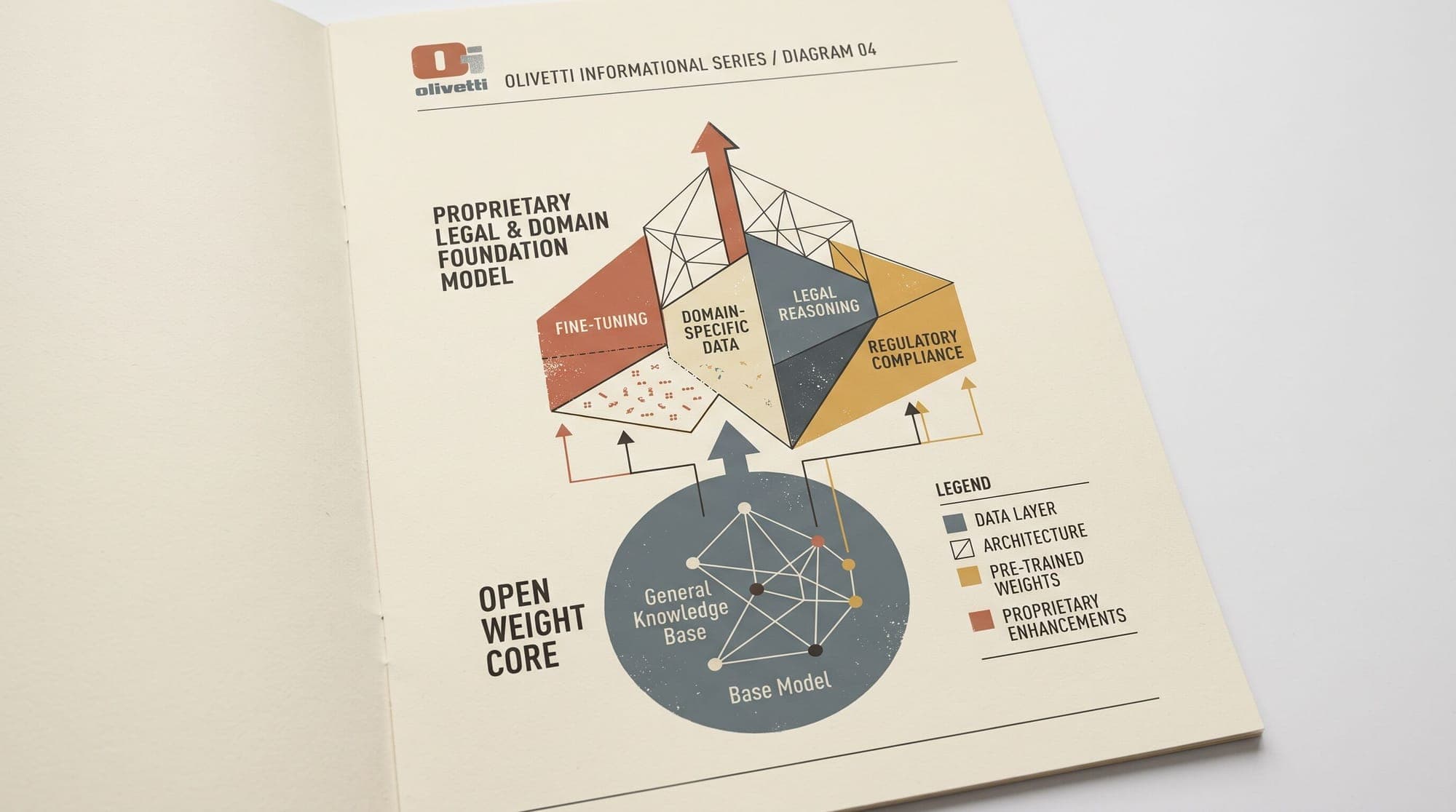
Thomson Reuters has deployed Thomson-1, a proprietary artificial intelligence model engineered from an open-weight base architecture. The system is designed to execute high-volume legal and domain-specific analytical workflows, reducing the information conglomerate's direct computational dependence on third-party frontier models like Anthropic's Claude.
According to financial reporting and recent corporate earnings disclosures, Thomson Reuters invested approximately $40 million into developing Thomson-1. The model's foundation is built upon Snowdon, a model family developed in collaboration with Imperial College London's FAIR Lab that was originally initialized by realigning Alibaba's open-weight Qwen architecture.

Benchmark Evaluations and Legal Domain Performance
In comparative evaluations published alongside the launch, Thomson Reuters reported that Thomson-1-Large achieved a score of 0.823 on the Stanford LegalBench evaluation suite. This compares to 0.843 for Google's Gemini 3.1 Pro and 0.832 for OpenAI's GPT-5.5, while exceeding Anthropic's Claude Opus 4.8 at 0.818.
On the specialized PrBench Legal Hard benchmark, Thomson-1 registered a top score of 0.352, outperforming both GPT-5.5 (0.333) and Claude Opus 4.8 (0.315). The model also posted an instruction-following metric of 0.914. Technical observers note that benchmark conditions varied across systems: Thomson-1 utilized test-time scaling configurations, while comparator models operated in distinct reasoning and non-reasoning modes.
Production Integration in CoCounsel
Thomson-1 is entering active production this month within CoCounsel, Thomson Reuters' flagship AI assistant that currently serves over one million professionals across 107 countries and territories. Initial production deployments assign Thomson-1 to handle structured document review and targeted analytical tasks, with subsequent rollouts planned for broader legal and tax modules.
The company previously deepened its partnership with Anthropic in May, connecting CoCounsel Legal into Claude through Model Context Protocol (MCP) integrations and building upon the Claude Agent SDK. Thomson Reuters Chief Technology Officer Joel Hron clarified that CoCounsel will maintain a multi-model architecture where Claude continues to handle significant workloads alongside Thomson-1.
Strategic Leverage Over Proprietary Data Assets
Thomson Reuters indicated that less than 10% of its internal content catalog has been incorporated into continued pre-training pipelines to date. This repository includes over a century of curated legal opinions, annotated statutory archives from Westlaw, practical guidance from Practical Law, and Checkpoint tax documentation.
By establishing an in-house model lineage initialized from open weights, enterprise data owners can adjust workload routing between proprietary infrastructure and external API providers. This architecture establishes structural leverage against foundation model pricing and insulates core platform capabilities from external roadmap shifts.