
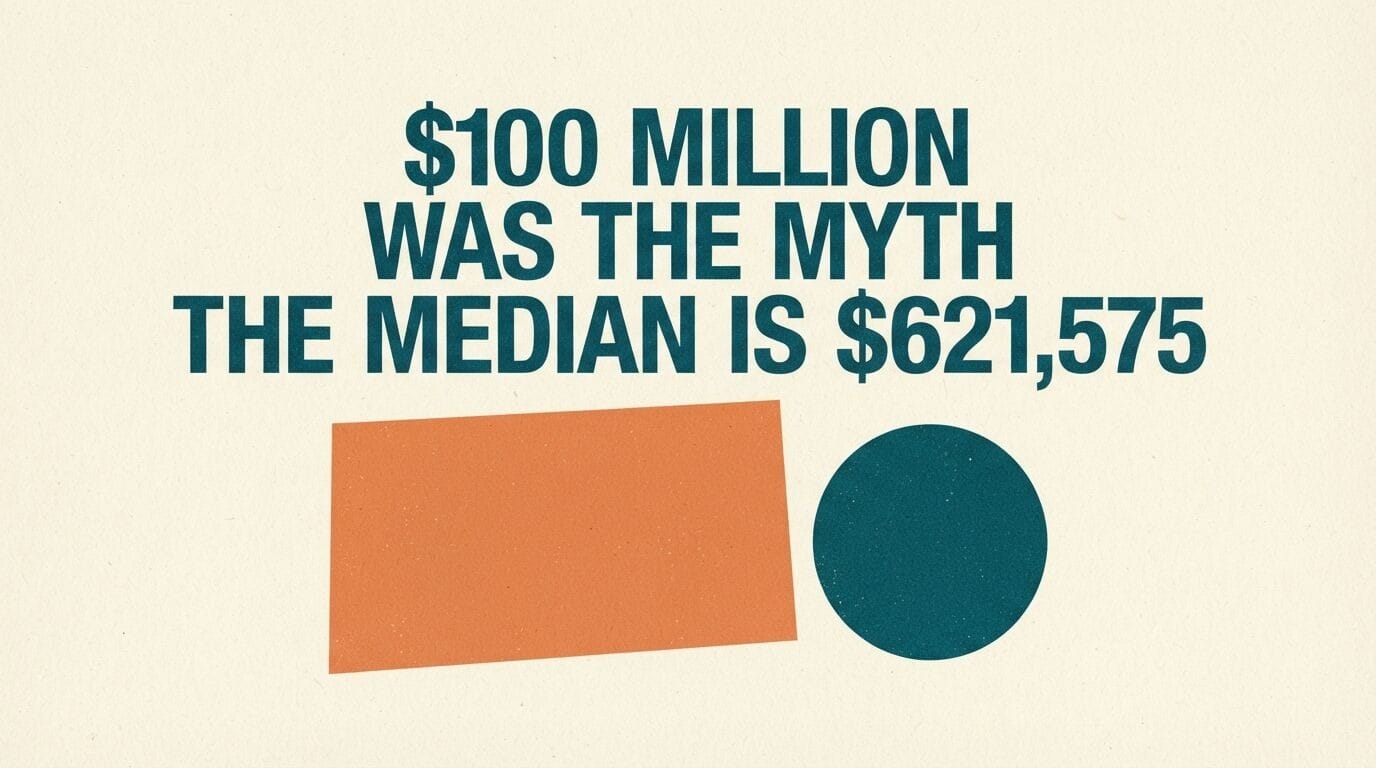
On November 19 Anthropic started trading on Nasdaq at $83 a share and closed its first day at $97.17. By the closing bell, the options and restricted stock held by its employees were worth about $270 billion at a blended average exercise price of $2.91. That number, not the signing-bonus stories of 2025, is what the frontier AI labor market actually produced: pay so heavily weighted toward private equity that its real product was wealth events, and so concentrated that the headline figures were marketing from the first day.
The $100 million claim never survived contact with the company that made it
The reference point for AI pay talk dates to June 2025, when Sam Altman said on a podcast that Meta had tried to poach OpenAI staff with signing bonuses as high as $100 million. WIRED reported that Meta Superintelligence Labs had offered top-tier research talent packages of up to $300 million over four years, with more than $100 million of total compensation in the first year, and had made at least 10 such offers to OpenAI staffers. The stock in the first year vested immediately, WIRED's sources said.
Then Meta's own CTO pushed back. Andrew Bosworth told an employee Q&A that not everyone is getting a $100 million offer: "the market's hot. It's not that hot. Okay? So it's just a lie," per the same report. A Meta spokesperson called the reported package sizes misrepresented. WIRED also noted that none of the OpenAI staffers who actually left for Meta received the $300 million offer. For scale, the article pointed out that Microsoft CEO Satya Nadella's total 2024 compensation was $79.1 million.
So the nine-figure packages were a handful of named-individual exceptions, priced like athlete trades, while the going rate for frontier talent ran in the high six and seven figures. The rest of this post is about that market.
What the pay tables say
Levels.fyi self-reported data, last updated September 2026, puts the OpenAI median total compensation across reported roles at $621,575. The software engineering ladder reads $250,000 at L2, $333,000 at L3, $652,000 at L4, $942,000 at L5, and $1.39 million at L6. Non-engineering roles are elevated too: recruiter median $580,000, product manager $750,000, engineering manager $1.38 million.
The Anthropic page, updated October 2026, shows a software engineer median of $882,500 and a staff engineer average of $1,412,500, but a median across all reported job families of just $402,350. Trust and safety sits at $198,588 and marketing at $311,933. Inside both labs the distribution is steep: the frontier premium is attached to model-shipping roles, not to the company as an employer brand.
The baseline for comparison is the Bureau of Labor Statistics, which puts the median annual wage for computer and information research scientists at $140,300 in May 2025, with even the 90th percentile at $230,630. The lab medians are roughly four to six times the occupation, and the top-of-house staff engineer figure is about ten times it. This is a two-market country, not one market with noise.

Most of the money is not cash
The part of these packages you can spend is much smaller than the totals. Department of Labor wage filings, aggregated by H1BData, show median reported base salaries around $310,000 at OpenAI and about $300,000 at Anthropic. The gap between roughly $300,000 of salary and $900,000-plus of total comp is equity, and until late 2025 that equity was nearly illiquid private paper. OpenAI pays its equity in profit participation units, a partnership-interest instrument rather than stock, and Levels.fyi shows both labs on standard four-year, 25 percent-per-year vesting for reported offers.
What changed the calculus is not the signing bonuses. It is that the tenders worked.
The liquidity lane is the real compensation story
US startup tender offers reached $18.4 billion in 2025, with 396 tenders executed on Carta, up 62 percent year over year. OpenAI's autumn 2025 tender began with a $6 billion target, expanded to $10.3 billion to absorb investor demand, and still closed at roughly $6.6 billion sold, leaving about $4 billion of buy interest unfulfilled. PitchBook notes employees at these companies routinely transact above prevailing secondary marks, the opposite of the discount that normally applies to private shares.
The holdouts were paid. OpenAI's late-2024 tender was struck at a $157 billion valuation; the company is later valued at $852 billion, and The Information counted roughly $14 billion in cumulative employee cash-outs at OpenAI and Anthropic, with OpenAI alone completing at least eight share sales worth more than $9 billion to staff in five years. Anthropic's most recent private tender, at a $350 billion pre-money valuation, came in undersubscribed because employees preferred to wait for the IPO, per the same PitchBook report, which also has Anthropic annualized revenue above $30 billion, up from roughly $9 billion at the end of 2025. The IPO then delivered the largest debut on record: $81.3 billion raised, a fully diluted value near $1.5 trillion, and a first-day close 17 percent above the offering price.
For compensation teams this is the mechanism that the nine-figure signing bonuses were a sideshow to: a senior engineer hired in 2024 at a modest seven-figure package ended 2026 holding paper priced first in a $350 billion pre-money tender and then in a $1.5 trillion listing. A company cannot counter-offer that with cash.
Money bought volume, not loyalty
Retention data says the checks did not do what they were advertised to do. SignalFire's State of Talent report has two-year retention at 80 percent for Anthropic, 78 percent for Google DeepMind, 67 percent for OpenAI, and 64 percent for Meta, the lab that made the largest reported offers. Anthropic's tech offer acceptance rate was 88 percent. Net flows favor it too: OpenAI researchers moved toward Anthropic about 8:1 against the reverse direction, and DeepMind about 11:1, per SignalFire data cited in coverage of its hiring. Dario Amodei declined to match the Meta packages, saying the company was "not willing to compromise our compensation principles" and, on mission, that "you can't buy alignment with a mission."
The countermeasures elsewhere were expensive and defensive. Fortune, citing Reuters, reported that OpenAI offered retention bonuses above $2 million and equity packages exceeding $20 million to deter moves to Ilya Sutskever's new lab, and that Google DeepMind put six-to-12-month noncompetes on some researchers, paying them full salary while sidelined. OpenAI's chief research officer Mark Chen described the Meta raids in an internal note as feeling "as if someone has broken into our home and stolen something," per WIRED. Two years on, the lab that refused to spend like that has the public listing.
A new mandatory line item: immigration
One cost multiplier is now policy. A September 19, 2025 proclamation conditioned certain new H-1B petitions on a $100,000 payment from the employer; a federal court in Massachusetts vacated the implementing guidance in June 2026 in State of California v. Mullin, with DHS appealing, so labs are budgeting around a contested six-figure per-hire surcharge. The demand side is not obviously elastic: an NBER working paper on the H-1B wage gap simulates that even with a $100,000 fee, 45 to 64 percent of recent H-1B hires would still be hired, because employers' payroll savings on these roles exceed the fee. Labs are exactly the employers with the most savings to protect.
What a frontier hire actually costs
Strip the myth and the arithmetic is mundane. A mid-senior OpenAI engineer prices at about $942,000 a year on Levels.fyi data, of which the cash portion is roughly a third. Fifty of them cost more than $45 million annually before the eight-figure retention refreshes reported at the top of the ladder. That is small change against a lab with $30 billion in run-rate revenue and compute programs that cost billions per training run, which is the honest frame: frontier labs did not outbid the market for bodies, they outbid it for equity, and the tenders and the IPOs that made the equity real are what changed talent flows. The $100 million signing bonus was always a press release about one person. The $621,575 median is the market, and after the Anthropic debut it has become the most liquid market in venture history.
Sources
- Fortune: Meta's $100 million signing bonuses and the extreme AI talent war
- WIRED: What Mark Zuckerberg is offering top AI talent
- Levels.fyi: OpenAI salaries and Anthropic salaries, OpenAI PPU explainer
- US Bureau of Labor Statistics: Computer and Information Research Scientists
- H1BData: DOL wage filing aggregates
- PitchBook: Employees at mega-IPO candidates are opting out of tender offers
- Canadian HR Reporter citing The Information: $14 billion in AI employee cash-outs
- CNN: Anthropic IPO live updates and CNBC: Anthropic IPO
- Business Insider via Yahoo Finance: Anthropic employee holdings at first close
- SignalFire: Anthropic talent retention analysis
- TechFundingNews: Anthropic's top 2026 hires and Amodei compensation quotes
- USCIS: H-1B specialty occupations, $100,000 payment and court vacatur
- NBER Working Paper 34793: The H-1B Wage Gap
