
Mercury 3, Claude Haiku 5.5, and GPT-6 Luna are the small, fast, low-cost models from Inception, Anthropic, and OpenAI. All three list a context window of about 1M tokens and input prices of $0.20 per million tokens or less. They differ in how they generate text, how fast they run, and how each vendor describes their quality. This guide compares them as of October 2026 on speed, price, and quality, using only figures that the vendors or Artificial Analysis state.
For the next tier up, see our Claude Sonnet 5.5 vs GPT-6.1 Sol vs Gemini 3.8 Flash comparison. For the top models, see Gemini 4 Argon vs GPT-6 Astra vs Claude Opus 5.5. For prices across all vendors, see our LLM API pricing guide.
Model names and IDs
All three names match the vendors' own pages:
- Mercury 3 from Inception: API model
mercury-3, per Inception's models documentation. Inception announced it on October 19, 2026, in Diffusion at Scale: Introducing Mercury 3. The company's site and blog use the name "Inception." Mercury 3 is a diffusion language model; Inception calls its models "dLLMs." - Claude Haiku 5.5 from Anthropic: Claude API ID
claude-haiku-5-5, per Anthropic's models overview. Anthropic launched it on October 7, 2026, in Introducing Claude Haiku 5.5. - GPT-6 Luna from OpenAI: model ID
gpt-6-luna, per OpenAI's model page.
One note on Mercury: Inception's models page says Mercury 2 and Mercury 2.5 "are no longer available to new users. Existing customers with usage before October 19, 2026 will keep access until November 15, 2026."
Speed
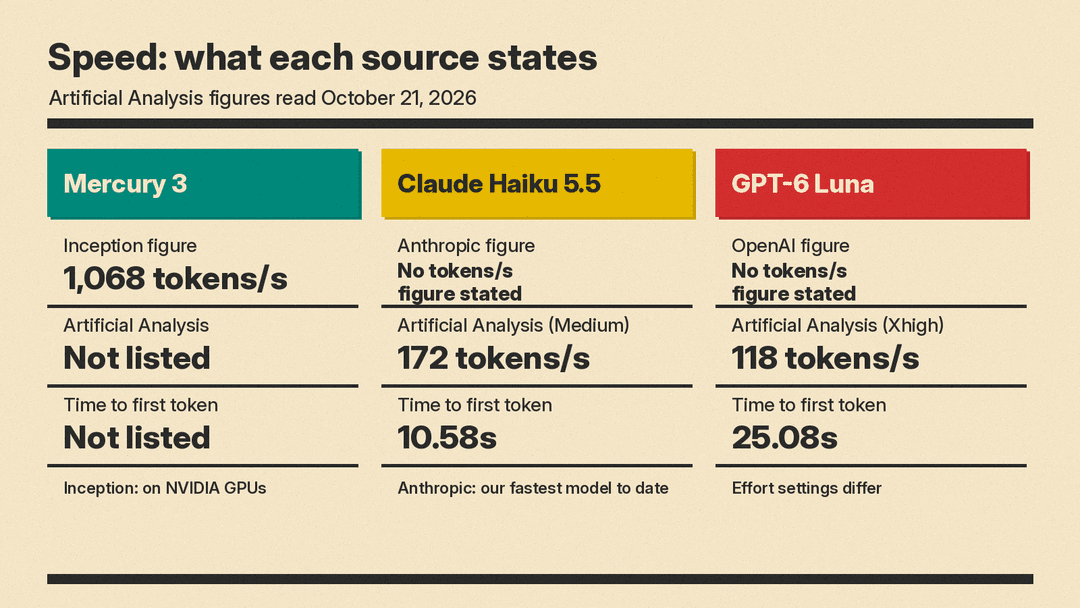
Speed figures come from different sources and methods. Read each one with its source.
Mercury 3
- Inception's launch post (October 19, 2026) lists "Speed: 1,068 tokens per second on NVIDIA GPUs."
- The same post says Mercury 3 outperforms GPT-6 Luna and Claude Haiku 5.5 "while running" 4 to 8 times faster "at 1,000+ tokens per second."
- Inception's models page says its models "run at 1000+ tokens per second on commercial NVIDIA GPUs" and that its dLLMs "deliver frontier LLM quality at 5x greater speed."
- Artificial Analysis had no Mercury 3 page when we checked on October 21, 2026, so we have no independent speed figure for it.
Two partner quotes in the launch post give latency examples. Octen AI says Mercury 3 had "a median generation time of 0.9 seconds and a median end-to-end response time of 2.2 seconds" in its Sense API tests. RevisionDojo says "Hints, marked answers and definitions now come back in about a second." These are customer reports, not standard benchmarks.
Claude Haiku 5.5
- Anthropic's launch post says Haiku 5.5 is "our fastest model to date," with a footnote: it is the fastest "at each model's standard speed, although it runs less quickly than our Opus models in Fast Mode."
- The models overview lists its comparative latency as "Fastest" in the current Claude lineup.
- Anthropic gives no tokens-per-second figure.
- Artificial Analysis, read October 21, 2026, lists Claude Haiku 5.5 (Medium) at an output speed of 172 tokens/s and a time to first token of 10.58s.
GPT-6 Luna
- OpenAI's GPT-6 guide labels GPT-6 Luna "Fastest and most cost-effective" within the GPT-6 family. The model page calls it "Our most efficient model for focused, high-volume tasks."
- OpenAI gives no tokens-per-second figure for GPT-6 Luna.
- On the same Artificial Analysis page, read October 21, 2026, GPT-6 Luna (Xhigh) has an output speed of 118 tokens/s and a time to first token of 25.08s.
- Artificial Analysis did not show an output speed for GPT-6 Luna (Medium) on its Medium vs Medium comparison when we checked.
Artificial Analysis defines output speed as "Tokens per second received while the model is generating tokens." Its figures "represent performance of the model's first-party API." The numbers update over time, and the effort settings above are not the same for the two models.
Price per million tokens
Mercury 3
From Inception's models documentation:
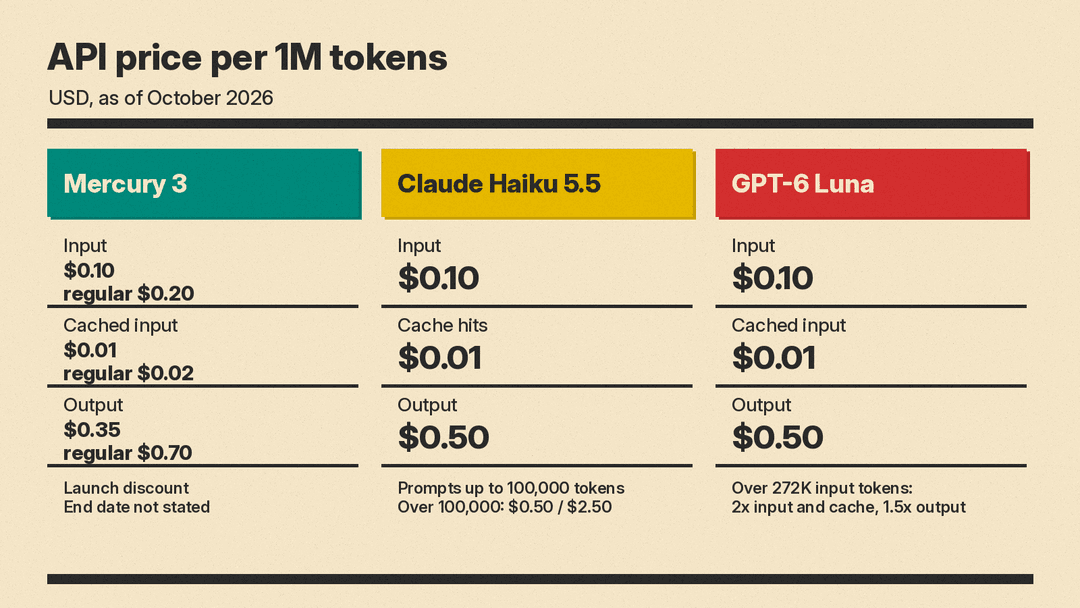
- Input: $0.20, now $0.10 with the launch discount
- Cached input: $0.02, now $0.01
- Output: $0.70, now $0.35
The launch post says: "At launch, Mercury 3 is 50% off at $0.10 per 1M input and $0.35 per 1M output. Cached tokens are 90% off the input price." Inception does not state an end date for the launch discount on the pages we checked. The models page also says "New API keys come with 100 million free tokens."
Claude Haiku 5.5
From Anthropic's pricing page, Haiku 5.5 is priced by prompt length:
- Prompts up to 100,000 tokens: $0.10 input, $0.50 output, $0.01 cache hits, $0.125 for 5-minute cache writes, $0.20 for 1-hour cache writes
- Prompts over 100,000 tokens: $0.50 input, $2.50 output, $0.05 cache hits, $0.625 for 5-minute cache writes, $1 for 1-hour cache writes
- Batch: $0.05 input and $0.25 output up to 100,000 tokens; $0.25 input and $1.25 output over 100,000 tokens
Anthropic says "a request whose prompt is over 100,000 tokens pays higher prices" and that a prompt's length "counts all of its input tokens, including cache reads and cache writes." The launch post says Haiku 5.5 "is especially good value when used for tasks with prompts up to 100,000 tokens, which make up around 90% of requests to our previous Haiku model." Anthropic lists no promotional price for Haiku 5.5.
GPT-6 Luna
From OpenAI's pricing page and model page:
- Standard: $0.10 input, $0.01 cached input, $0.125 cache writes, $0.50 output (model page)
- Batch: $0.05 input and $0.25 output (pricing page)
- Fast: $0.20 input and $1.00 output (pricing page)
The model page says "Prompts with more than 272K input tokens are priced at 2x input and cache rates and 1.5x output for the full request." Output goes up 1.5x, not 2x. Input and cache rates go up 2x. The page also says "Batch and Flex are priced at 50% of Standard rates" and "Fast mode is priced at 2x the applicable rates." OpenAI lists no promotional price for GPT-6 Luna.
Quality, as each source reports it
No single source tests all three models on the same benchmarks. Each claim below names its source.
Inception's claims for Mercury 3
From the launch post, published October 19, 2026:
- "Across a range of benchmarks, Mercury 3 outperforms GPT-6 Luna and Claude Haiku 5.5."
- "Quality: On par or better than frontier speed-optimized models like GPT-6 Luna and Claude Haiku 5.5."
- Inception says "intelligence across a range of standard benchmarks has risen 3x from Mercury 1 (mini) to Mercury 3."
- TinyFish AI, a partner, says Mercury 3 "completed 50%" of "50 live Mind2Web navigation tasks," "significantly more than GPT-6.1-Sol."
The launch post shows its benchmark results as charts, and its text does not list Mercury 3's scores, so we do not quote any. Inception's models page uses milder words: "Comparable quality to cost-optimized frontier models like GPT-6 Luna (medium) and Claude Haiku 5.5 (medium)."
Anthropic's figures for Claude Haiku 5.5
From the Haiku 5.5 launch post, published October 7, 2026. Anthropic's table includes GPT-6 Luna, but not Mercury 3, which launched later:
- GDPval-AA v2.1: Haiku 5.5 1620, GPT-6 Luna 1437
- AA-Briefcase v1.1: Haiku 5.5 1578, GPT-6 Luna 1336
- OSWorld 2.1 (offline subset): Haiku 5.5 72.4%, GPT-6 Luna 48.9%
- Terminal-Bench 4.0: Haiku 5.5 39.2%, GPT-6 Luna 16.4%
- FrontierCode 1.1 (Main): Haiku 5.5 46.4%, GPT-6 Luna 42.4%
- Chartography (no tools): Haiku 5.5 46.4%, GPT-6 Luna 29.1%
- Humanity's Last Exam: Haiku 5.5 45.9% no tools and 57.4% with tools; no GPT-6 Luna figure
Anthropic adds that "Sonnet 5.5 and Opus 5.5 remain better choices for complex agentic coding tasks" and that Haiku 5.5 "is best suited to more narrowly scoped tasks." The launch post calls Haiku 5.5 "the cheapest, fastest, and most capable small model we've ever released."
OpenAI's description of GPT-6 Luna
OpenAI's GPT-6 guide describes GPT-6 Luna as "Strong performance for focused, high-volume tasks." The pages we checked give no benchmark scores for GPT-6 Luna.
Artificial Analysis Intelligence Index
Artificial Analysis runs the same tests on Haiku 5.5 and GPT-6 Luna. Its Intelligence Index v4.3.2, read October 21, 2026:
- Claude Haiku 5.5 (Medium): 34
- GPT-6 Luna (Medium): 30
- GPT-6 Luna (Xhigh): 35
- On its Max vs Max page: Claude Haiku 5.5 (Max) 43, GPT-6 Luna (Max) 38
Artificial Analysis had no Mercury 3 results on October 21, 2026.
Context, output, and features
Mercury 3
From Inception's models documentation:
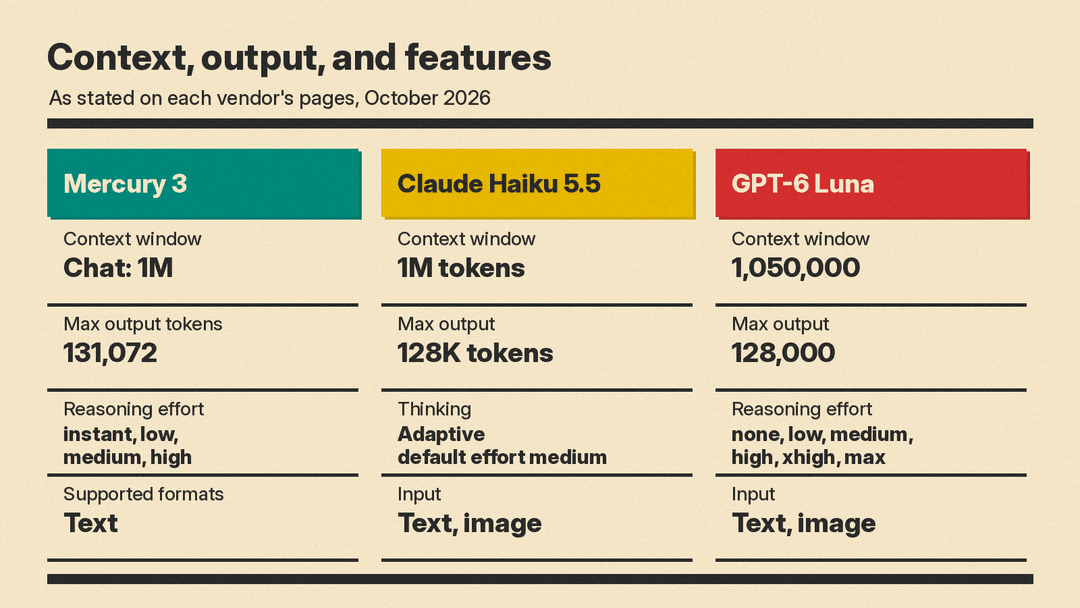
- Context window: "Chat: 1M"
- Max output tokens: 131,072
- Reasoning effort:
instant,low,medium, andhigh - Supported formats: text
- Features: tool calling and structured outputs
- Endpoint:
v1/chat/completions - Temperature: "adjustable from 0.5 to 1.0"
The launch post says Mercury 3 is "OpenAI API compatible" and "available today on the Inception API Platform and through OpenRouter, Baseten, and Vercel."
Claude Haiku 5.5
From Anthropic's models overview:
- Context window: 1M tokens
- Max output: 128K tokens
- Input: text and image; output: text
- Thinking: "Adaptive." Default effort:
medium. - Reliable knowledge cutoff: June 2026
Anthropic says Haiku 5.5 "is our first Haiku-class model to come with an adjustable effort setting." It is "available now on all platforms, including Amazon Web Services, Google Cloud, and Microsoft Azure."
GPT-6 Luna
From OpenAI's model page:
- Context window: 1,050,000 tokens
- Max output: 128,000 tokens
- Input: text and image; output: text
- Knowledge cutoff: May 18, 2026
- Reasoning effort:
none,low,medium(default),high,xhigh, andmax - Rate limits (Build tier): 5,000 RPM and 2,000,000 TPM
The model page says "Chat Completions supports function calling only with reasoning_effort set to none" and "EU data residency is available with Standard, Fast, Flex, and Batch processing."
Which one should you pick?
These suggestions follow the figures above and what each vendor says the model is for. They are not results of our own testing.
Pick Mercury 3 if
- Speed per request is your main need and you accept a vendor-stated figure of 1,068 tokens per second until independent tests appear.
- You want the launch prices of $0.10 input and $0.35 output, and you plan for the regular $0.20 and $0.70 when the discount ends.
- Your app already uses the OpenAI API format, since Inception says Mercury 3 is "OpenAI API compatible."
- Your inputs are text only. Inception lists text as the supported format.
Pick Claude Haiku 5.5 if
- You want vendor benchmark results against GPT-6 Luna. Anthropic's launch table shows Haiku 5.5 ahead of GPT-6 Luna on every row where both have a score.
- Your prompts stay at or below 100,000 tokens, where Haiku 5.5 costs $0.10 input and $0.50 output.
- You run subagents under Claude Opus 5.5 or Sonnet 5.5. Anthropic says Haiku 5.5 "pairs well with Opus 5.5 and Sonnet 5.5 as a subagent on coding work."
- You need image input. Inception lists text as the only supported format for Mercury 3.
Pick GPT-6 Luna if
- You use OpenAI tools such as web search, file search, code interpreter, and computer use, which the model page lists as supported in the Responses API.
- You want to turn reasoning off for simple calls. OpenAI lists a
nonereasoning effort for GPT-6 Luna. Mercury 3 listsinstantas its lowest effort. - Your prompts go above 100,000 tokens but stay at or below 272K, where GPT-6 Luna keeps its short-context price of $0.10 input and $0.50 output.
- You need EU data residency with Batch or Flex processing.
Summary
- Mercury 3 (
mercury-3): $0.10 input and $0.35 output at launch (regularly $0.20 and $0.70). 1M context, 131,072 max output. Inception states 1,068 tokens per second on NVIDIA GPUs. Inception's own quality claims; no independent results yet. - Claude Haiku 5.5 (
claude-haiku-5-5): $0.10 input and $0.50 output up to 100,000 prompt tokens; $0.50 and $2.50 above. 1M context, 128K max output. Artificial Analysis: 172 tokens/s at Medium effort (read October 21, 2026). - GPT-6 Luna (
gpt-6-luna): $0.10 input and $0.50 output; prompts over 272K input tokens cost 2x for input and cache and 1.5x for output. 1,050,000 context, 128,000 max output. Artificial Analysis: 118 tokens/s at Xhigh effort (read October 21, 2026).
Speed and quality figures come from different sources and settings. Test the three models on your own workload before you choose.
Sources
- Inception: Diffusion at Scale: Introducing Mercury 3
- Inception: Models
- Inception docs: Models
- Anthropic: Introducing Claude Haiku 5.5
- Anthropic: Models overview
- Anthropic: Pricing
- OpenAI: GPT-6 Luna model page
- OpenAI: Using GPT-6
- OpenAI: API pricing
- Artificial Analysis: Claude Haiku 5.5 (Medium) vs GPT-6 Luna (Xhigh)
- Artificial Analysis: Claude Haiku 5.5 (Medium) vs GPT-6 Luna (Medium)
- Artificial Analysis: Claude Haiku 5.5 (Max) vs GPT-6 Luna (Max)
- llms.blog: Claude Sonnet 5.5 vs GPT-6.1 Sol vs Gemini 3.8 Flash
- llms.blog: Gemini 4 Argon vs GPT-6 Astra vs Claude Opus 5.5
- llms.blog: LLM API Pricing Compared (October 2026)
