
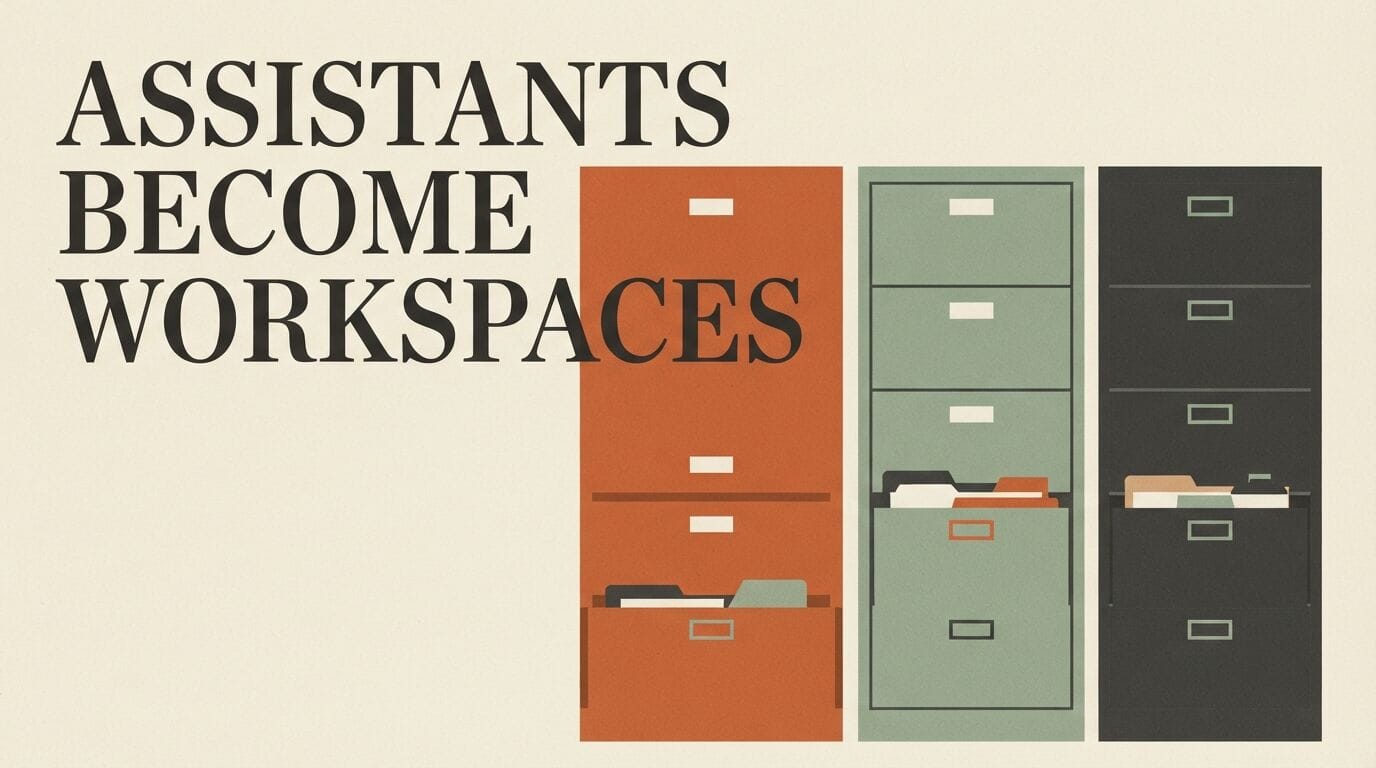
In 2026, ChatGPT, Claude, and Gemini converged on identical workspace skeletons featuring containers, scoped instructions, and memory layers, but they differ significantly in memory isolation, source scalability, and provider portability. ChatGPT enforces strict fences around shared projects, Claude blends account memory by default while offering explicit import/export tools, and Gemini integrates extensive source limits up to 600 files via NotebookLM sync.
Sometime in 2026, the consumer AI assistants stopped being chat windows. ChatGPT, Claude and the Gemini app now all ship the same three primitives: a container that groups chats and files, a scoped instruction set, and a memory layer that decides what survives between conversations. The bones are identical. The differences are in the fine print, and the fine print is where the lock-in lives.
The shared skeleton
All three vendors converged on the same design. ChatGPT Projects "keep related chats, files, and instructions together" so the model can reuse that context. Claude Projects are "self-contained workspaces with their own chat histories and knowledge bases." Google's version, notebooks in the Gemini app, launched in April 2026 as "personal knowledge bases shared across Google products," holding chats, source files and one set of custom instructions per notebook.
Each container carries its own instructions that override or sit beside your global ones, its own file uploads, and its own memory rules. If you have used any one of them, you know the shape of all three.

ChatGPT: strict fences around shared work
ChatGPT's distinguishing move is memory scoping. OpenAI's memory documentation lists what personalization can draw on: past chats, saved memories, custom instructions, files in Library or Space, and content from connected apps such as Gmail. Inside a project, project instructions replace your global custom instructions.
The isolation rules matter most for teams. Shared projects are automatically switched to "project-only" memory and cannot be switched back. Members of a shared project get none of your personal memories or custom instructions, and your ordinary chats cannot reach into the project either. OpenAI offers project sharing on every plan, Free through Enterprise, with chat or edit access per invitee. Files and responses can be saved into the project as reusable sources, and chats can be branched rather than co-edited in real time.
OpenAI is also consolidating its customization layer. The company's Custom GPT retirement FAQ sets December 11, 2026 as the standard retirement date for custom GPTs, with new GPT creation in affected Enterprise workspaces already ended October 26, 2026 and a deferred date of February 11, 2027 for FedRAMP and qualifying workspaces. The migration path to ChatGPT plugins carries over instructions (converted into a skill), knowledge files and connected apps. Custom actions, the selected model and sharing settings do not come along.
Claude: memory everywhere by default, sharing only up top
Claude runs the opposite defaults. Per Anthropic's help center, memory is on by default for Free, Pro, Max and Ultra, and Claude saves it as individual topics during the chat rather than a summary written after the fact. Sensitive subjects such as health are excluded unless you opt in. Team and Enterprise are the reverse: an owner must enable it first.
Project memory in Claude leaks less strictly than ChatGPT's shared-project fence. Each project keeps its own memory, but Claude combines it with your account-wide memory unless you explicitly turn off "Use account memory" in the project settings. Personalization is the default posture; separation is opt-in.
On the knowledge side, paid Claude plans get automatic RAG scaling for projects: when a project's knowledge base approaches the context limit, retrieval mode expands capacity by up to 10x. Free accounts can hold five projects. Sharing projects, however, is gated to Team and Enterprise plans, where ChatGPT shares across all tiers.
Claude is also mid-redesign. A beta version of projects, rolling out first through Claude Code to Pro, Max and Ultra subscribers, turns a project into a single conversation that Claude breaks into parallel threads running in the cloud, which keep going after you close the laptop. And in a rare bit of platform courtesy, Anthropic ships memory import and export so you can carry your saved topics in from other assistants, a feature it still labels experimental.
Gemini: the workspace that is also a research tool
Google's notebooks borrow their muscle from NotebookLM. Because notebooks sync with NotebookLM, sources added in the Gemini app also feed features like Video Overviews and Infographics, which neither competitor matches natively. Subscription tiers decide volume: the Gemini apps help page lists up to 600 sources per notebook depending on your Google AI plan. Notebook memory is explicit but conditional: Gemini considers past chats in a notebook only while "Keep Activity" is on, and the feature shipped initially without Workspace, Education or under-18 accounts, per Google's launch footnote. Free users got notebooks in April 2026.
Google is retiring its older personalization primitive on a schedule that mirrors OpenAI's. Its Workspace Updates announcement replaces Gems with "skills," reusable instructions callable inside any conversation. Gems move to the Settings panel on November 17, 2026, support starts ending on personal accounts in November 2026, and business, enterprise and nonprofit accounts keep them no sooner than March 1, 2027, with education until June 1, 2027. Remaining Gems auto-migrate to draft skills.
Where the differences actually bite
Three comparisons decide which workspace fits which workflow.
Memory boundaries. ChatGPT walls off shared projects completely and irreversibly. Claude blends account memory into projects by default. Gemini keeps memory inside the notebook and switches it off with activity controls. If you alternate between private and team context all day, ChatGPT's model is the safest. If you want one assistant that knows everything you know, Claude's is.
Scale of sources. Claude scales big single workspaces with 10x RAG expansion on paid plans. Gemini lets you stack up to 600 sources per notebook on top plans and turns them into study artifacts. ChatGPT's projects lean on connected apps like Slack and Google Drive links instead of raw upload volume.
The persona layer is being rebuilt at both vendors. OpenAI is collapsing custom GPTs into plugins by December 11, 2026; Google is collapsing Gems into skills between November 2026 and mid-2027. Both migrations lose settings (custom actions and model choices at OpenAI, Studio flow steps at Google). Anything important configured in the old layer should be inventoried now, not at the deadline.
The switching cost is your context
The containers are free to recreate. The accumulated memory and file bases are not, which makes them the real lock-in of the assistant era. Only Anthropic currently offers a formal door out and in: memory export and import across providers, experimental as it is. If you are choosing a primary workspace today, the feature lists are roughly equal; the escape hatches are not.
Sources
- OpenAI Help Center: Projects in ChatGPT
- OpenAI Help Center: Memory in ChatGPT
- OpenAI Help Center: Custom GPT retirement and migration FAQ
- Claude Help Center: What are projects?
- Claude Help Center: Use Claude's chat search and memory to build on previous context
- Claude Help Center: Import and export your memory from Claude
- Anthropic: Claude's memory works everywhere, and you decide what's in it
- Google: Try notebooks in Gemini to easily keep track of projects
- Google Support: Organize your projects with notebooks in Gemini Apps
- Google Workspace Updates: Introducing skills in the Gemini app and Workspace, plus what's next for Gems
- 9to5Google: Notebooks are now available for free Gemini app users
Frequently asked questions
How does ChatGPT handle memory in shared projects?
Shared projects in ChatGPT automatically switch to 'project-only' memory, which cannot be switched back, ensuring members do not access personal memories or custom instructions.
What is the source limit for Gemini notebooks?
Depending on your Google AI plan, Gemini notebooks can hold up to 600 sources per notebook, with additional features like Video Overviews available through NotebookLM sync.
Does Claude offer memory import and export features?
Yes, Anthropic ships experimental memory import and export features in Claude, allowing users to carry saved topics from other assistants into their account.
When are Custom GPTs in ChatGPT retiring?
OpenAI sets December 11, 2026, as the standard retirement date for Custom GPTs, with new creation ending earlier in some Enterprise workspaces.
