
Online reviews are priced like real estate because they behave like it. A 2016 Harvard study of every Seattle restaurant found a one-star increase in a Yelp rating raised revenue 5 to 9 percent, an effect concentrated in independents. Consumer habits have hardened since. BrightLocal's 2026 survey reports 97 percent of Americans read reviews for local businesses, 41 percent always read them, and 31 percent now refuse any business below 4.5 stars, up from 17 percent a year earlier. That last number is the one fraudsters exploit: four stars used to be fine, so a handful of engineered one-star reviews can move a business further out of the market than a handful of five-star reviews can move it in.
The economics of review fraud were always a labor problem. Hiring a human to write a fake review costs a few dollars and takes a few minutes. Large language models priced the marginal fake review at nearly zero, and the measurements show what happened.
How much of the review web is fake
The Transparency Company, a watchdog firm, analyzed 73 million Google reviews across home services, legal services and medical services, roughly 62 billion review impressions. It judged 10 million of them (13.7 percent) actually or highly likely inauthentic, and expressed high confidence that 2.3 million were partly or entirely AI-generated, a category it measured growing 80 percent month over month since mid-2023.
Platform numbers are friendlier because they only count what they catch. Tripadvisor's 2025 transparency report says it safeguarded travelers from 2.7 million fraudulent reviews out of 31.1 million submitted in 2024, and separately flagged and removed 214,000 AI-generated reviews. Yelp's 2025 Trust & Safety report says its automated systems filtered nearly 500,000 suspected AI-generated reviews and that it closed 1.3 million accounts, a 138 percent increase over 2024. Amazon says its AI systems proactively blocked hundreds of millions of suspected fake reviews in 2025 and its legal actions shut down more than 100 websites and forced more than 40 fake-review brokers to cease activity. Google says it blocked or removed 292 million policy-violating Maps reviews in 2025 against roughly 1 billion published, up 21 percent from 240 million the year before, plus 13 million fake Business Profiles taken down.
Read together, the two most credible numbers in the set are the ones nobody wants printed on a slide.
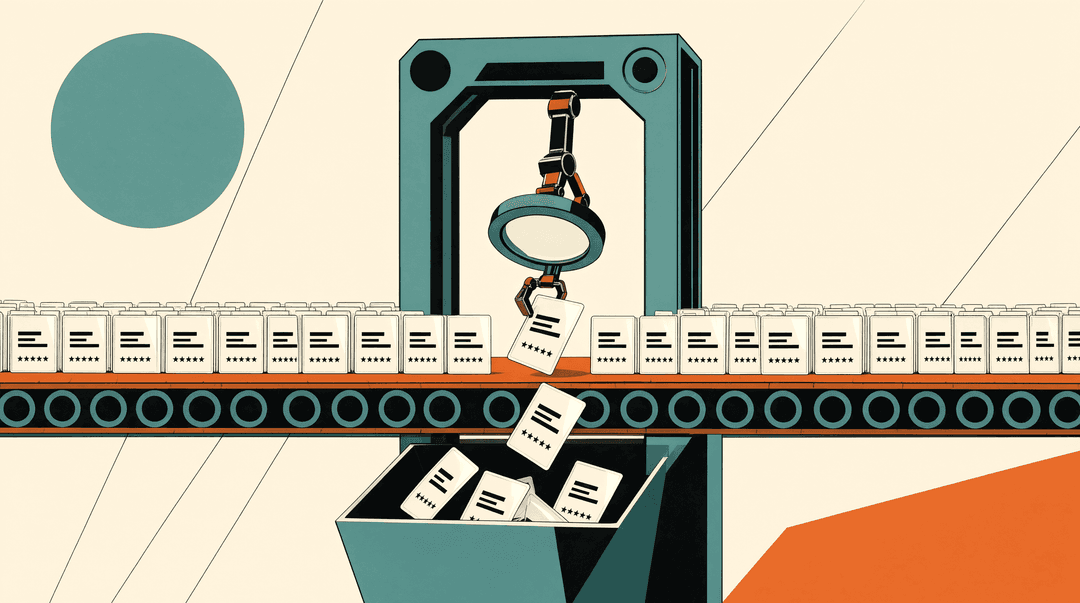
The Transparency Company's 13.7 percent likely-fake share, measured in a category (local services) where Google, not Amazon, owns the review surface. And Google's own flag rate: if 292 million blocked attempts represent a little over a fifth of all review activity, review spam is a structural feature of the ecosystem, not an edge case. Detection is lossy in both directions, and the platforms that report the totals set the definitions.
A third-party measurement keeps the honesty in check. Pangram Labs analyzed 30,000 front-page Amazon reviews and found about 3 percent AI-generated, nearly three-quarters of them five-star and 93 percent carrying the verified purchase badge. Verified purchase, it turns out, verifies the transaction, not the prose.
From astroturfing to extortion
The older fraud was promotional: businesses buying stars for themselves or for attacks on competitors. Tripadvisor attributed 54 percent of its 2024 fraud to review boosting by businesses and their allies. Generation cost near zero changed the business model, and the cheapest product now is protection. Fraudsters post waves of fake one-star reviews to Google Maps listings, then invoice the business for a few hundred dollars to stop or remove them. The New York Times documented the wave in September 2025, and Google shipped a dedicated extortion-reporting channel telling owners not to pay. Yelp claims it prevented extortion scams of exactly this kind aimed at businesses on other platforms, evidence that the attack is portable across review surfaces.
The consumer-side tooling thinned out at the same time. Mozilla announced on May 22, 2025 that it was shutting down Fakespot, the fake-review detector it bought in 2023, because it never fit a sustainable business model. The extension and website went dark on July 1, 2025. A paid, scaled detector-for-hire has so far been hard to sustain even as the fakes it detects multiplied.
The law found a price per review
The FTC's Consumer Review Rule, finalized in August 2024 and effective October 21, 2024, bans creating, selling or buying fake reviews, including AI-generated ones, along with review gating, undisclosed insider testimonials and fake social metrics. Its teeth are civil penalties of up to $53,088 per violation, and each review can count separately. The commission sent its first warning letters to ten companies on December 22, 2025.
The first real test case arrived in May 2026, and it was not a story about prose.
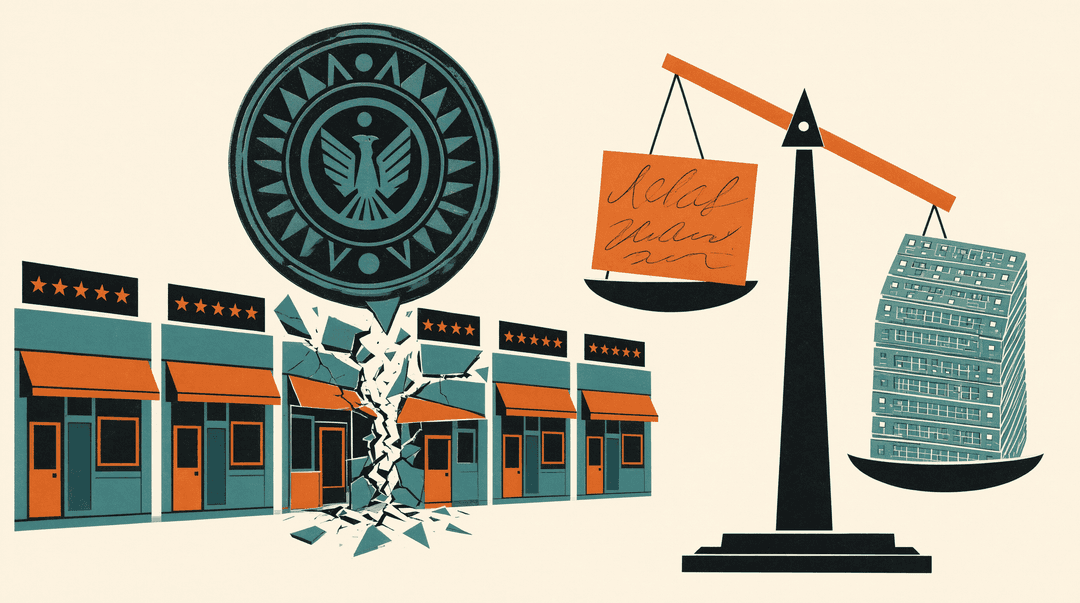
The DOJ and the FTC, joined by the Illinois Attorney General, sued Premium Home Service, a Chicago home-repair lead operation, for creating over 15,000 fake business profiles on Google Search and Maps with stolen addresses, overseas call centers and fabricated five-star reviews, deceiving more than 100,000 consumers since at least 2018 and collecting tens of millions of dollars, per the complaint coverage. The government sought civil penalties under the review rule. Note what won the case: fake storefronts and fake identities, artifacts that are provable. Nobody had to prove a sentence was written by a model.
Detection is losing the arms race it is built for
A 2026 study gave 288 human judges 50 reviews, half real, half written by ChatGPT-o1 with deliberate typos seeded in. Accuracy: 50.8 percent, a coin flip. Seven frontier LLMs acting as detectors scored 35.6 to 50 percent, none reliably better than the humans. Meanwhile MIT and Cornell researchers reported in November 2026 that a commercial detector caught only about 27 percent of AI text after it passed through humanizer rewriting, and their test-time-adaptation method recovered 93 percent, a result that will itself age out as models and humanizers change.
The platforms are running the same race with bigger budgets, on their own closed data. Amazon says its models analyze billions of signals against a review archive dating to 1995. Google says Gemini-powered reasoning blocks violations pre-publication and pauses profiles during spam spikes. There is one honest complication in all of it: a genuine customer who runs their review through ChatGPT to fix the grammar is not violating anything, and enforcement guidance concedes there is no clear test separating the assisted honest review from the fabricated one. The rule regulates intent and provenance; the classifiers only see style.
Where the trust settles
Consumers have not stopped reading reviews, they have started reading them through two filters: recency and verification, both of which platforms control. And the review economy has grown a supply chain nobody advertised. Yelp notes that ChatGPT, Apple Maps, Amazon's Alexa+, Microsoft Bing and others license its reviews and business data as ground truth. When half of Americans use AI chatbots, 60 percent read AI search summaries, and only 16 percent expect AI's impact on society to be positive, part of the answer's confidence still comes from a human-written Yelp review sold at wholesale.
The star rating is not dead, but it has been repriced. What was a reputation signal is now an authenticated feed, guarded by AI classifiers, policed by a per-review federal fine, and licensed to answer engines. Each layer of that defense is expensive, centralized and platform-owned. The fake cost nothing to make. The verification is turning out to be the product.
Sources
- FTC press release, final Consumer Review Rule (Aug 2024): https://www.ftc.gov/news-events/news/press-releases/2024/08/federal-trade-commission-announces-final-rule-banning-fake-reviews-testimonials
- FTC blog, warning letters under the Consumer Review Rule (Dec 2025): https://www.ftc.gov/business-guidance/blog/2025/12/warning-letter-or-ten-businesses-comply-ftcs-consumer-review-rule
- Covington Global Policy Watch, FTC/DOJ v. Premium Home Service (May 2026): https://www.globalpolicywatch.com/2026/06/ftc-and-doj-continue-focus-on-consumer-reviews-rule-with-complaint-against-premium-home-service
- Amazon 2025 Trustworthy Shopping Experience Report: https://trustworthyshopping.aboutamazon.com/2025-trustworthy-shopping-experience-report
- Yelp 2025 Trust & Safety Report: https://trust.yelp.com/trust-and-safety-report/2025-report
- Tripadvisor 2025 Transparency Report: https://tripadvisor.mediaroom.com/2025-03-18-Tripadvisors-2025-Transparency-Report-reveals-strong-review-submissions-and-improved-fraud-detection
- The Transparency Company, High Cost of Review Fraud: https://askfortransparency.com/research/high-cost-of-review-fraud
- Search Engine Roundtable, Google Maps 2025 enforcement numbers: https://www.seroundtable.com/google-maps-spam-fighting-2025-41176.html
- Michael Luca, Reviews, Reputation, and Revenue: https://papers.ssrn.com/sol3/papers.cfm?abstract_id=1928601
- BrightLocal Local Consumer Review Survey 2026: https://www.brightlocal.com/research/local-consumer-review-survey
- Pew Research, Americans and AI 2026: https://www.pewresearch.org/internet/2026/06/17/americans-and-ai-2026-chatbots-smart-devices-and-views-on-impact
