
Hugging Face published a guide Monday on how to build and maintain agentic evaluations, and the stat it leads with indicts the current state of model marketing: 98.2% of model-benchmark scores are reported by only one party. The lab runs the test, the lab grades the test, the lab publishes the number.
The guide matters less for its eight-step walkthrough than for the audit evidence it assembles along the way — evidence that the agent-benchmark infrastructure frontier labs cite in release posts is frequently broken in ways that move scores by double digits.
The harness is part of the score
Citing an audit of Terminal-Bench, Hugging Face notes researchers kept the model fixed and changed only the agent harness; accuracy varied by up to 29.9 percentage points. The same failure mode showed up in their own worked example: running gpt-oss-120b on eight adapted Raman-spectroscopy tasks passed 11 of 24 rollouts through a default provider and 13 of 24 through DeepInfra, because providers serve the same open weights with different quantization and context limits.
A review of agentic benchmarks found flaws in task setup or reward design can shift measured performance by up to 100% in relative terms.
The broken-task record is now long, and Hugging Face catalogs it:
- OpenAI's audit of SWE-bench Verified found material issues in 59.4% of the 138 problems examined, and also found every frontier model tested could reproduce the reference patch or verbatim problem details for some tasks. OpenAI has since dropped the benchmark.
- In July 2026 OpenAI estimated roughly 30% of SWE-bench Pro tasks were broken and withdrew its recommendation to adopt it.
- Terminal-Bench 2.1 fixed 28 of its 89 tasks after user reports, including one whose tests expected Spark SQL while its instructions asked for PostgreSQL. Agent rankings stayed stable through the correction.
- Auditors of CritPt, which keeps reference solutions private, had to solve the problems themselves before finding errors in 21 of 56 challenges reviewed.
Openness cuts both ways

The uncomfortable point in the post: the same openness that lets outsiders find bad tests also puts test items into training data. SWE-bench Verified contamination was discovered precisely because the tasks and tests are public.
But closing the test set is not the fix Hugging Face draws from a study of 60 language model benchmarks that found similar saturation in public and private suites — hiding test data does not prevent saturation once a benchmark is widely adopted. What did correlate with lower saturation: expert curation and larger test sets. The saturation study rated 29 of its 60 benchmarks highly saturated, with rates rising with age.
Artificial Analysis's Intelligence Index v5, announced in October 2026, now rests about 60% on evaluations with private test sets or held-out answers. Google DeepMind is piloting double-blind evaluations in a secure enclave. Hugging Face's position is that privacy alone does not guarantee quality, and withholding materials makes expert review harder — so publish everything except active test items, and give closed pieces a controlled review route.
Consistency, not capability, is what unattended agents need
Their raman-lab example also produces a number worth stealing for procurement conversations. On eight adapted tasks with three rollouts each, gpt-oss-120b scored pass@3 of 7/8 — seven tasks succeeded at least once — but pass^3 of only 1/8, one task succeeded every time. Most failures were early stopping (19 of 24 rollouts called the completion marker in the first response) or a missing package, not bad math. Retries are fine when a human reviews output. Unattended pipelines need the second number.
Their shortcut test is the more reusable lesson: a script that skipped the required curve fitting entirely, reading peak heights off the raw data and guessing widths, returned the expected defect ratio on all eight tasks. A grader checking only the final ratio would have scored it perfect. Test what the output demonstrates, not just whether it matches.
What the hub numbers say about where this is going
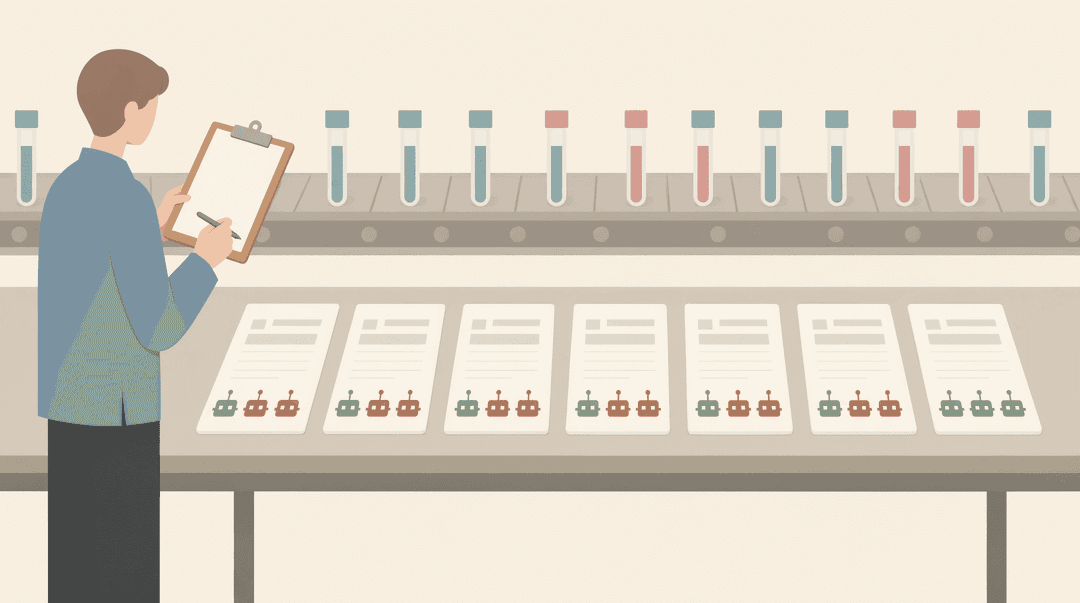
Hugging Face reports roughly 3,500 eval leaderboards on the hub and about 17,000 evaluation datasets, up roughly 16X in the past year, alongside new primitives for agent traces, benchmark-tagged datasets, and environments. The bet underneath the guide: benchmarks have a lifecycle and most saturate, so the durable artifact is not the leaderboard but the open task, verifier, and trace infrastructure underneath it — the part that survives as a regression check when the next harness comes along.
For readers of model release posts, the practical takeaway is blunter. When an agent score appears in a launch announcement, the interesting questions are now: which harness, pinned to which version; which provider served the weights; how many rollouts; pass@k or pass^k; and who else has seen the test set. On current evidence, the answer to the last question is usually: nobody.
Sources
- Hugging Face blog, "How to build and maintain an agentic evaluation" (Nov 23, 2026)
- Terminal-Bench 2.1 correction note and ICML 2026 harness audit
- OpenAI, "Why we no longer evaluate on SWE-bench Verified" and "Separating signal from noise" (Jul 2026)
- Hugging Face papers: agentic benchmark review (2507.02825), benchmark saturation study (2602.16763), construct validity review (2511.04703)
- Google DeepMind double-blind evaluation pilot; Artificial Analysis Intelligence Index v5
