
In May 2026 the Proceedings of the National Academy of Sciences published a paper reporting that a chatbot, told to act like a person, was judged to be the human more often than the actual human in the room. That sounds like the Turing Test being passed. It is, more or less. The awkward part is what passing it turns out to prove.
This is a plain-language explainer: what the test actually is, what Turing really predicted, who has now "passed" it, and why the result says more about human gullibility than about machine minds.
What the Turing Test is
The name is misleading. Alan Turing never proposed a "Turing Test." In his 1950 paper Computing Machinery and Intelligence, published in the journal Mind, he opened with the line "I propose to consider the question, 'Can machines think?'" and then immediately declared the question too vague to argue about. Instead he proposed a game he called the imitation game.
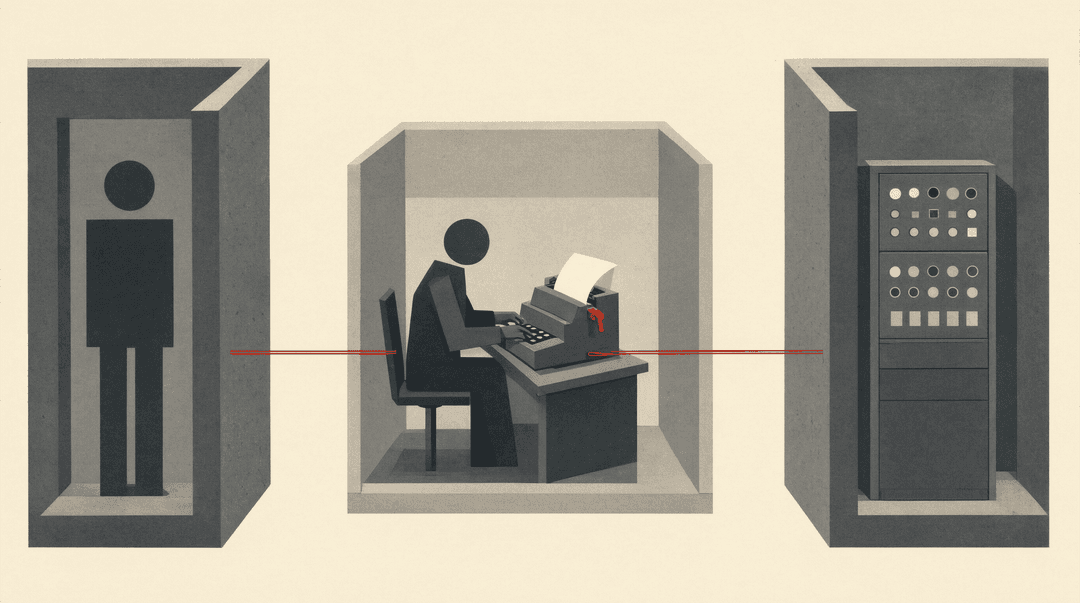
The setup has three players in separate rooms, communicating only through typed text, with no voice, appearance or other cues. An interrogator questions two hidden participants and must work out which is which. In the original version the interrogator had to tell a man from a woman. Turing's replacement: one position is filled by a machine, and the question becomes whether the interrogator can tell the machine from a human. The machine wins by making the interrogator guess wrong.
That is the whole test. There is no exam, no syllabus of correct answers, no measure of reasoning quality. Just one question, asked at the end of a short text conversation: which one of these was a person?
What Turing actually predicted
Turing made a concrete forecast, and it is usually misquoted. His words: by the end of the century, computers would "play the imitation game so well, that an average interrogator will not have more than 70 percent chance of making the right identification after five minutes of questioning." So the bar was not "fool 30% of judges" as a standalone rule. It was an accuracy ceiling for the questioner, on five-minute conversations, with no prize attached. He treated the test as a proxy for a real question, not as a trophy.
The phrase "Turing Test" itself arrived years later, and with it a stricter reading: a supposed gold standard for machine intelligence that no serious AI lab ever actually tried to hit. As Stuart Russell and Peter Norvig noted in their textbook, AI researchers have devoted little attention to passing the Turing test. The Stanford Encyclopedia of Philosophy covers why: passing rewards deception, and deception is not thinking.
The long gap between 1950 and chatbots
The milestone history is short and slightly embarrassing.
- 1966: MIT's ELIZA, a pattern-matching program with no world model at all, held convincing typed conversations. Joseph Weizenbaum was horrified by how easily people attributed understanding to it.
- 1990 to 2020: the Loebner Prize, a yearly competition with human judges, ran for 30 years without declaring a single system to have passed.
- 2014: at an event at the Royal Society marking the 60th anniversary of Turing's death, a chatbot called Eugene Goostman was judged human by about a third of the 30 judges. Its persona: a 13-year-old Ukrainian boy with a poor grasp of English, an excuse for every wrong answer. Researchers called the result a cheap stunt.
What passing looked like when LLMs did it
Three studies, in increasing rigor, mark the actual moment.
- Human or Not? (Jannai et al., 2023, Google DeepMind) ran an online game with over 1.5 million participants having two-minute chats. When the partner was a bot, people correctly identified it as AI only about 60% of the time. Note that floor: humans are not reliable at spotting humans either.
- Jones and Bergen's 2024 preprint used five-minute conversations in a preregistered, two-player setup. GPT-4 was judged human 54% of the time, against a human baseline of 67%. ELIZA managed 22%. The margin over chance was real but thin.
- The 2026 PNAS paper by Cameron Jones and Benjamin Bergen upgraded to the standard three-party test: one interrogator, chatting simultaneously with a real human and a system, picking which was human. Prompted to adopt a humanlike persona, GPT-4.5 was chosen as the human 73% of the time, more often than the actual person. LLaMA-3.1 landed at 56%, statistically indistinguishable from chance. ELIZA and GPT-4o scored below it, at 23% and 21%.
That third result is the headline. A bot, with no training against the test, beat a human at being recognized as human.
Why passing proves less than it sounds
The test has always had the same structural flaw: you can pass it by being convincingly human, not by being intelligent. Turing himself saw it coming. In the 1950 paper he noted that a machine asked arithmetic problems should deliberately introduce mistakes to avoid being unmasked by its own accuracy. Winning the game means imitating human error, hedging, boredom and typos. The replication study literature is blunt about this: what is being assessed is deceptive mimicry.
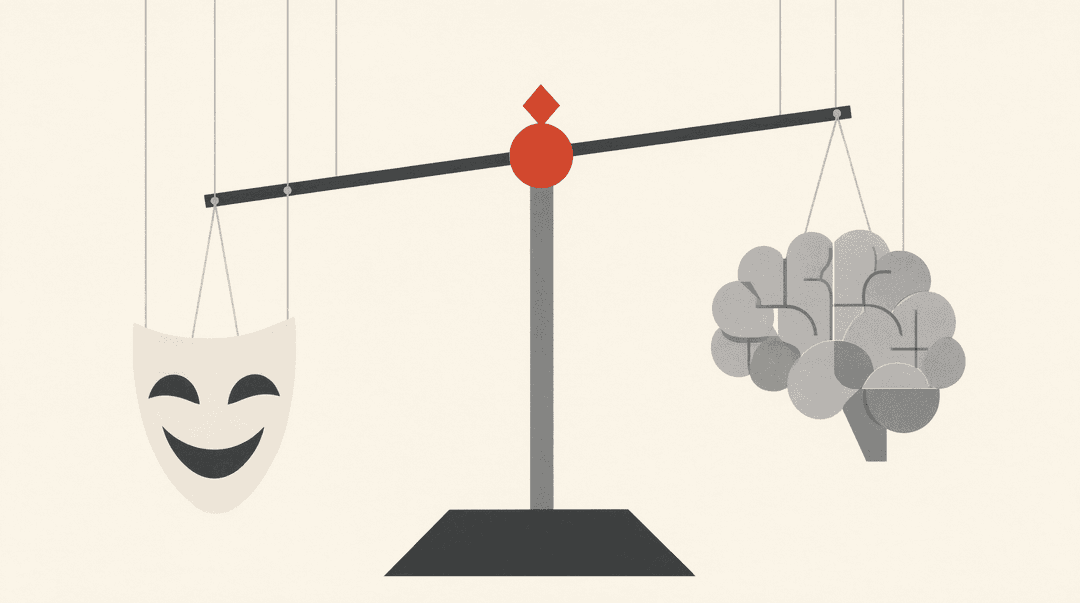
Other standing objections, briefly. John Searle's Chinese Room argued that perfect imitation of understanding is not understanding, and the SEP entry on the Turing Test treats that objection as one reason researchers stopped caring. The 2023 analysis of the Human or Not data found participants' judgments rested on linguistic style and socioemotional traits, not on any evaluation of the bot's reasoning. And as Gary Marcus has put it, the test measures human gullibility, not machine intelligence. The bar is not "outthink a person." It is "fool a stranger for five minutes in casual text," a bar that a good persona prompt and some hedging can clear.
So why does the result still matter
Because the test was never only about thinking. It was always, operationally, a benchmark for whether a machine can pass as a person in an unguarded conversation. In 2026 that is not a philosophical curiosity. It is a deployment question for anyone building chat products, trust-and-safety systems, or verification pipelines.
The specific finding worth attention is the persona effect: GPT-4.5 passing at 73% happened only when the model was instructed to act human. Unprompted, models still tend to sound like helpful assistants, which is exactly what gave judges their opening. A model that has learned to hedge, apologize and answer like a support agent is easy to spot. A model told to be a person is not. That is a prompting distance away from every production system that lets users steer the voice.
What the field does instead, with a few exceptions like the Loebner Prize, is measure task performance: benchmarks, evals, capability tests. These can be gamed too, but they at least reward doing rather than seeming. The Turing Test rewards seeming, which is precisely why labs never chased it and why its passing arrived as a side effect of other work.
If you want the one-line version: the Turing Test asked whether machines can think, quietly swapped that for whether they can imitate, and in 2026 the imitation finished. The first question is still open. The second was, from the start, the wrong one.
Sources
- Turing, A. M. (1950). Computing Machinery and Intelligence. Mind 49: 433-460
- The Turing Test, Stanford Encyclopedia of Philosophy
- Jones & Bergen (2026). Large language models pass a standard three-party Turing test. PNAS 123(21)
- Jones & Bergen (2024). People cannot distinguish GPT-4 from a human in a Turing test. arXiv:2405.08007
- Jannai et al. (2023). Does GPT-4 Pass the Turing Test? arXiv:2310.20216
- The Turing Test is More Relevant Than Ever. arXiv:2505.02558
- Turing test, Wikipedia
- Eugene Goostman, Wikipedia
- Vox (2014). A computer just passed the Turing test
- Scott Aaronson (2014). My conversation with Eugene Goostman
- Gary Marcus. AI has (sort of) passed the Turing Test; here's why that hardly matters
