
Every major image generator today, from Stable Diffusion to the models baked into ChatGPT and Gemini, is built on denoising. But for most of the second decade of deep learning, the field that taught machines to draw invented faces and fake scenery ran on a different idea: two neural networks attacking each other until one of them could not tell real from fake. That idea is the generative adversarial network, the GAN, and it is worth understanding even now that it has been pushed aside. It showed that a model could be trained to produce convincing output without anyone hand-writing a definition of convincing.
The trick: a forger and a detective
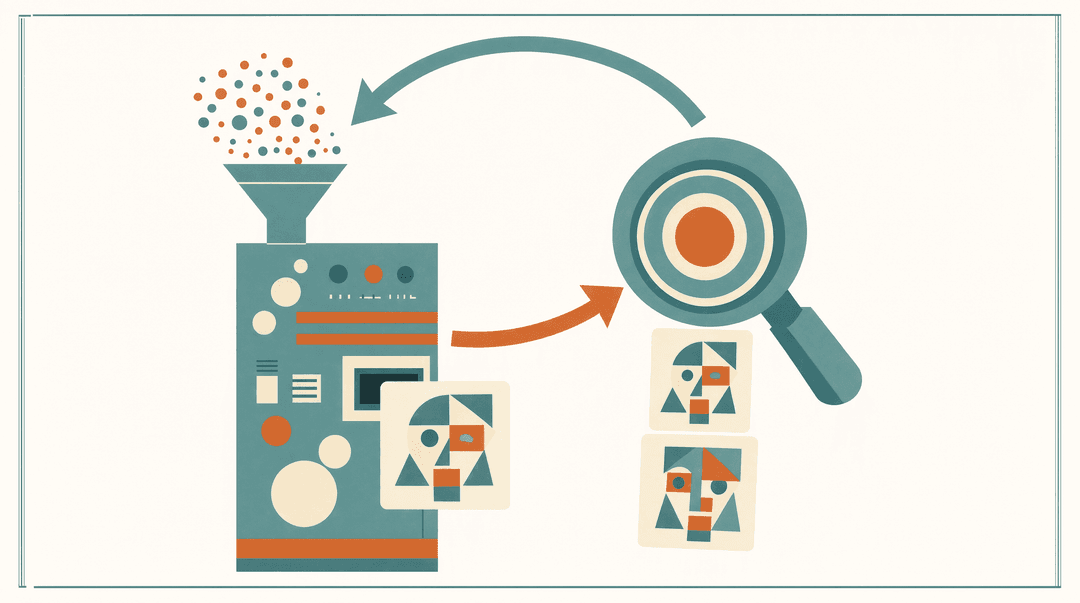
Ian Goodfellow, then a researcher at the Universite de Montréal working with Yoshua Bengio, proposed the framework in a paper posted to arXiv on June 10, 2014 (Goodfellow et al., 2014). The paper's own metaphor was a police chase. One network, the generator, is the counterfeiter: it takes random noise and turns it into a sample meant to pass as real data. The other network, the discriminator, is the detective: it looks at an image and estimates whether it came from the actual dataset or from the generator.
What makes the arrangement powerful is that nobody writes the rules. There is no loss function that says "a face has two eyes at these coordinates." The detector learns what real looks like by seeing real photos, and the forger learns by getting caught. The paper showed that this setup is a minimax two-player game with a unique equilibrium: the generator recovers the training data distribution exactly, and the detector's best guess collapses to 1/2 on every input, meaning it can no longer tell the two sources apart. Both networks improve together through ordinary backpropagation.
Eight years of getting better at lying
The GAN era moved fast because the recipe was so general. Anything you can photograph, you can adversarially imitate.
- DCGAN (Radford et al., 2015) standardized the convolutional recipe that made GANs trainable at scale and produced the first recognizably coherent images.
- Progressive GANs (Karras et al. at Nvidia, 2017) grew networks from low to high resolution during training and reached 1024x1024 outputs that looked like real photographs.
- BigGAN (Brock et al., 2018) showed the same approach scaled up on ImageNet with much larger batches and capacity.
- StyleGAN (Karras, Laine and Aila, 2018, published at CVPR 2019) restructured the generator around a learned style space, giving fine control over pose, lighting and texture in faces.
StyleGAN came with a new dataset that defined a decade of face research: Flickr-Faces-HQ, 70,000 high-quality 1024x1024 portraits crawled from Flickr, chosen deliberately for wider variation in age, ethnicity, and background than the celebrity datasets that came before. In February 2019 an Uber engineer named Phillip Wang wired a StyleGAN demo into a website, This Person Does Not Exist, which refreshed a brand new photorealistic human face on every page load. It became the era's signature demonstration that the forger had essentially won.
The academic verdict on how convincing the faces had become arrived in 2022. A PNAS study by Sophie Nightingale and Hany Farid asked 315 participants to separate real photographs from StyleGAN2-synthesized faces. Accuracy was 48.2 percent, no better than chance. A second group rated the synthetic faces as slightly more trustworthy than the real ones (4.82 versus 4.48 on a 7-point scale). The authors concluded that synthetic faces had crossed through the uncanny valley.
Why GANs lost anyway
Three problems never went away, and they are all visible in the original framing.
Training is a moving target. The generator and discriminator have to stay in balance, and gradient descent on a two-player game with no stable resting point is fragile. Mescheder et al. (2018) showed formally that the standard GAN objective does not always converge, even in simple settings. Labs ran on heuristics and paper-specific tricks for years.
Mode collapse. A generator that finds one reliably convincing pattern can keep serving that pattern instead of the whole data distribution, producing a hundred faces with the same haircut. The failure mode was named and addressed in Improved Techniques for Training GANs (Salimans et al., 2016), and taming it remained a permanent tax on every serious GAN project.
The mirror problem. A GAN imitates whatever its training set is, bias included. An ECCV 2022 audit of Flickr-Faces-HQ found Black people substantially underrepresented at around 4 percent of the dataset, and StyleGAN models trained on FFHQ faithfully reproduced that skew. NVIDIA's own authors documented that dataset inherited the biases of Flickr when they released it.
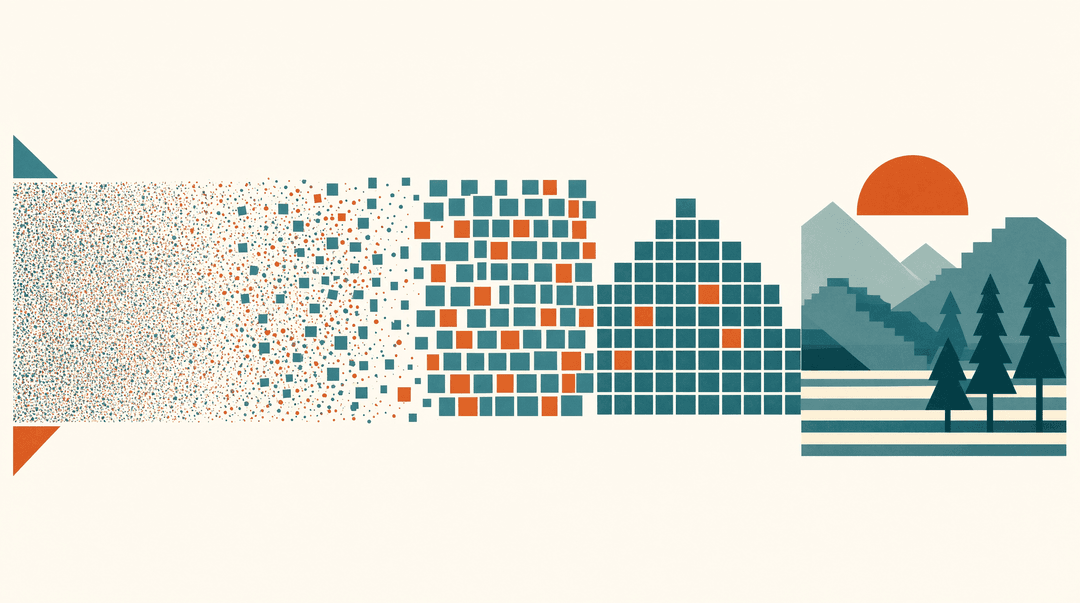
The competitor that actually finished GANs off in image synthesis was denoising diffusion. Ho, Jain and Abbeel revived the approach in 2020, and in May 2021 OpenAI's Dhariwal and Nichol published a paper with the result in its title: "Diffusion Models Beat GANs on Image Synthesis." Diffusion models reached better FID scores while training like ordinary supervised denoising, which is stable, and covering the data distribution more faithfully, which is exactly the diversity GANs kept losing to mode collapse. Latent diffusion moved the denoising process into a compressed space, making the math cheap enough to run on a gaming GPU (Rombach et al., December 2021), and the first public release built on that recipe, Stable Diffusion, landed on August 22, 2022 from the CompVis group at LMU Munich with Runway and Stability AI. Text-to-image generation then consolidated around diffusion plus CLIP guidance, a stack with no adversarial game in it at all.
What GANs still do
The architecture did not go extinct; it retreated to problems where its strengths fit. Image-to-image translation, grayscale to color, sketches to photographs, horse to zebra, runs on CycleGAN (Zhu et al., 2016-2017) and its descendants, which pair generators and discriminators over two domains. Upscaling and restoration models still lean on adversarial losses, including the perceptual loss recipe from ESRGAN (Wang et al., 2018) that defined the super-resolution leaderboards for years. StyleGAN remains a standard tool in face-analysis research, a benchmark generator for deepfake detectors, and a data-augmentation option when real labeled images are scarce.
The deeper legacy is the lesson, not the architecture. GANs proved a model can be trained to produce convincing output without any human-written definition of convincing, simply by being attacked by a second learned model. The core idea, training one network to satisfy a second learned judge rather than a fixed score, reappears in the reward models and preference training behind modern AI assistants. The forger lost the image race; the two-player setup did not disappear from the field.
Sources
- Goodfellow et al., Generative Adversarial Nets, arXiv:1406.2661, June 2014
- Radford et al., Unsupervised Representation Learning with Deep Convolutional GANs, arXiv:1511.06434, 2015
- Karras et al., Progressive Growing of GANs, arXiv:1710.10196, 2017
- Brock et al., BigGAN, arXiv:1809.11096, 2018
- Karras, Laine and Aila, A Style-Based Generator Architecture for GANs, CVPR 2019 (includes the FFHQ dataset description)
- Salimans et al., Improved Techniques for Training GANs, arXiv:1606.03498, 2016
- Mescheder et al., Which Training Methods for GANs do actually Converge?, ICML 2018
- Nightingale and Farid, AI-synthesized faces are indistinguishable from real faces and more trustworthy, PNAS 119(8), 2022
- Pape et al., Studying Bias in GANs through the Lens of Race, ECCV 2022
- Ho, Jain and Abbeel, Denoising Diffusion Probabilistic Models, arXiv:2006.11239, 2020
- Dhariwal and Nichol, Diffusion Models Beat GANs on Image Synthesis, NeurIPS 2021
- Rombach et al., High-Resolution Image Synthesis with Latent Diffusion Models, CVPR 2022
- Zhu et al., Unpaired Image-to-Image Translation using Cycle-Consistent Adversarial Networks, ICCV 2017
- Wang et al., ESRGAN: Enhanced Super-Resolution Generative Adversarial Networks, ECCVW 2018
- Inverse, 'This Person Does Not Exist' Creator Reveals His Site's Creepy Origin Story, February 2019
- Wikipedia, Stable Diffusion (release dates and contributors)
