
Every method that trains a language model with reinforcement learning reuses data it should not have. The responses that update the policy were generated by an older copy of the model, a snapshot from minutes or gradient steps ago, not the model being optimized. The math says such data is biased. The fix is an estimator from 1949 nuclear physics called importance sampling. It is the reason PPO has a clipping range, the reason training frameworks log token probabilities you would think they do not need, and the quiet subject of a small argument in 2025 over what granularity the correction should even apply at.
The problem in one line
Suppose you want the average value of some quantity under a distribution P, but your samples come from a different distribution Q. Estimating the average by just averaging the Q samples is wrong unless Q and P happen to agree.
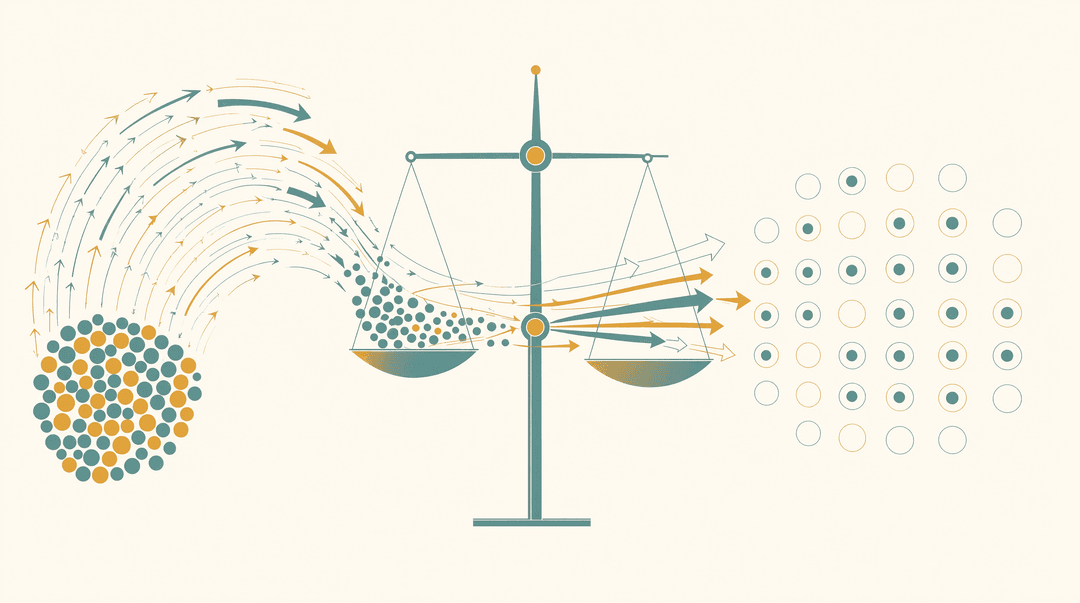
Importance sampling turns the wrong average into a right one with an algebraic identity. The expectation of f under P equals the expectation, under Q, of f times the ratio of the two densities, p(x)/q(x). The ratio is called the importance weight. Samples Q generously provides but P would rarely produce get downweighted; samples P cares about that Q almost never draws get upweighted. You do not resample. You reweight what you already drew.
The method was born at RAND in June 1949, in work on how many neutrons and gamma rays get through thick shielding. Herman Kahn and Gerald Goertzel, in reports written within a week of each other, described drawing particles according to a rigged scheme that oversampled the events that mattered to the answer. Kahn's 1950 write-up, presenting work with T.E. Harris, records the rename: Goertzel suggested "importance sampling," because the frequency of sampling any region of phase space should be proportional to the importance of that region's contribution to the answer. The technique had first been called "quota sampling," which confused statisticians. The Kahn and Harris 1951 paper appeared in volume 12 of the National Bureau of Standards Applied Mathematics Series, the 1949 symposium proceedings that helped standardize the name "Monte Carlo method." The same shield work is where the Metropolis algorithm's lineage begins, per a 2022 historical note by Charly Andral tracing the whole episode.
Why it breaks, which is the interesting part
Importance sampling is unbiased and frequently useless. The variance of the estimator is the variance of f under Q weighted by the squared ratio. One sample with a gigantic weight can dominate an entire estimate, and the estimate of that weight itself requires knowing the densities you did not have in the first place.
Two results define how badly it can go. First, the effective sample size: with n samples, the variance of the corrected estimate is roughly the naive variance inflated by a factor of 1 + Var_q(W), where W is the weight. If your weights are wildly unequal, an actual sample of 1,000 behaves like a sample of 4. Second, a clean statement of the worst case. Chatterjee and Diaconis showed that the sample size required for importance sampling to work at all grows roughly like e raised to the Kullback-Leibler divergence between the distribution you want and the distribution you have. A KL divergence of 10 means a million samples minimum. A KL of 20 is unaffordable. Reweighting cannot substitute for coverage.
Practitioners cope by bending the rules. Self-normalized importance sampling divides the weighted sum by the sum of weights, trading a small bias for stability and for an estimator that works when you only know the ratio up to a constant. Truncation or clipping caps extreme weights, trading bias for bounded variance. These are approximations, but in counterfactual learning from logged data, Swaminathan and Joachims showed the conventional unbiased estimator suffers propensity overfitting on complex hypothesis spaces, and that the self-normalized version produced far better learners in practice. This bias-for-variance pragmatism is exactly what modern LLM training inherited.
Where it lives inside your model's training run
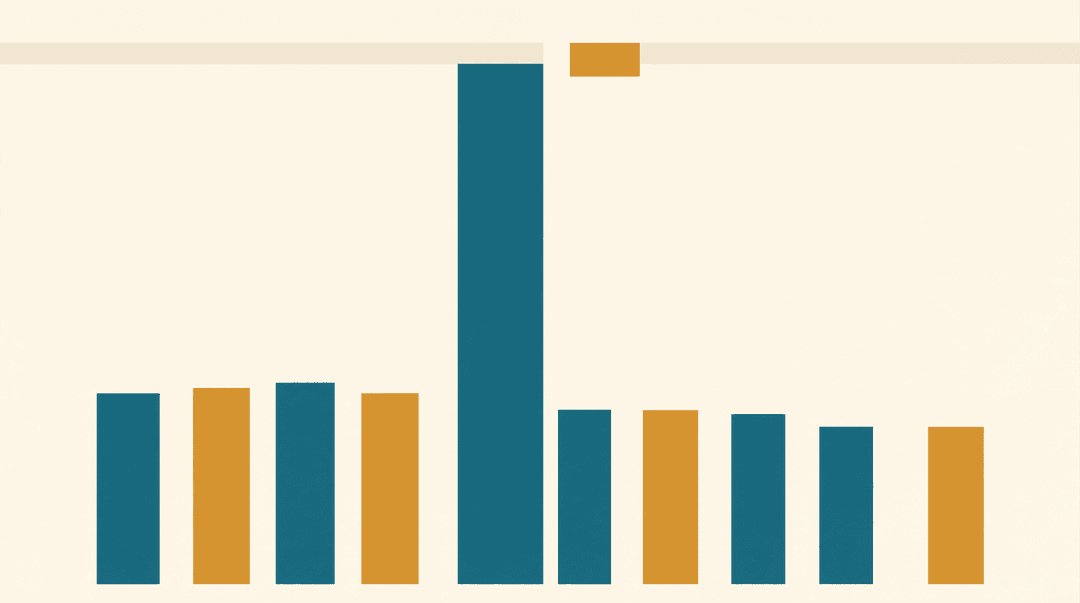
PPO's clip is an importance ratio. Proximal Policy Optimization (Schulman et al., 2017) computes, for every token, the ratio of the current policy's probability to the old policy's, multiplies it into the advantage, and clips the ratio to a band around 1, typically [0.8, 1.2]. The ratio is importance sampling, plainly. The clip exists because the ratio's variance explodes as the policy drifts from the sampler, so PPO deliberately computes a biased surrogate objective that stops rewarding updates for trajectories the current policy would not produce anyway.
RLHF inherits the machinery and the arguments. When Ahmadian et al. asked whether PPO's complexity was even needed for LLMs, they stripped the method down to a REINFORCE variant and the debate that followed has mostly been about the correction itself. GRPO keeps PPO's clipped token-level ratio and drops the critic. Qwen's GSPO paper argues the token level is the wrong granularity entirely: rewards are assigned to whole sequences, so the importance ratio should be the whole-sequence likelihood ratio, length-normalized to keep the variance sane. GSPO is what the Qwen team reports using to train Qwen3, including its MoE models, where token-level ratios were noisy under expert routing shifts. MiniMax's M1 report took the opposite lever: instead of clipping the update, clip the importance weight itself and take the gradient through every token regardless (CISPO), which the report credits as half of why M1's full RL run cost only $534,700 in GPU rental.
Engine mismatch made the correction mandatory. In production RL stacks, the sampler that generates completions runs on an optimized inference engine, and the learner that updates weights runs on a training framework. The two compute slightly different probabilities for the same token from the same weights, because of batching, kernel differences, and quantization. That makes even "on-policy" data technically off-policy, and it is why training libraries like verl apply truncated importance sampling between sampler and learner: cap the ratio, accept a little bias, keep the gradient variance under control. Stabilization work spanning hundreds of thousands of GPU-hours reports that the basic policy gradient with importance-sampling correction is the most stable option when updates stay on-policy, and that clipping plus correction becomes necessary the moment they do not.
It also shows up outside RL. Self-improvement pipelines that fine-tune on model-generated samples can filter by an importance-weighting estimate of how far each sample sits from the model's own distribution (IWSI, AAAI 2025), beating plain correctness filtering with only a 5% validation set. Recommender and ad systems learn from click logs using the counterfactual risk minimization estimator line described above. And risk modeling still uses importance sampling to price rare events in insurance portfolios, the direct descendant of Kahn's shield problem: oversample the losses that almost never happen, reweight them back down, and pray the proposal had heavy enough tails.
The transferable intuition
Three things generalize beyond the formulas. First, whenever a model evaluates data generated by a different model, version, or engine, someone is computing a probability ratio somewhere, whether or not the paper mentions it. Second, that correction is exponentially cheap or exponentially expensive depending on the KL divergence between the two distributions; a policy that has drifted far from its sampler cannot be fixed by reweighting, which is why RL training pipelines keep the sampler fresh and why "on-policy" became a selling point again. Third, every practical system chooses bias on purpose. Clipping, truncation, and self-normalization all buy variance control with accuracy, and the 2025 debates between token-level, sequence-level, and clipped-weight recipes are arguments about where to spend that trade.
The estimator is 77 years old, was designed to count neutrons getting through lead, and now decides which tokens a frontier model learns from. The bitter lesson applies to statistics too: the old, simple corrections never lost.
Sources
- An attempt to trace the birth of importance sampling, Charly Andral, 2022
- Estimation of Particle Transmission by Random Sampling, Kahn and Harris, NBS Applied Mathematics Series 12, 1951
- The sample size required in importance sampling, Chatterjee and Diaconis, Annals of Applied Probability 2018
- Effective Sample Size in Importance Sampling, Sebastian Nowozin
- Chapter 9, Importance Sampling, Art Owen, Monte Carlo Theory and Practice
- Proximal Policy Optimization Algorithms, Schulman et al., 2017
- Back to Basics: Revisiting REINFORCE Style Optimization for Learning from Human Feedback, Ahmadian et al., 2024
- Group Sequence Policy Optimization, Qwen team, 2025, and the GSPO blog post
- MiniMax-M1: Scaling Test-Time Compute Efficiently with Lightning Attention, 2025
- Tapered Off-Policy REINFORCE, 2025
- Stabilizing Reinforcement Learning with LLMs: Formulation and Practices, 2025/2026
- Counterfactual Risk Minimization: Learning from Logged Bandit Feedback, Swaminathan and Joachims, ICML 2015
- The Self-Normalized Estimator for Counterfactual Learning, Swaminathan and Joachims, NIPS 2015
- Importance Weighting Can Help Large Language Models Self-Improve, Jiang et al., AAAI 2025
- PPO for LLMs: A Guide for Normal People, Cameron R. Wolfe
