
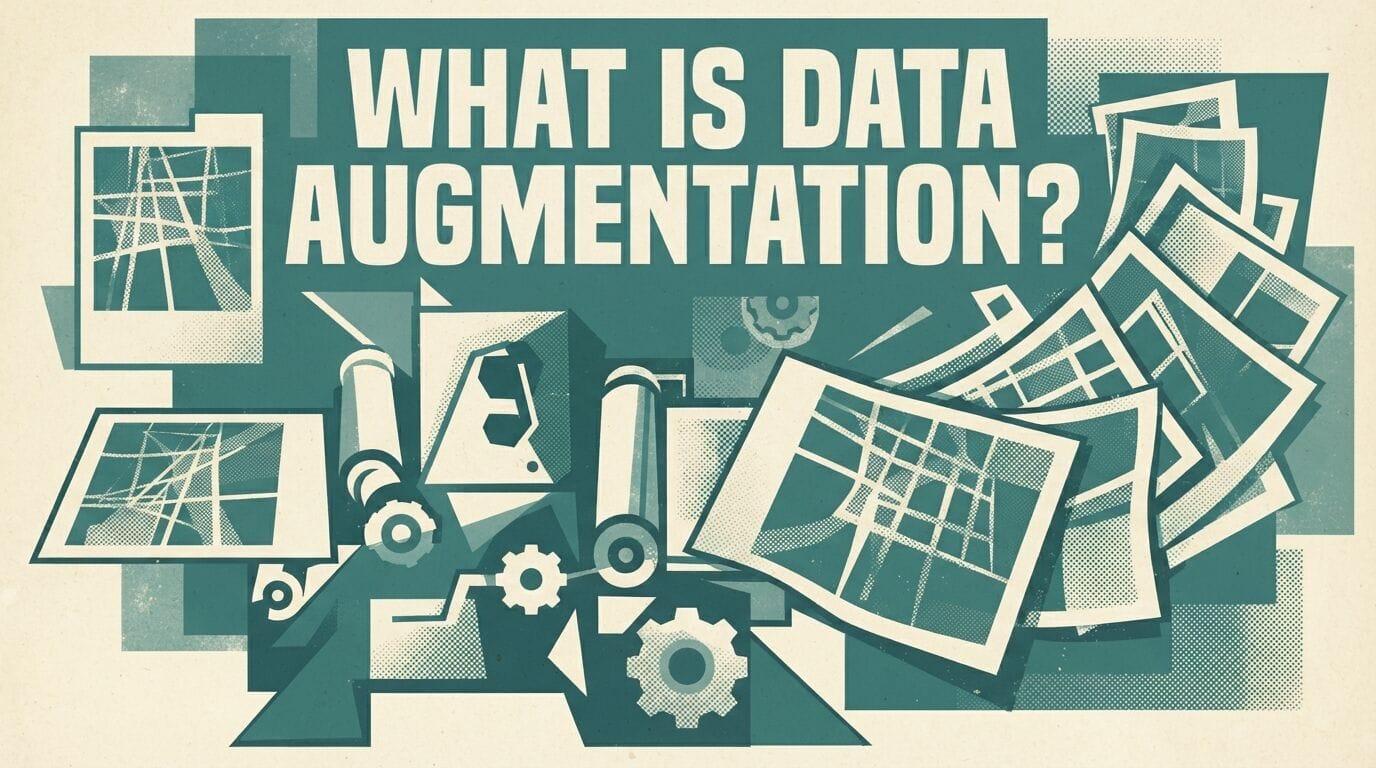
A neural network sees a training image once per step and forgets the pixels the moment the batch moves on. Show the same ten thousand images to that network enough times and it stops learning the concept and starts memorizing the files: perfect on the training set, flaky on anything new. The oldest fix in deep learning is not more data. It is lies about the data you already have, told in a very specific way.
Data augmentation is the practice of generating synthetic training examples by transforming real ones, under one hard constraint: the transformation must not change the answer. Rotate a photo of a cat and it is still a cat. Shift its colors toward blue and it is still a cat. So every augmentation pipeline is a list of transformations the model designer has decided the label can survive. The dataset stops being a fixed set of examples and becomes a sampling procedure, usually run live on the GPU during training, so the model effectively never sees the same input twice.
The trick that made deep learning survivable
Augmentation predates the modern boom. LeCun's network that read handwritten digits on bank checks trained on deliberately distorted samples of each digit, so it would learn the shape of a "7" rather than the exact ink of one "7" (LeCun et al., 1998).
The template for the modern era was AlexNet, the 2012 network that won ImageNet and opened the deep learning wave. Its authors listed two augmentation schemes in the paper. First, random 224x224 crops and horizontal reflections of each 256x256 image, which nominally enlarged the training set by a factor of 2,048. Second, perturbations of RGB channel intensities along the principal components of the pixel distribution. The paper is blunt about why: without these schemes, the network suffered from substantial overfitting. It is also honest about the limits. The enlarged examples are "highly inter-dependent"; augmentation buys you the statistical behavior of a bigger dataset, not its actual information.
That caveat never mattered much, because the returns were enormous. For a decade after 2012, training a vision model without flips, crops, and color jitter was malpractice.
From hand-tuned to learned distortions
Once augmentation was standard, the obvious next step was to optimize it.
- mixup (2017) went sideways: instead of transforming one example, it trained on convex combinations of pairs of examples and their labels. Beyond better generalization, the authors reported it reduces memorization of corrupt labels, increases robustness to adversarial examples, and stabilizes GAN training.
- AutoAugment (2018) treated the augmentation policy itself as a search problem, letting a controller find which operations, probabilities, and magnitudes maximize validation accuracy. It set records on the era's benchmarks: 1.5% error on CIFAR-10 and 83.5% top-1 on ImageNet, with policies that transferred between datasets.
- RandAugment (2019) deleted the expensive search phase, showing that a uniform random policy with a single strength dial matched or beat learned policies: 85.0% on ImageNet, a full point over baseline augmentation.
- SpecAugment (2019) carried the idea into speech, masking and warping blocks of the log-mel spectrogram as if the audio were an image. LibriSpeech word error rate went from 7.5% in the previous state of the art to 6.8% without even using a language model.
- Copy-Paste (2020) for segmentation showed augmentation could target weak spots: randomly cutting objects out of one image and pasting them into another produced +3.6 mask AP on rare LVIS categories over a strong baseline, exactly where collecting real data is hardest.
The pattern across all of them: augmentation pays most where the label-preserving transformations are obvious and the data is scarce.

Text fights back
Language is where augmentation ran into the constraint. An image survives a rotation; a sentence rarely survives an edit. Change one word and a review flips from praise to insult. Synonym replacement can silently invert a label because "good" and "evil" are both one thesaurus hop from "great."
Two workarounds defined pre-LLM text augmentation. Back-translation (Sennrich, Haddow, Birch, 2016) sidestepped meaning-preserving edits entirely: take monolingual German text, machine-translate it into English, and treat the synthetic English-German pair as extra parallel training data for the translator. Sentences the project had no budget to human-translate became usable training pairs. It became the standard recipe in neural machine translation for low-resource languages.
EDA (Wei and Zou, 2019) went the other way, with four brutally simple operations: synonym replacement, random insertion, random swap, random deletion. On small classification datasets, training with half the data plus EDA matched training on all of it. But the same paper flagged the coming problem: with pretrained models in the loop, EDA's gains were negligible. If the model has already read the internet, manufacturing variants of your five-thousand-row labeled set is no longer where the leverage is.
The technique that shape-shifted into synthetic data
Modern LLM development did not drop augmentation. It absorbed it into data generation, and the pretraining corpus went the other direction.
Pretraining settled on more real text rather than transformed text. DeepMind's Chinchilla analysis (2022) showed the field's biggest models of the era were trained on roughly 300 billion tokens and were, in the authors' framing, significantly undertrained; their compute-optimal recipe spent the same budget on a smaller model fed 1.4 trillion tokens. The fix for LLM overfitting was the internet, plus deduplication and quality filtering, not jitter.
Post-training is where augmentation's descendant lives. Self-Instruct (2022) had the language model itself generate new task instructions and input-output instances, filter them, and fine-tune on the result. Unnatural Instructions (2022) scraped 64,000 creative instruction examples out of a language model with almost no human labor, then had the model rephrase each one to expand the set to roughly 240,000 - a literal augmentation pass, performed by the model on its own data - and showed that training on the noisy result rivals training on hand-curated open-source datasets. Structurally, this is data augmentation with the transformation step performed by another model: paraphrase the task, invent an instance, keep the label format. A 2026 instruction-tuning set is closer to an augmented spectrogram than to a hand-curated corpus, and back-translation in 2016 was the first time a neural net's output became its own training data.
That inheritance carries the same caveat, upgraded. Distorted pixels cannot make a dataset wrong; a model-generated training example can be confidently incorrect, and feeding model output back into model training is the exact setup that model collapse research warns about. Augmentation's old contract was that the transformation provably preserved the label. Generative augmentation breaks the contract and asks evals to police it after the fact.
What still holds
If you are training anything on a scarce, real dataset - documents, medical scans, audio, sensor time series - the 2012-to-2020 toolkit is still the cheapest accuracy per dollar, and the design question is still the same one AlexNet answered: which transformations can this label survive. If you are working with large language models, the question has moved: you are not choosing rotations and crops, you are choosing which transformations of your instructions a generator is allowed to make, and how you will know the label survived.
The through-line from distorted digits to synthetic instructions is one idea: a model learns the concept, not the example, and you can force that lesson by making every example wear a disguise. The disguise has to be honest about the label. Everything else in augmentation history is people negotiating what counts as honest.
Sources
- LeCun et al., "Gradient-based learning applied to document recognition," 1998
- Krizhevsky, Sutskever, Hinton, "ImageNet Classification with Deep Convolutional Neural Networks," NeurIPS 2012
- Zhang et al., "mixup: Beyond Empirical Risk Minimization," arXiv:1710.09412
- Cubuk et al., "AutoAugment: Learning Augmentation Policies from Data," arXiv:1805.09501
- Cubuk et al., "RandAugment," arXiv:1909.13719
- Park et al., "SpecAugment," arXiv:1904.08779
- Ghiasi et al., "Simple Copy-Paste is a Strong Data Augmentation Method for Instance Segmentation," arXiv:2012.07177
- Sennrich, Haddow, Birch, "Improving Neural Machine Translation Models with Monolingual Data," arXiv:1511.06709
- Wei and Zou, "EDA: Easy Data Augmentation Techniques," arXiv:1901.11196
- Hoffmann et al., "Training Compute-Optimal Large Language Models," arXiv:2203.15556
- Wang et al., "Self-Instruct," arXiv:2212.10560
- Honovich et al., "Unnatural Instructions," arXiv:2212.09689
- llms.blog, "Model Collapse: When AI Trains on AI Output"
