
An Elo rating in AI measures which model wins in head-to-head comparisons rather than absolute quality, using a statistical system originally developed for chess by Arpad Elo. Modern AI leaderboards like Chatbot Arena primarily use a Bradley-Terry model fitted to historical votes instead of traditional online Elo updates to provide stable ratings. These scores reflect human preference under specific prompt conditions, which can be influenced by factors like answer length and formatting.
Every model release gets announced with a number from Chatbot Arena, and the press releases call it an Elo score. It is the same idea a chess federation adopted in 1970, repurposed to rank language models. The number is easy to quote and widely misunderstood: it does not measure how good a model is. It measures who beats whom.
The chess problem Elo solved
Arpad Elo was a Hungarian-American physics professor at the University of Wisconsin-Milwaukee and a strong amateur chess player. Before his system, chess ratings were assembled from rules of thumb that weighted tournament reputation arbitrarily. Elo wanted a method grounded in probability theory instead. He published it in 1960 in the book "The Rating of Chessplayers, Past and Present", the US Chess Federation adopted it the same year at its meeting in St. Louis, and the world federation FIDE followed in 1970, publishing its first Elo list in 1971 with Bobby Fischer top at 2760 (Wikipedia, FIDE).
The system rests on one claim: a rating difference predicts a win probability. If player A is rated R_A and player B is rated R_B, A's expected score is
E_A = 1 / (1 + 10^((R_B - R_A) / 400))A 200-point gap translates to roughly a 76 percent expected score for the higher-rated player; even an 800-point gap never reaches certainty (Wikipedia). After each game, ratings move in proportion to surprise:
R_new = R_old + K * (actual score - expected score)An upset pays the winner and costs the loser; an expected result barely moves anything. The K-factor caps how fast a rating can chase recent form. Chess uses something like K=10 for grandmasters and K=40 for developing players, because a young player's true strength changes faster than a settled one's (omnicalculator).
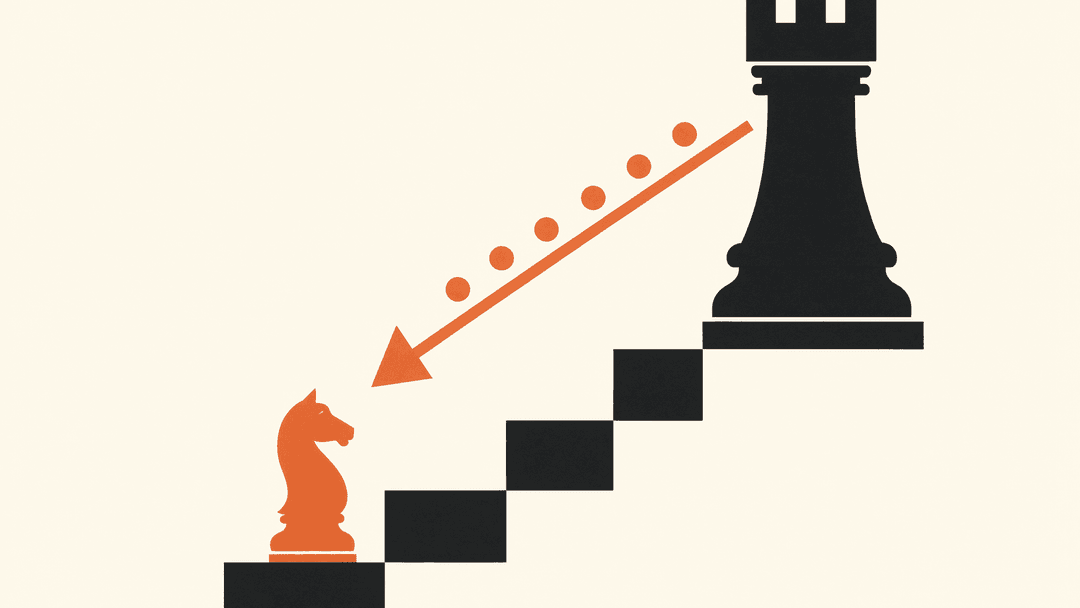
Worked example: a 1000-rated player beats a 1200-rated one. Expected score was about 0.24, actual was 1, so with K=40 the winner gains roughly 30 points and the loser drops the same amount. The system is zero-sum per game, which is exactly what makes it robust: there is no absolute scale to inflate, only head-to-head results.
Why pairwise beats absolute scoring for chatbots
Static benchmarks give a model a question and grade the answer. That works for arithmetic and multiple choice. It falls apart on the questions people actually ask chat assistants, where there is no answer key and a good response can take many shapes.
Pairwise comparison sidesteps the problem. Nobody has to decide what a 7.4 means. Show two anonymous answers to the same prompt, ask one human which they prefer, and the statistics accumulate. The underlying math predates Elo: the paired-comparisons literature runs from Zermelo (1929) to the Bradley-Terry model of 1952, which estimates a latent strength for each competitor from win rates across many match-ups (Statistical Framework for Ranking LLM-Based Chatbots, ICLR 2025).
Chatbot Arena, launched by the LMSYS group in 2023, industrialized this. Real users type real prompts, two randomly selected models answer side by side, and the user votes or abstains. The companion paper, published in March 2024, described the first 240,000 votes and the ranking pipeline: Bradley-Terry coefficients with bootstrapped confidence intervals, plus sampling strategies to spend votes where rankings were least certain (Chiang et al. 2024, arXiv:2403.04132).
The same group showed the preferences themselves could be approximated cheaply. GPT-4 judging pairwise comparisons agreed with human crowdsourced votes over 80 percent of the time, the same level as human-to-human agreement, which is how LLM-as-a-judge evaluations became standard practice (Zheng et al. 2023, arXiv:2306.05685).
The number is probably not an Elo
Here is the part most coverage gets wrong. Arena did start with online Elo updates, where each vote moves ratings immediately. In December 2023 the team switched to maximum-likelihood Bradley-Terry coefficients fitted over all historical votes (LMSYS blog).
The difference matters. Online Elo weights recent games more heavily, which suits chess, where a player's strength drifts. Models are static artifacts: the same weights answer vote one and vote one million the same way. Fitting the whole history at once removes order-dependence, produces stable ratings, and yields proper confidence intervals. The reported scores sit on an Elo-like scale, so journalists keep saying Elo. They are reading Bradley-Terry coefficients.
What the ranking actually measures
A win rate against other models under a particular prompt mix and a particular voter pool. That definition carries three known problems.
Style beats substance. In August 2024 LMSYS published its own audit: controlling for answer length and markdown formatting in the Bradley-Terry regression reshuffled the leaderboard. GPT-4o-mini and Grok-2 fell, Claude 3.5 Sonnet and Llama-3.1-405B rose. Longer, prettier answers were winning votes they had not earned on content (LMSYS, Does style matter?). This is why a style-controlled leaderboard variant exists and why the headline rank and the style-controlled rank can tell different stories.
Votes can be rigged. An ICML 2025 paper demonstrated that a few hundred coordinated votes, spent by identifying the target model in anonymous battles through prompt-probing, could measurably improve its rank. The manipulation also exploited the length-control mechanism itself (Wang et al., arXiv:2501.17858). Crowdsourced preferences at scale are cheap to influence relative to the money that now moves on a leaderboard placement.
The testing pool is uneven. The April 2025 paper "The Leaderboard Illusion" (Cohere, Stanford, Princeton, AI2 and others) found that a handful of providers get private pre-release access, test many variants, and publish selectively. Meta alone had 27 private variants tested in a single month before the Llama 4 launch, according to the authors' analysis; picking the best score of 27 noisy estimates inflates the reported number on pure statistics (arXiv:2504.20879, Simon Willison's summary). The platform, since spun out as the company LMArena and renamed Arena in January 2026, disputed the framing and adopted changes including public removal histories (HoneyHive explainer).
How to read a leaderboard number
- Treat rank as preference, not correctness. Arena rewards answers people like; a math benchmark measures answers that are right. The two diverge, and the arena papers say so plainly.
- Read the confidence interval before crowning a winner. Models with overlapping intervals are statistically tied, and Bradley-Terry intervals on millions of votes are usually tighter than they look on a leaderboard screenshot.
- Check the style-controlled variant when a claim hinges on a few rank positions.
- Ask how many battles produced the number. A fresh model with wide intervals in its first week is a provisional rank, not a verdict.
Elo's 1960 insight was that you do not need an absolute meter of chess strength, only honest games. AI labs inherited the math and, with it, the old warning from competitive rating systems: once the number is the target, the games stop being honest.
Sources
- Arpad Elo - Wikipedia
- Elo rating system - Wikipedia
- Anniversary of Arpad Elo - FIDE
- Chatbot Arena: An Open Platform for Evaluating LLMs by Human Preference - Chiang et al., arXiv:2403.04132
- Judging LLM-as-a-Judge with MT-Bench and Chatbot Arena - Zheng et al., arXiv:2306.05685
- Chatbot Arena and Elo system update - LMSYS blog, December 2023
- Does style matter? Disentangling style and substance in Chatbot Arena - LMSYS blog, August 2024
- Improving Your Model Ranking on Chatbot Arena by Vote Rigging - arXiv:2501.17858
- The Leaderboard Illusion - arXiv:2504.20879
- Understanding the recent criticism of the Chatbot Arena - Simon Willison
- A Statistical Framework for Ranking LLM-Based Chatbots - ICLR 2025
- LMArena (now Arena) explained - HoneyHive
- Elo Calculator - Omni Calculator
Frequently asked questions
Does an AI leaderboard score measure how good a model is?
No, the number does not measure how good a model is; it measures who beats whom in pairwise comparisons.
Is the Chatbot Arena score actually an Elo rating?
The reported scores sit on an Elo-like scale, but the platform switched to maximum-likelihood Bradley-Terry coefficients in December 2023, making them technically Bradley-Terry coefficients rather than true Elo ratings.
How does answer style affect AI rankings?
Style beats substance because longer, prettier answers with markdown formatting can win votes they have not earned on content, which has been shown to reshuffle leaderboards when controlled for in regressions.
Can AI leaderboard votes be manipulated?
Yes, research demonstrates that coordinated votes, spending hundreds of votes through prompt-probing to identify models, can measurably improve a model's rank and exploit length-control mechanisms.
Who invented the Elo rating system?
The system was created by Arpad Elo, a Hungarian-American physics professor at the University of Wisconsin-Milwaukee, who published it in 1960 to ground chess ratings in probability theory.
