
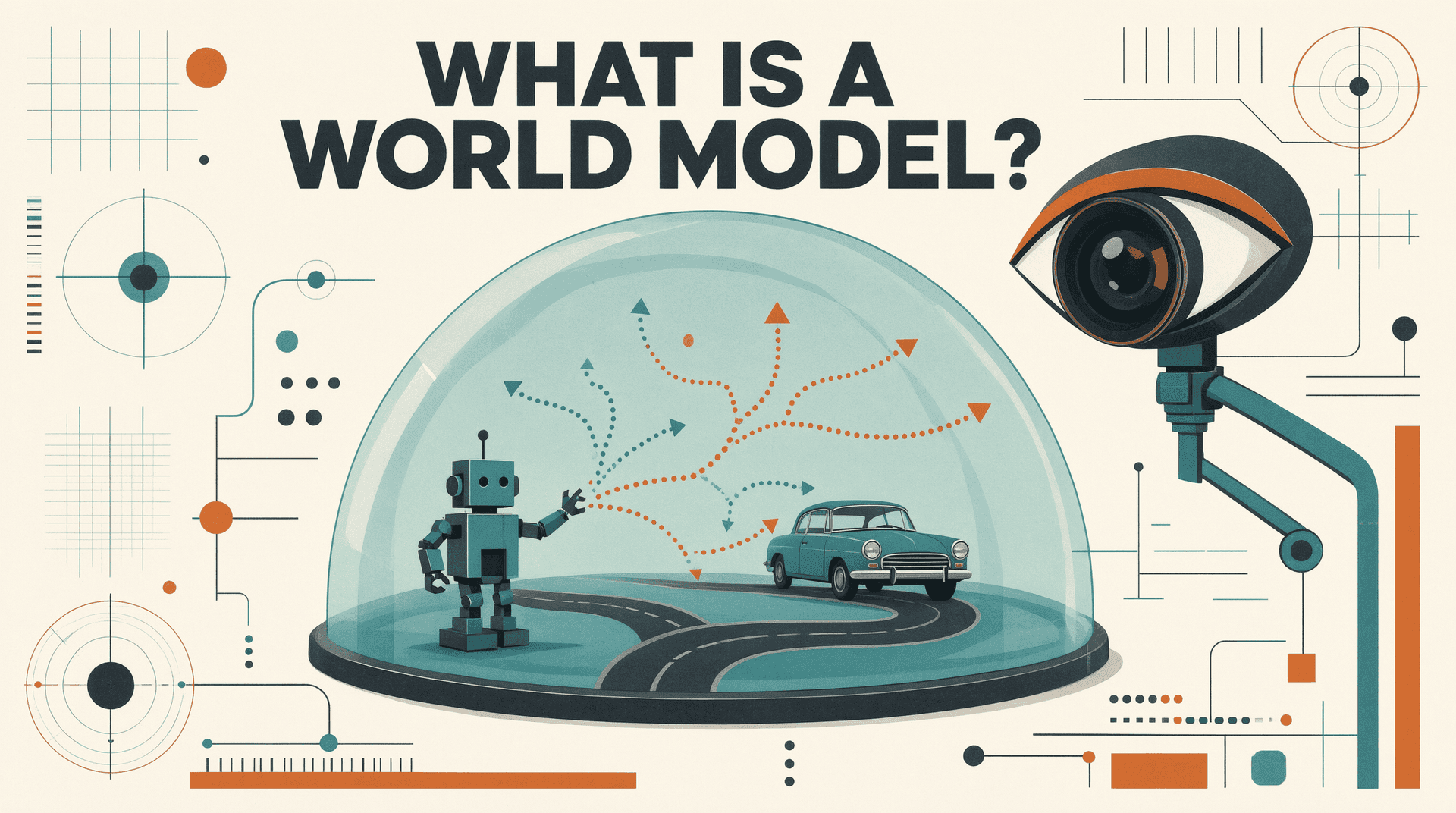
A world model is a learned simulation inside a neural network that predicts future states from observations and current situations to train agents for better decision-making. Modern examples include Google DeepMind’s Genie 4, OpenAI’s Sora, and Meta’s V-JEPA 2, which vary between generating realistic video or predicting abstract latent representations.
On October 27, 2026, Google DeepMind announced Genie 4, a model that generates worlds you can walk through, edit by typing, and listen to in real time. The company filed it under an old term with a new urgency: the world model. DeepMind is not alone. OpenAI calls its video systems prototype world simulators, Meta ships a video-trained world model that steers robots, and NVIDIA sells a world foundation model platform as if it were CUDA for physical AI.
This explainer covers what a world model actually is, where the idea comes from, the two competing ways to build one, and why the field thinks language models alone will not get you there.
The one-sentence definition
A world model is a learned simulation inside a neural network: given a description of the current situation and a candidate action, it predicts what happens next. Instead of reacting to the world at every step, an agent with a world model can run the scene forward in its own head, compare outcomes, and act on the best one.
The phrase predates the current wave by decades. Jürgen Schmidhuber introduced "world model" into machine learning in 1990, describing recurrent networks that predict future states from observations and use those predictions to train agents. What changed is scale: today's systems learn these predictive models from video at internet scale rather than from toy environments.
Learning inside the dream
The modern lineage starts with the 2018 paper World Models by David Ha (Google Brain) and Schmidhuber (IDSIA). Their setup had three parts: a vision model that compresses game screens into a short latent vector, a memory model that predicts how that latent state evolves, and a small controller that acts on it. The striking result: the controller could be trained entirely inside the model's own generated simulation, a "dream" of the environment, and still solve the real task, including a car-driving game and a first-person shooter.
Danijar Hafner's Dreamer line turned that curiosity into a general algorithm. DreamerV3, published in Nature in 2025, learns a world model from experience, then trains an actor-critic policy on trajectories imagined inside that model. It masters more than 150 tasks across robot control, Atari, and 3D worlds with one fixed set of hyperparameters, and it was, to the authors' knowledge, the first algorithm to collect diamonds in Minecraft from scratch, without human demonstrations or hand-designed curricula. Every Dreamer agent in that experiment found a diamond within 100 million environment steps.
The practical point is economic. Real interaction is slow, expensive, and sometimes dangerous. Imagination is a batch job.
Two camps: render to predict, compress to understand
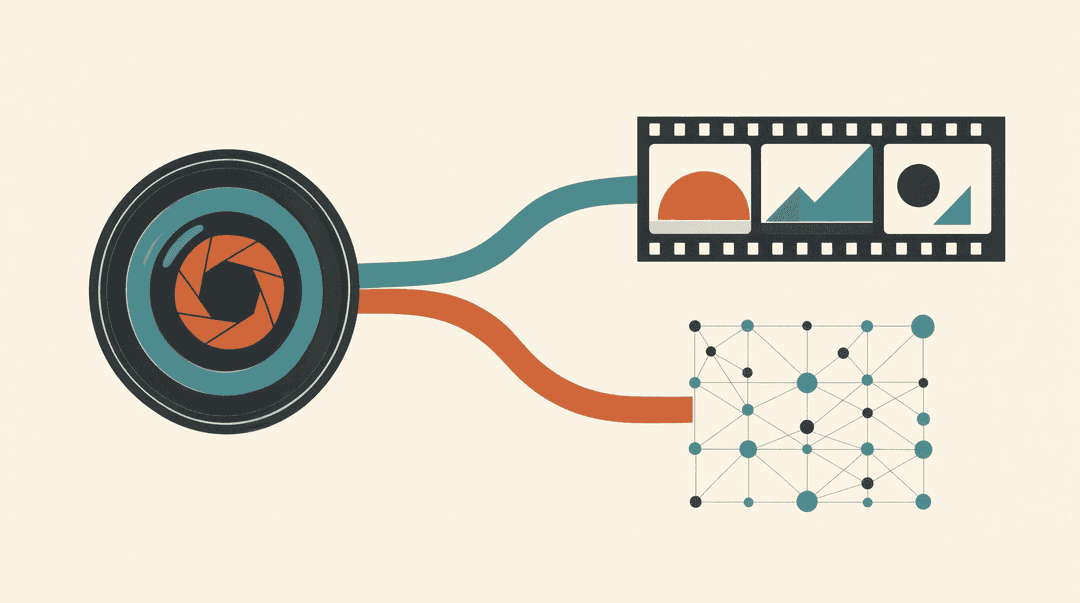
Current world models split along one design question: should the model predict what the future looks like, or just what it means?
The generative camp renders. OpenAI's Sora technical report (February 2024) argued that "scaling video generation models is a promising path towards building general purpose simulators of the physical world," and the Sora 2 announcement doubled down, noting that simple behaviors like object permanence emerged from scaling pre-training compute. DeepMind's Genie line went further, from the original Genie paper (February 2024), an 11-billion-parameter model that learned playable platformer worlds from unlabeled internet gameplay video with no action labels at all, to Genie 3 (August 2025), which renders navigable worlds at 720p and 24 frames per second and keeps them consistent for several minutes, with text-commandable "world events" like changed weather. Genie 4 adds native audio, steerable characters, and a creative agent on top.
The latent-prediction camp refuses to render anything. Yann LeCun's 2022 position paper proposed the Joint Embedding Predictive Architecture (JEPA): encode the present, predict an abstract representation of the future, and stop there. No decoder, no pixels, no wasting capacity drawing leaves on a tree that no decision depends on. Meta made the strongest case with V-JEPA 2 (June 2025): a model pre-trained on more than a million hours of internet video, then conditioned on robot actions using just 62 hours of robot data, and deployed to plan picking and placing on robot arms in laboratories it had never seen. Zero-shot manipulation from a video model, argued as a step toward "advanced machine intelligence."
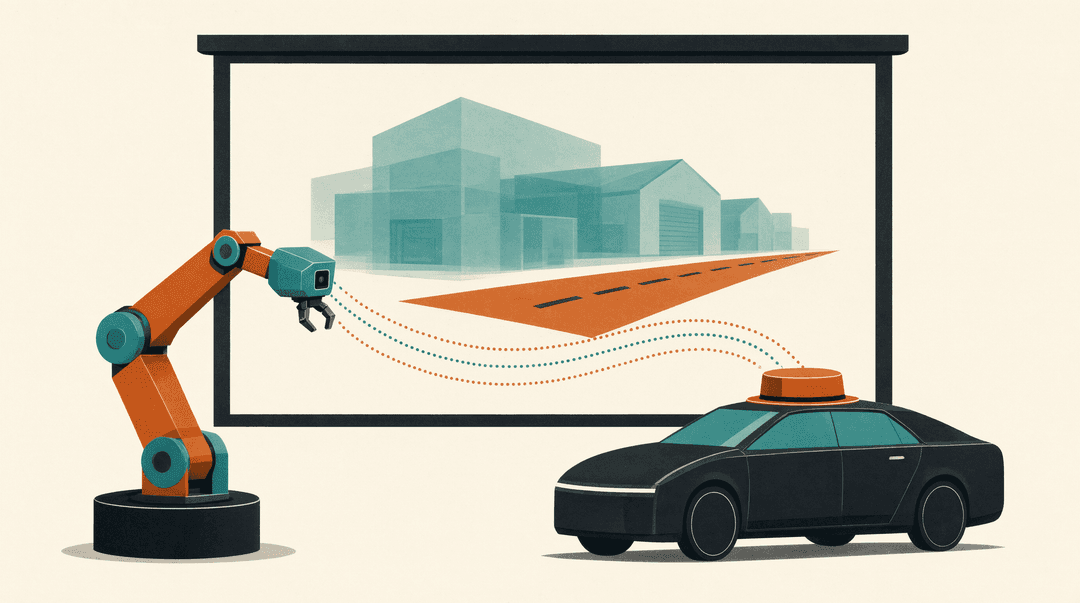
NVIDIA's pitch sits between the camps and is commercial rather than scientific. At CES in January 2025 the company announced Cosmos, a platform of open-licensed "world foundation models" trained on millions of hours of driving and robotics video, meant to generate physically plausible synthetic data for training robots and autonomous vehicles. Jensen Huang's framing: "The ChatGPT moment for robotics is coming," and world models are the way in.
Do language models already have one?
The uncomfortable question for the field, since LLMs are the dominant AI paradigm and world model builders explicitly position against them.
An LLM predicts the next token, not the next state of a world. Defenders point out that a model which writes coherent stories about chemical experiments and chess games must encode some structure of those domains. Skeptics reply that apparent structure and an actual usable model are different things. A 2024 paper by Vafa, Chen, Rambachan, Kleinberg and Mullainathan tested generative models in domains with a definite underlying state (navigation maps, Othello, logic puzzles) and found that models which passed existing diagnostics had recovered world models "far less coherent than they appear," a fragility that shows up as soon as you ask a subtly different question. Follow-up work is more conciliatory: fine-tuned LLMs can roll out short-horizon dynamics in structured text environments, they just do not do it for free.
LeCun's broader argument is that text is a lossy projection of reality, so a system trained only on it can never predict the physical world reliably, which is why his startup, AMI Labs, is building JEPA-style systems instead. That claim is a bet, not a result, and the scaling of multimodal LLMs keeps narrowing the gap. The fair summary: language models learn something world-shaped, but nobody has demonstrated that next-token prediction on text yields a simulator an engineer can trust for a robot arm.
Why the concept matters
Three practical reasons the term keeps surfacing in product announcements:
- Planning without paying for mistakes. A robot, car, or agent can evaluate candidate actions against its internal model before touching anything real. V-JEPA 2's control loop is exactly this: imagine the consequences of candidate actions, score them against a goal image, execute the best one, replan.
- Data that does not exist yet. Cosmos-style generators produce rare driving scenarios and factory edge cases on demand, which is cheaper and faster than collecting them.
- A training ground for agents. Genie's original framing was that interactive world models are environments where generalist agents can be trained before meeting the world. DeepMind has since plugged its SIMA agent into Genie 3 worlds for exactly that purpose.
What still does not work
Consistency is the open wound. Genie 3 keeps a world coherent for minutes, and DeepMind itself describes accumulating error as the core difficulty of autoregressive generation; a simulation you cannot trust after five minutes cannot train most real tasks. Physical fidelity is also unproven: OpenAI's own Sora documentation says the capabilities are "emerging" and that the models have known failure modes, including object permanence breaks, and philosophers of the field (see Millière's analysis) argue that rendering plausible frames is not simulating in any strict sense. And none of the shipped systems is a general model of physics; they are narrow, domain-flavored predictors, strong on video-like statistics and weak everywhere else.
The honest state of the art in one line: world models are real, useful, and nowhere near the phrase's implications. The next few product cycles will be a test of whether prediction in latent space or prediction in pixels wins, and whether language models turn out to need one of these bolted on.
Sources
- Ha & Schmidhuber, "World Models", NIPS 2018 / arXiv:1803.10122 and the project page
- Hafner et al., "Mastering diverse control tasks through world models", Nature, 2025; DreamerV3 project page
- LeCun, "A Path Towards Autonomous Machine Intelligence", OpenReview, 2022
- OpenAI, "Video generation models as world simulators", February 2024; OpenAI, "Sora 2 is here"
- Bruce et al., "Genie: Generative Interactive Environments", arXiv:2402.15391
- Google DeepMind, "Genie 3: A new frontier for world models", August 2025; blog.google Genie 4 announcement, October 2026; DeepMind, "Genie 4 is now available"
- Meta AI, "Introducing V-JEPA 2", June 2025
- NVIDIA newsroom, "NVIDIA Launches Cosmos World Foundation Model Platform", January 2025
- Vafa et al., "Evaluating the World Model Implicit in a Generative Model", arXiv:2406.03689
- Raphaël Millière, "Are Video Generation Models World Simulators?"
Frequently asked questions
When was the concept of a world model introduced?
Jürgen Schmidhuber introduced the term "world model" into machine learning in 1990, describing recurrent networks that predict future states from observations.
How does DreamerV3 use world models?
DreamerV3 learns a world model from experience and then trains an actor-critic policy on trajectories imagined inside that model, allowing it to master over 150 tasks including robotics and Atari games.
What is the difference between the generative and latent-prediction camps?
The generative camp, represented by OpenAI's Sora and DeepMind's Genie, renders video outputs to predict the future, while the latent-prediction camp, such as Meta's V-JEPA 2, encodes the present and predicts abstract future representations without rendering pixels.
Can large language models (LLMs) act as world models?
While LLMs encode some domain structure, a 2024 paper found that their implicit world models are far less coherent than they appear, and text is considered a lossy projection of reality unable to reliably predict physical worlds.
