
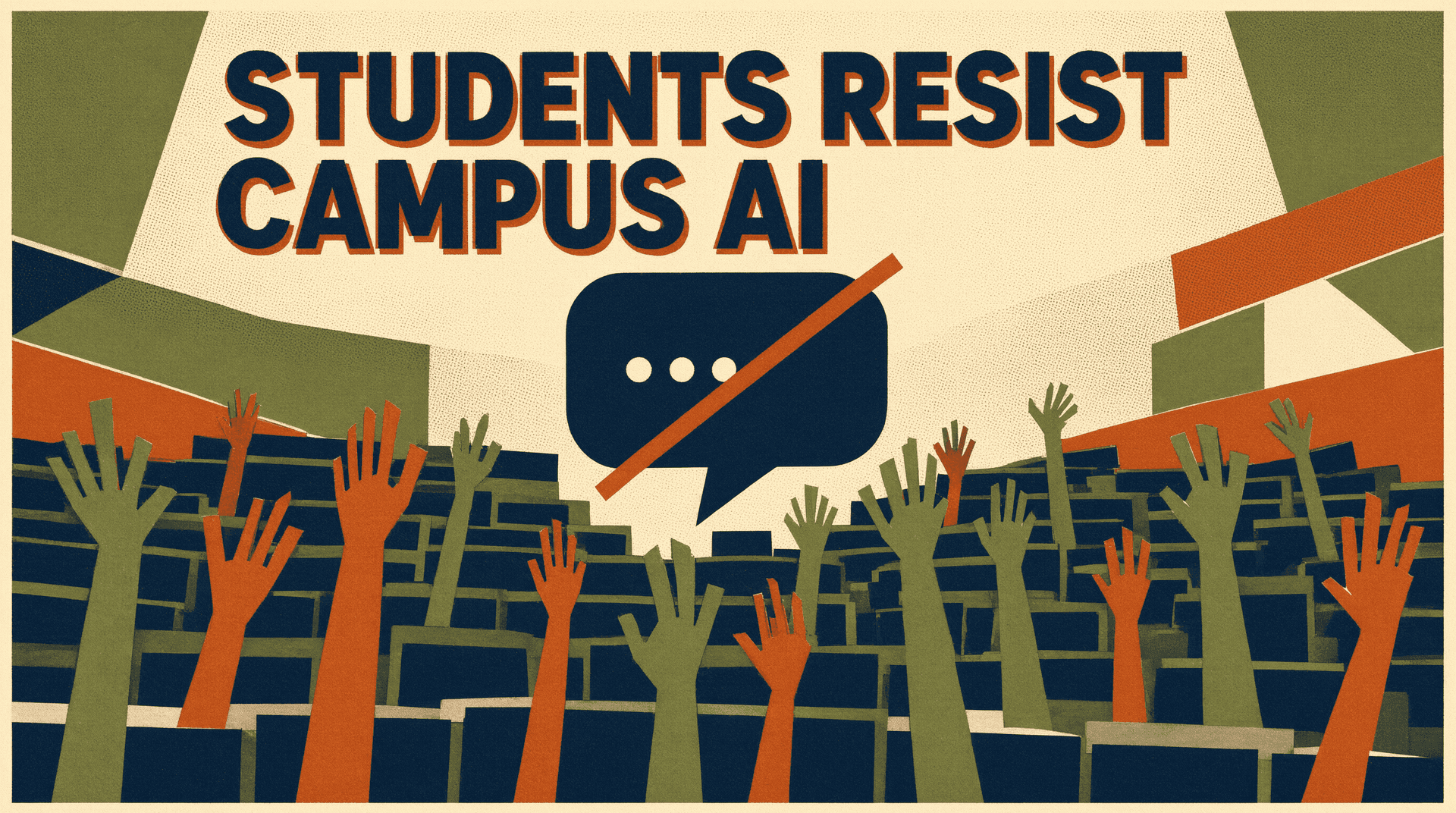
A petition against artificial intelligence at Transylvania University, a Kentucky college of fewer than 1,000 students, collected signatures from about a third of the student body last March. It asked the administration to cancel its chatbot licenses, which the student newspaper had priced at roughly $120,000 for ChatGPT and Gemini access, and to spend that money on "human-centered education" instead. The New York Times, reporting the broader trend Thursday, describes a swell of campus resistance from California to Sydney to Paris that no longer fits one protest song.
The demands are specific, not vague
Student manifestos coalescing around three asks, per the Times: colleges should not sign partnership deals with AI companies; professors should not be required to use generative AI in teaching or grading; and students must be allowed to refuse chatbot-required assignments without grade penalties. That third demand, opt-outs on coursework, is the one giving provosts nightmares, because it makes AI adoption a consent question rather than a procurement decision.
The opposition skews left and concentrates in the arts and law schools, where copyright litigation and creative-practice concerns overlap with a quieter worry about cognitive offloading, the loss of reading and reasoning muscle to outsourcing. The Times' most striking anecdote is procedural rather than philosophical: a University of Kentucky research employee, describing himself as a humanist, was granted a religious exemption from using AI at work, reportedly a first.
The numbers underneath the resentment
Gallup and Lumina Foundation surveyed about 3,800 enrolled students in late 2025: 57% use AI in coursework at least weekly, roughly one in five daily. But more than half say their schools discourage AI use (42%) or prohibit it outright (11%), and only about four in ten say schools encourage it. Ethics, not access, is the most cited reason non-users give for abstaining. The administration-versus-reality gap the survey documents is exactly what student organizers are pointing at.
Where administrations are moving
Georgetown, which gave students and faculty free Gemini access in March, is recalibrating under new president Eduardo Penalver: a faculty committee will draft clearer AI principles, course expectations will be more transparent, and the university plans more tech-free spaces and more oral examinations and in-person tests. Internal focus groups found 40% of student sentiment cautious or negative toward AI, versus 25% positive. Georgetown will keep expanding free tool access anyway. Cornell went the other direction in October, announcing free access to ChatGPT, Claude, Gemini and agentic coding tools, over the objections of faculty like psychology professor Shimon Edelman, who told the Times he finds AI in his own research unthinkable even while facing 800 documents for a book.
Around 1,300 educators, including Georgetown Law privacy director Emily Tucker, have signed an open letter refusing "the call to adopt genAI in schools and colleges" and rejecting its inevitability. Tucker's argument to nervous law students is competence-based: relying on AI degrades the ability to parse dense legal text and produces false citations.
What it means
The campus anti-AI movement is small in enrollment terms and uneven in motive. Its negotiating position is stronger than its size suggests, because it has converted an adoption debate into a consent debate: enterprise licenses signed with little or no student consultation, Georgetown's focus groups being a rare counter-example, are now politically expensive. Administrators hedging with "clearer principles" and opt-outs are paying the cost of having treated AI rollout as a purchasing decision. Expect the opt-out demand to spread first, because it is the one a university can concede without reversing anything.
