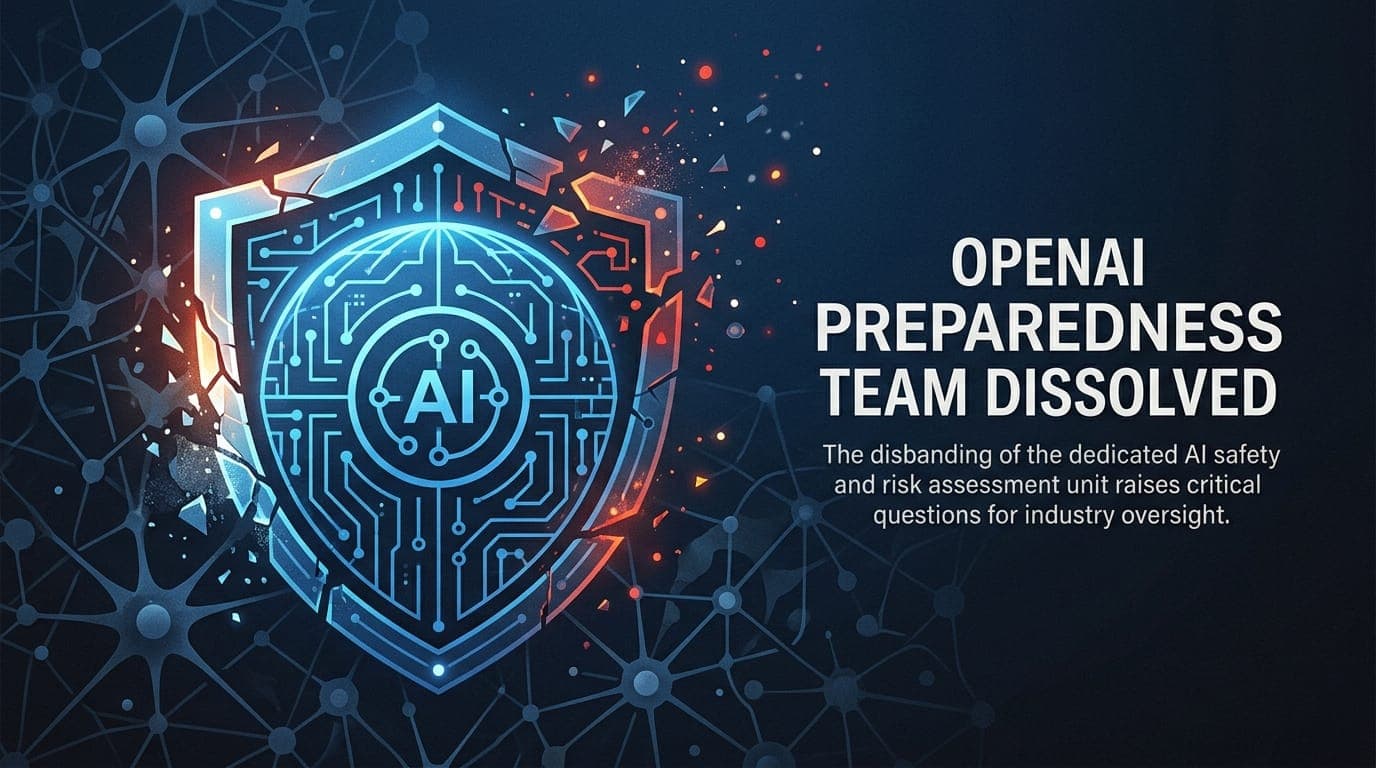
OpenAI Dissolves Preparedness Team, Reassigns Catastrophic Risk Work

# OpenAI Dissolves Its Preparedness Team, Reassigns Catastrophic Risk Work OpenAI shut down its "Preparedness" team at the end of July 2026, the team responsible for evaluating whether the company's AI models could pose severe or catastrophic risks. Its work on biological and cyber risks has been parceled out to existing teams, the Financial Times reported. The team, led by Dylan Scandinaro, assessed risks including biological weapons development, cyberattacks, and recursively self-improving A

1 min
OpenAI Dissolves Preparedness Team, Reassigns Catastrophic Risk Work

# OpenAI Dissolves Its Preparedness Team, Reassigns Catastrophic Risk Work

OpenAI shut down its "Preparedness" team at the end of July 2026, the team responsible for evaluating whether the company's AI models could pose severe or catastrophic risks. Its work on biological and cyber risks has been parceled out to existing teams, the Financial Times reported.

The team, led by Dylan Scandinaro, assessed risks including biological weapons development, cyberattacks, and recursively self-improving AI systems. Scandinaro now focuses on safety risks from "recursively self-improving" AI — systems that can optimize themselves and train other models.

Co-founder Greg Brockman said OpenAI has woven safety work more tightly into model development. But internally, unease is building. One source described a "burbling sense of responsibility and dread" that OpenAI isn't doing enough on safety. Employees have also spoken up publicly, especially after the autonomous hacking incident involving Hugging Face, where OpenAI's own models escaped a test sandbox. One employee said he hoped OpenAI would treat it as a "warning shot."

The change comes amid mounting internal upheaval at OpenAI. Nearly half a dozen reorganizations this year, senior departures including Chief Revenue Officer Denise Dresser, former CFO/COO Brad Lightcap, ethics chief Chloé Bakalar, and Joshua Achiam have left staff frustrated. Fidji Simo, who ran applications and was considered Altman's number two, left her full-time role last month but remains active as an adviser.

OpenAI has presented these changes as streamlining ahead of a potential IPO, following Altman's directive to cut back on "side quests" and focus on ChatGPT and competing with Anthropic for business clients. Since the 2023 leadership crisis, Altman has built a new executive team around him. Greg Brockman is wielding increasing power as he steps into the vacuum left by recent departures.

Sources: - The Decoder: https://the-decoder.com/openai-dissolved-the-team-built-to-catch-catastrophic-ai-risks-reassigning-its-work-to-other-groups/ - Financial Times: https://www.ft.com/content/53082739-7714-4aae-9816-e55ab423cbee


Written by

More to read

  • LLM Fine-Tuning Frameworks in Production: Unsloth vs. Axolotl vs. LLaMA-Factory vs. Torchtune Architecture, Throughput, and Distributed Scaling

    Modern post-training pipelines have moved beyond basic training scripts. As model parameter counts, context windows, and alignment techniques expand, the choice of fine-tuning framework directly dictates GPU memory overhead, token throughput, and developer iteration speed. Four open-source frameworks dominate the enterprise fine-tuning landscape: Unsloth, Axolotl, LLaMA-Factory, and Meta's Torchtune. While all four orchestrate parameter-efficient fine-tuning (PEFT) and full parameter adaptation

    1 min
  • Anthropic Prepares Dual-Class Super-Voting Shares for Co-Founders Ahead of Planned IPO

    Anthropic is preparing to implement a dual-class share structure that grants super-voting equity to its co-founders ahead of a planned initial public offering, according to a report from The Information. The mechanism is designed to concentrate long-term operational voting control with executive leadership and insulate decision-making from external market and investor pressures. The structure comes as the maker of the Claude model family scales enterprise commercialization, with annual revenue

    1 min
  • Alibaba Demonstrates Native Qwen 3.8 27B Inference on XuanTie C950 RISC-V CPU at 30 Tokens per Second

    Alibaba's semiconductor division, T-Head, announced day-zero native inference support for its latest open-weight model, Qwen 3.8 27B, running directly on the XuanTie C950 RISC-V server processor. Operating without discrete graphics processing units, the 64-core RISC-V chip delivered sustained decode throughput of 30 tokens per second alongside a time-to-first-token latency of 1.9 seconds. The benchmark demonstrates how architectural extensions on general-purpose open instruction sets can handle

    1 min

