

Claims that a single AI prompt consumes an entire bottle of water are factually incorrect when isolated; they refer to total-water estimates for dozens of exchanges including power generation. Actual per-prompt measurements for on-site cooling range from approximately 0.26 to 0.3 milliliters for modern models like Gemini and ChatGPT, while lifecycle assessments including hardware manufacturing can reach 45 milliliters per response.
One ChatGPT prompt drinks a bottle of water. You have probably seen the claim, in headlines, in Senate testimony prep, in the group chat where someone forwards an infographic about data centers. The claim is not fabricated. It is a real number, quoted without the conditions that produced it, and the conditions matter more than the number.
During 2025 the big model providers started publishing their own figures, and they disagree by roughly three orders of magnitude. Google says a median Gemini text prompt consumes 0.26 milliliters of water, about five drops. Sam Altman says a typical ChatGPT query uses roughly 0.3 milliliters, one fifteenth of a teaspoon. Mistral says a 400-token response from its Le Chat assistant uses 45 milliliters, nearly three tablespoons. The UC Riverside study that lit the original fire works out to roughly 10 to 25 milliliters per short response once you divide its half-liter by the 20 to 50 exchanges it describes.
None of these numbers is fake. They answer different questions, and almost nobody quoting them says which question was answered. Here is what each figure actually measures, and what to ask the next time you see a water statistic attached to AI.
Where the bottle came from
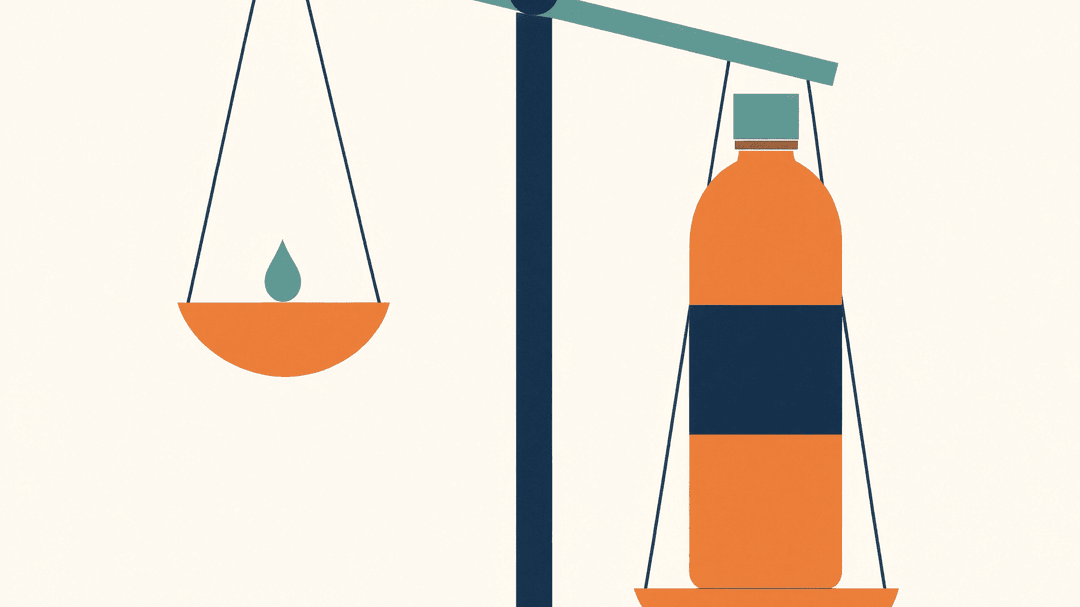
The half-liter claim traces to one paper: Making AI Less "Thirsty": Uncovering and Addressing the Secret Water Footprint of AI Models, by researchers at UC Riverside and Microsoft, first posted in April 2023 and later peer-reviewed at an IEEE venue. UC Riverside's press release said that running "some 20 to 50 queries" uses roughly half a liter of fresh water. Over a few dozen prompts, one water bottle.
Two details got lost on the way to the memes. First, the paper modeled GPT-3 as a stand-in for ChatGPT, and its inference estimate covers a conversational exchange of many prompts, not one question. Second, the half-liter is a total-water figure. It adds the water evaporated in data center cooling towers to the water that power plants consumed to generate the electricity the queries used, and the authors' methodology puts most of the total on the power side, not the cooling tower. When the Washington Post worked with the same researchers to price a 100-word email in water, the point of the exercise was that the burden is "nearly impossible to quantify," not that every prompt costs a bottle.
The paper's other headline number survived intact. Training GPT-3 in Microsoft's US data centers took about 700,000 liters of freshwater, roughly the water used to manufacture 370 BMW cars, and triple that if trained in the company's then-less-efficient Asian facilities. Training is a one-time cost per model. Inference repeats per prompt, forever, and that is where the provider numbers come in.
What the published figures count
Three providers have put per-prompt or per-response water numbers on the record, and each picked a different accounting boundary.
- Google published the only production measurement. Its August 2025 technical report, summarized here, measured the median text prompt in Gemini Apps using May 2025 fleet data: 0.24 watt-hours of energy, 0.03 grams of CO2 equivalent, and 0.26 milliliters of water, on-site cooling included. The number is a measured median across a real serving fleet, but it is a median prompt on recent hardware, and Google itself noted the figure drops to 0.15 milliliters under a narrower method, so the 0.26 already carries some scope.
- OpenAI has no published methodology. Altman's June 2025 blog post states in passing that an average prompt "uses about 0.000085 gallons of water; roughly one fifteenth of a teaspoon," which is about 0.3 milliliters. There is no model breakdown, no boundary definition, and no measurement attached. It is a CEO assertion that happens to land close to Google's measurement.
- Mistral published the most complete accounting and the largest number. Its July 2025 lifecycle study, conducted with consultancy Carbone 4 and the French environment agency ADEME and reviewed by two outside audit firms, puts a 400-token Le Chat response at 45 milliliters of water and 1.14 grams of CO2 equivalent. That figure amortizes model training and includes the water consumed making the servers, which is exactly why it is 170 times Google's. The same study reports that training and 18 months of running Mistral Large 2 had consumed 281,000 cubic meters of water as of January 2025.
The UC Riverside total sits in a fourth category: GPT-3 era estimates including grid water, which the follow-up commentary in The Conversation puts at up to half a liter per short conversation, but around 25 milliliters for a modern long-output query and single digits for shorter ones when cooling is efficient. So the public range for "water per AI response," depending on boundary, model vintage, prompt length, and whether you are measuring or estimating, runs from 0.26 milliliters to about 500. That is the factor of two thousand.
The distinction that matters more: withdrawal versus consumption
Water statistics for data centers carry a second trap. Withdrawal is water taken from a river, lake, or aquifer. Consumption is water that does not come back, mostly because it evaporated in a cooling tower. A facility can withdraw millions of liters and return most of it, or withdraw less and consume nearly all of it through evaporation. Headlines routinely quote whichever number is more dramatic, and the UC Riverside authors themselves stressed that the local impact depends on where the plant sits and how water-stressed its basin is, which is why their paper argues for siting and timing decisions as seriously as it argues for the footprint itself.
The relevant question for a community next to a data center is consumption in a stressed watershed, not the global liter count, and no per-prompt number from any provider answers that.
Small times a billion is not small

The per-prompt debate mostly misses where the water actually goes. The International Energy Agency's Energy and AI report estimates global data center water consumption at about 560 billion liters per year today, with roughly two-thirds of it already spent generating the electricity rather than cooling the machines, and projects up to about 1,200 billion liters by 2030 in its base case, alongside data center electricity demand doubling from 415 to around 945 terawatt-hours. That growth is driven by how many GPUs get built and how long they run, not by how many emails people ask a chatbot to draft.
For scale in the other direction: Americans irrigate lawns with about 34 billion liters of water a day, more than twenty times what the entire global data center sector consumes on an average day. Individual consumer choices about prompting are not where this story is. Hosting, siting, cooling technology, and grid mix are.
Three questions for the next water statistic
When a number like "a bottle per prompt" shows up again, and it will, three questions settle it in under a minute. What is the boundary: on-site cooling only, cooling plus the grid, or the full lifecycle including manufacturing? What is the unit: one median short prompt, one 400-token response, or one 20-prompt conversation? And is it measured from a production fleet, modeled from a 2023 paper, or asserted in a blog post?
The honest version of the story is dull, which is why it does not spread. A prompt is about five drops of cooling water, and an AI boom measured in hundreds of billions of liters a year is a real infrastructure and siting problem. Both sentences are true. The infographic will only fit one of them.
Sources
- Making AI Less "Thirsty": Uncovering and Addressing the Secret Water Footprint of AI Models (UC Riverside / Microsoft), arXiv: https://arxiv.org/abs/2304.03271
- UC Riverside news: AI programs consume large volumes of scarce water: https://news.ucr.edu/articles/2023/04/28/ai-programs-consume-large-volumes-scarce-water
- Google Cloud blog: Measuring the environmental impact of AI inference: https://cloud.google.com/blog/products/infrastructure/measuring-the-environmental-impact-of-ai-inference
- Google technical report (PDF): Measuring the environmental impact of delivering AI at Google scale: https://services.google.com/fh/files/misc/measuring_the_environmental_impact_of_delivering_ai_at_google_scale.pdf
- Sam Altman, The Gentle Singularity: http://blog.samaltman.com/the-gentle-singularity
- Mistral AI: Our contribution to a global environmental standard for AI (LCA with Carbone 4 and ADEME): https://mistral.ai/news/our-contribution-to-a-global-environmental-standard-for-ai
- The Washington Post: How much energy can AI use? : https://www.washingtonpost.com/technology/2024-09-18/energy-ai-use-electricity-water-data-centers/
- The Conversation: AI has a hidden water cost, here is how to calculate yours: https://theconversation.com/ai-has-a-hidden-water-cost-heres-how-to-calculate-yours-263252
- IEA, Energy and AI (PDF): https://iea.blob.core.windows.net/assets/de9dea13-b07d-42c5-a398-d1b3ae17d866/EnergyandAI.pdf
- EPA water terminology (withdrawal vs consumption): https://www.epa.gov/waterdata/terminology
Frequently asked questions
How much water does a typical ChatGPT query use according to Sam Altman?
Sam Altman states that an average ChatGPT prompt uses roughly 0.3 milliliters of water, which is about one fifteenth of a teaspoon.
What does the UC Riverside study's half-liter claim actually measure?
The half-liter figure represents the total fresh water used for running 20 to 50 queries of GPT-3, combining power plant consumption and data center cooling evaporation, rather than a single prompt.
Why does Mistral's water usage figure differ so much from Google's?
Mistral's figure of 45 milliliters per response includes lifecycle costs such as amortized model training and server manufacturing, whereas Google's 0.26 milliliters measures only on-site cooling for a median text prompt.
What is the difference between water withdrawal and consumption in data centers?
Withdrawal refers to water taken from local sources, while consumption refers to water lost primarily through evaporation in cooling towers, which has the greater local environmental impact in water-stressed areas.
