
Two datasets about AI phishing disagree by roughly a factor of 40, and the gap between them is the actual story. KnowBe4's threat telemetry found that 86% of phishing attacks in the first quarter of 2026 were AI-driven. The FBI's 2025 Internet Crime Report found that out of 1,008,597 complaints filed with its Internet Crime Complaint Center (IC3), 22,364 reported any AI connection at all. Neither number is wrong. One measures how attacks are made, the other measures how losses are booked. Reading them together makes one thing clear: AI did not give phishers a superpower. It gave them a price cut, and the crime migrated to the channels where the price matters more than the prose.
What the controlled experiments measured
The most cited evidence that AI phishing works comes from experiments that were careful about exactly this distinction.
IBM X-Force Red's 2023 test sent two versions of a spear-phishing email to roughly 1,600 employees at a healthcare organization. A seasoned social engineer needed about 16 hours to craft her version. ChatGPT produced its version in roughly five minutes. The human email achieved a 14% click rate; the AI email managed 11%. The AI lost on effectiveness while costing about one two-hundredth of the effort. The test was presented by IBM's team and summarized with its parameters by security press.
A 2024 study from researchers at the University of Maryland and Harvard (Heiding, Lermen, Kao, Schneier and Vishwanath) went further and automated the whole pipeline: open-source reconnaissance to build a vulnerability profile per target, then email generation, then delivery, across 101 participants. A control group of generic phishing emails got a 12% click-through rate. Emails written by human experts got 54%. Fully AI-automated emails also got 54%. AI emails with a human in the loop got 56%. The automated recon produced accurate and useful target information in 88% of cases. The result that matters is the parity: a machine now does what an expert human phisher does, at the same hit rate, without the expert.
The economic framing matters more than the click framing. Phishing used to be constrained by two expensive inputs: writers who could produce a convincing message, and hours of research per target. Both became minutes and cents. Nothing in these experiments says the lure got smarter. They say the marginal cost of a good lure collapsed.
What the money actually says
The FBI's 2025 IC3 report, the first in its nearly 25-year history with a dedicated AI section, logged 22,364 AI-related complaints with adjusted losses exceeding $893 million, against total reported losses of nearly $21 billion across all complaint types. Inside the AI bucket: more than $632 million in investment scams with a reported AI nexus, more than $30 million in business email compromise, more than $19 million in confidence and romance scams, and more than $5 million in voice-cloning distress scams.
Two caveats the FBI itself flags. First, AI involvement is undercounted, because most victims do not know they were talking to a chatbot; overall investment fraud losses, AI-noted or not, exceeded $8 billion. Second, complaint data lags and underreports: phishing and spoofing, extortion and investment schemes were the most frequently reported categories regardless of how they were written.
The corporate side shows the same pattern in smaller numbers. IBM's Cost of a Data Breach Report 2025 found that about 16% of breaches involved attackers using AI, most often to generate phishing emails (37% of those incidents) or run deepfake impersonation (35%). IBM's July 2026 update put the share of malicious breaches that were AI-enabled at one in four, with average costs near $6 million for those attacks, concentrated in critical infrastructure and financial services. The direction of travel is consistent; the absolute share is still a fraction.
Which is the honest summary: AI is now present in a meaningful minority of losses and on a clear growth curve, not in most of them. The panic premium lives in the delivery channels, not in the dollars booked as AI crimes.
Where the crime actually moved
Vendor telemetry, which sees raw traffic rather than victim complaints, shows where the price cut landed. KnowBe4's first-quarter 2026 report paired its 86% AI-driven figure with a 49% increase in calendar-invite phishing, a 139% surge in reverse-proxy sites harvesting Microsoft 365 credentials, a 41% rise in Microsoft Teams attacks, and internal-team impersonation in 30% of observed attacks. Its follow-up report documented attackers hosting fake login pages and API-key harvesters on the real domains of trusted AI platforms, where valid certificates and genuine addresses disarm both filters and cautious users, plus a 228% surge in AI-brand impersonation attacks between March and August 2026. Same firm, same year: about 41% of phishing emails now get past secure email gateways entirely.
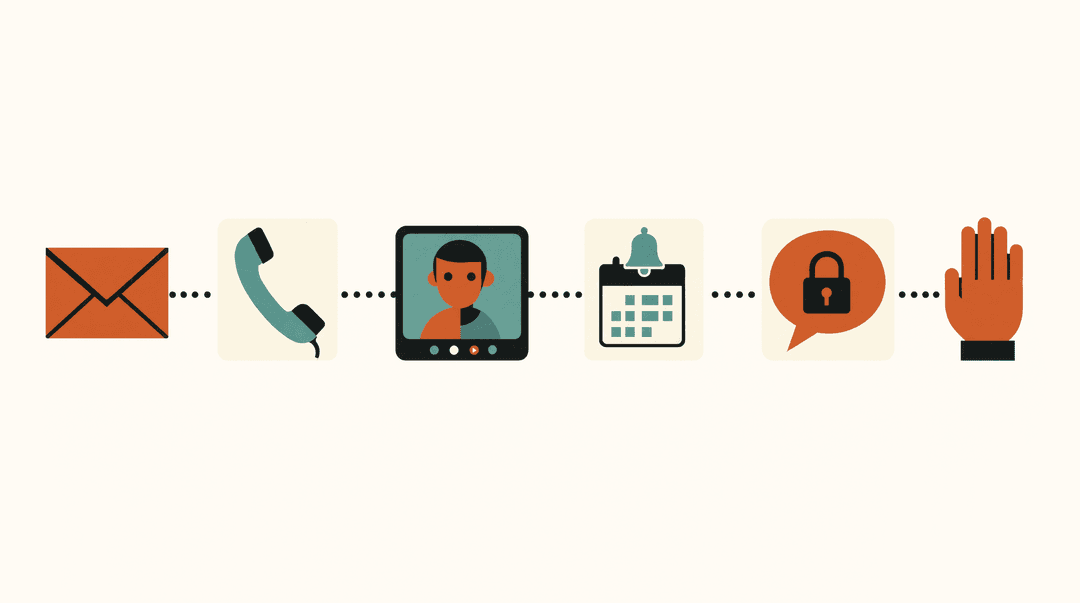
The common thread is not better writing. It is better infrastructure. Calendar invites, chat platforms, phone calls and reverse-proxied login pages are channels where the old heuristics (bad grammar, ugly design, off-domain links) never applied, and where an AI-generated lure is only the entry ticket to a relay that steals the session, not just the password.
Voice is the sharpest curve. CrowdStrike's 2025 Global Threat Report measured a 442% increase in voice phishing between the first and second halves of 2024. Cisco Talos found that vishing accounted for over 60% of its phishing-related incident response engagements in the first quarter of 2025. Pindrop, analyzing 1.2 billion contact-center calls, recorded a 1,300% rise in deepfake fraud attempts during 2024, from about one per month to seven per day. Microsoft's Digital Defense Report 2025 measured a 195% global increase in the use of AI-generated identity documents, and notes that deepfake techniques now defeat selfie checks and liveness tests by simulating blinks and head turns.
The signature incident of this category is the February 2024 case from Hong Kong: a finance worker authorized 15 transfers totaling about $25 million (HK$200 million) after joining a video call with what police confirmed was a deepfake of the company's UK-based CFO, surrounded by deepfakes of colleagues he recognized. The worker had suspected the initial email was a phishing attempt. The video call is what convinced him otherwise. The verification step became the attack surface.
Detection lost the text war
If the lure is short, cheap and indistinguishable, the automated checks fail for structural reasons. Egress analyzed AI-content detectors against real phishing corpora and found the detectors need roughly 250 characters to work at all: 44.9% of phishing emails fall below that threshold and 71.4% fall below 500 characters, meaning current AI detectors are unreliable or simply inoperable on about seven in ten attacks. Meanwhile the cheap end of the market industrialized: Hoxhunt reported that mass AI-generated phishing campaigns surged 14-fold starting in December 2025 and came to represent about half of user-reported attacks, replacing the error-riddled phishing kits that had dominated through 2025.
There is a symmetry here that the security industry has not finished exploiting. The Maryland-Harvard paper that measured AI phishing parity also found that a frontier LLM (Claude 3.5 Sonnet) detected malicious emails with over 90% accuracy and low false-positive rates, catching several attacks that passed human review. A 2025 controlled experiment put human users against LLM-generated warning dialogs that explained why a suspicious email looked risky, and found the AI-written warnings reduced click-through rates on par with or better than human-composed ones, with feature-based explanations working best. The model that writes the lure can also read it. Adoption of the second half has been slower than the first.
What works, discounted for who is selling it
The headline defense statistic in this market is KnowBe4's 2026 industry benchmarking report: a full year of consistent security awareness training reduces phishing susceptibility by 79%, to a 4.2% click rate, even as the same report notes a 17.1% spike in phishing volume since late 2025. KnowBe4 sells security awareness training, and its training-efficacy numbers are measured on its own simulations. Take them as directional, not as verdicts. Training the human to read better is the same strategy the economics just defeated.
The controls that survive the price cut do not involve reading the message at all. Out-of-band verification of payment and credential requests, where the confirmation arrives on a channel the attacker did not choose: the Hong Kong case is the canonical failure mode, because an in-band video call is not out-of-band anything. Phishing-resistant authentication, since the 139% surge in proxied credential harvesting describes exactly the relay that defeats one-time codes and password prompts but not WebAuthn and certificate-based methods. And wire-release policies with mandatory delays and second-person approval, because every dollar in the IC3 report moved through a human who believed they were obeying a colleague.
The blunt version: the tell was never really in the email. It was in the request. Attackers industrialized the writing when writing got cheap, then outsourced the trust to calendars, chat, phone calls and real domains. A defense priced for the era of broken grammar and princess widows is subsidizing the other side's cost curve. Verify the request on a channel the attacker does not control, and let a model read the lure, since a model wrote it anyway.
Sources
- FBI Internet Crime Complaint Center, 2025 Internet Crime Report
- FBI press release: Cryptocurrency and AI Scams Bilk Americans of Billions
- KnowBe4: Research Finds 86% of Phishing Attacks are AI Driven (Phishing Threat Trends Report Volume Seven)
- KnowBe4: 2026 Phishing Threat Trends Report, Volume Eight
- KnowBe4: Global Phishing Susceptibility Drops 79% After One Year of Security Awareness Training
- Heiding, Lermen, Kao, Schneier, Vishwanath: Evaluating Large Language Models' Capability to Launch Fully Automated Spear Phishing Campaigns (arXiv:2412.00586)
- ABA Banking Journal: AI-generated phishing emails almost as effective as humans (IBM X-Force test)
- Adaptive Security: LLM Phishing, The Complete Guide (IBM X-Force parameters)
- CrowdStrike: 2025 Global Threat Report
- Vectra AI: How Vishing Works and How to Stop It (Cisco Talos Q1 2025 data)
- Pindrop: 2025 Voice Intelligence and Security Report
- Microsoft: Digital Defense Report 2025
- CNN: Finance worker pays out $25 million after video call with deepfake CFO
- Infosecurity Magazine: AI-Generated Phishing Emails Almost Impossible to Detect (Egress findings)
- Hoxhunt: Phishing Trends Report
- IBM: Cost of a Data Breach Report 2025
- IBM: One in Four Malicious Breaches are AI-Enabled (July 2026)
- Can Large Language Models Improve Phishing Defense? A Large-Scale Controlled Experiment on Warning Dialogue Explanations (arXiv:2507.07916)
